
Dilshat Rakhimov
April 2026 · 8 min read
For years, digital strategy was built on a simple foundation: you pay Meta or Google, and they use their enormous user-data sets (third-party data) to find buyers for you. It was an "audience rental". Convenient, fast, but incredibly fragile.
With the introduction of strict privacy laws (GDPR in Europe, CCPA in the US), the deprecation of third-party cookies in browsers, and Apple's App Tracking Transparency (ATT), this rented land has been disappearing from under your feet. Ad platforms are "going blind". They can no longer find your target audience with the same precision, and the cost of acquiring a customer (CAC) shoots through the roof.
While I was working on the analytics architecture for a large EMEA company in Dubai, I saw this shift first hand. To survive the new reality of strict GDPR compliance, global enterprise companies are radically changing their approach: they stop renting data and start collecting their own (First-Party Data), with the Data Warehouse (DWH) as the central node of all analytics.
The Shift: from third-party cookies to your own data
Third-Party Data is data collected by someone else. For example, a user interest profile assembled by Facebook from their likes. First-Party Data is data the customer knowingly handed to you. It is their purchase history in your CRM, their behavior in the logged-in area of your site, the surveys they filled out, and how they responded to email campaigns.
When browsers block tracking, the only way to recognize a user is to make them log in. That is why retailers are aggressively pushing loyalty programs and why media outlets are moving behind paywalls.
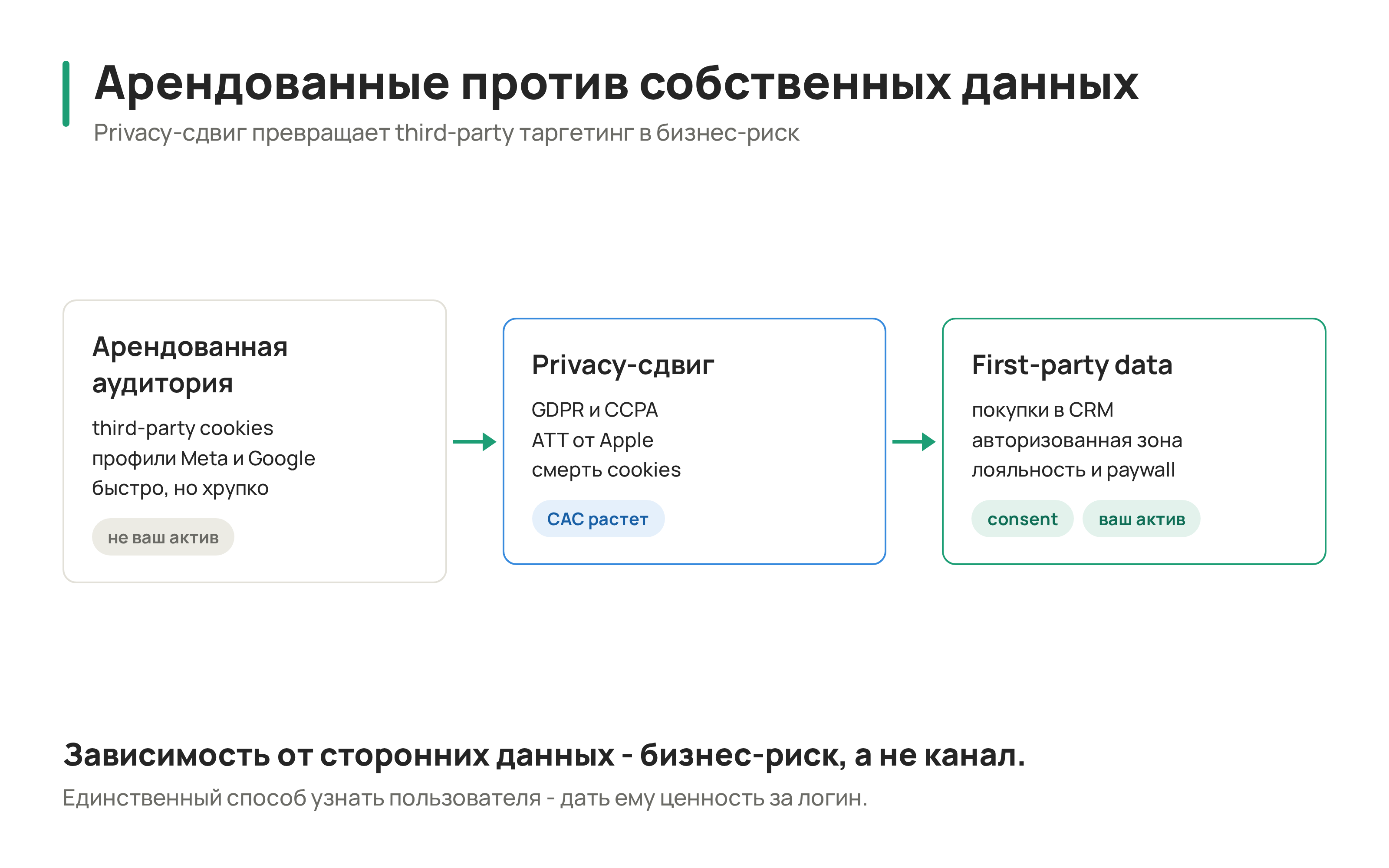
Dependence on third-party data is a business risk. If Meta changes its algorithm tomorrow or Apple ships another iOS update, your sales team is left without leads.
The Infrastructure: the DWH as the single source of truth
Marketers used to try to stitch data together inside Google Analytics. But GA is a web analytics tool, not a database. It samples reports, limits the history it stores, and cannot properly handle complex offline deals.
The modern approach (the Modern Data Stack) moves all data into your own cloud warehouse — a Data Warehouse (DWH) such as Google BigQuery, Snowflake, or Amazon Redshift.
The DWH ingests:
- Site/app events: unsampled raw clicks and views.
- CRM data: offline purchases, deal statuses, calls.
- Ad spend: costs pulled from the Google Ads, TikTok, and Meta accounts.
Inside the DWH, analysts use SQL and transformation tools (such as dbt) to unify these disparate fragments into a single, clean customer profile (Single Customer View).
The Activation: Composable CDP and Reverse ETL
Collecting data in a DWH is only half the job. A database is useless if a marketer cannot run a campaign on top of it. Historically, you would buy bulky, expensive customer data platforms (CDP — Customer Data Platform).
Today the enterprise segment is moving to a Composable CDP architecture. At its core is a process called Reverse ETL.
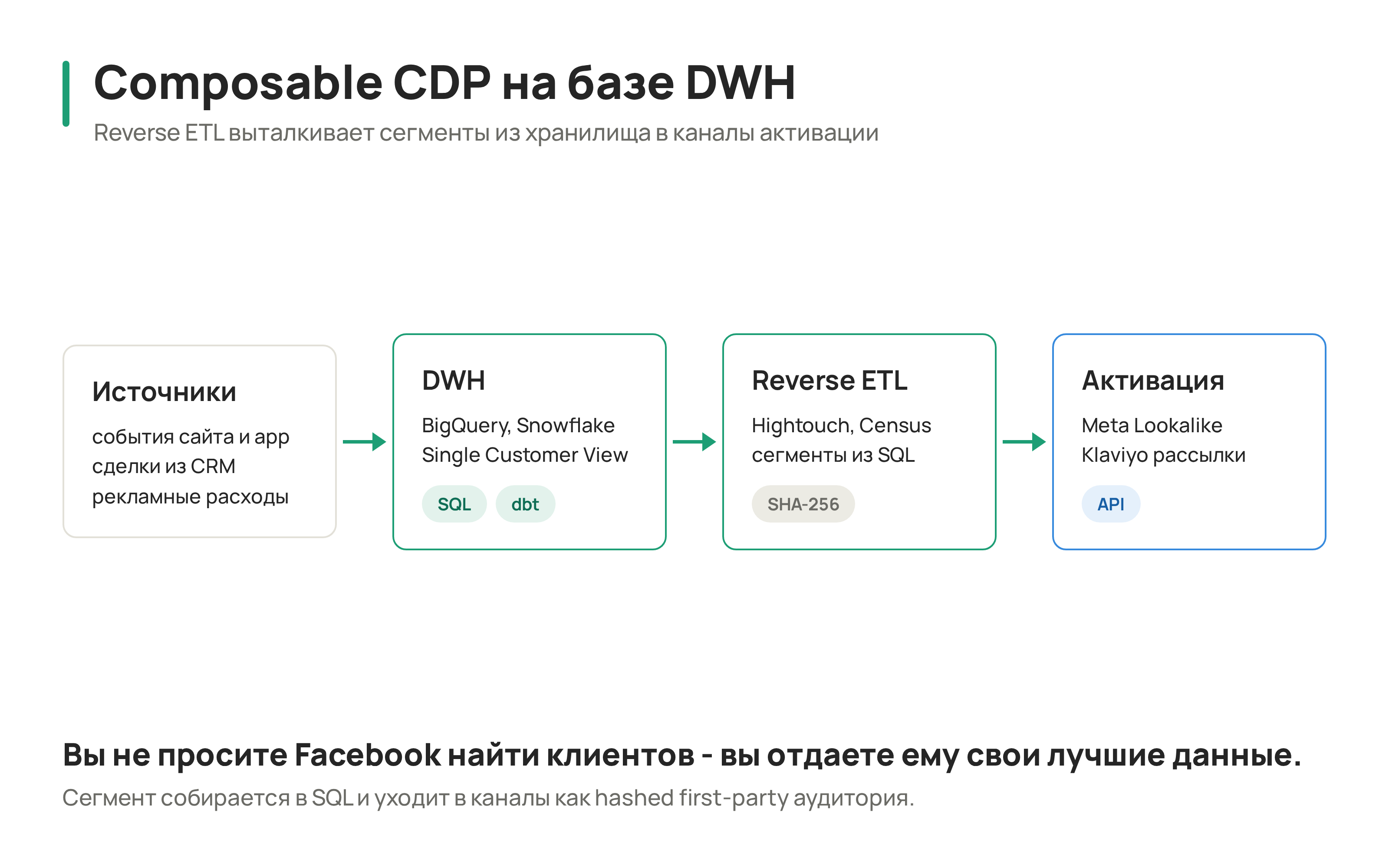
Instead of copying your database into a third-party platform, Reverse ETL tools (such as Hightouch or Census) connect directly to your DWH and "push" the required segments to wherever they are needed:
- Build a SQL segment of "high-LTV users who have not purchased in 30 days".
- Reverse ETL takes their hashed emails and phone numbers.
- It sends them through APIs straight into Meta Ads (to build a Lookalike audience) and into Klaviyo (for a personalized campaign).
You no longer ask Facebook to find you customers. You upload your best First-Party Data into Facebook and tell it: "Find me more people exactly like these".
What to do next
For C-level leaders:
- Invest in data engineering. In 2026, marketing without your own database is money thrown to the wind. Treat the DWH as a core company asset.
For product and marketing teams:
- Build a reason to log in (a value exchange). A user will not hand you their email for nothing. Offer loyalty points, closed sales, or exclusive content in exchange for the login.
For data analysts:
- Learn SQL and dbt. The era when a marketing analyst just stared at pretty GA4 dashboards is over. Real O2O work, multi-channel attribution, and segmentation now live at the level of raw tables in BigQuery and Snowflake.
Moving to a First-Party Data strategy takes time and resources, but it is the only way to keep control of growth under strict privacy rules.
Dilshat Rakhimov
Growth Analytics & Digital Architecture
¹ The Marketer's Privacy Playbook by Think with Google
² Google Cloud BigQuery Documentation
³ Hightouch: What is Reverse ETL?
FAQ
Why is depending on third-party data a business risk rather than a marketing one?
Because the audience is rented. GDPR, CCPA, third-party cookie deprecation and ATT already shrank what platforms can see. If Meta changes its algorithm or Apple ships another iOS update, the pipeline feeding your sales team disappears — and you control none of it.
What is the DWH actually for in this architecture?
It is the single source of truth. First-party data is collected once and modelled once in the warehouse, then activated outward — instead of every ad platform holding its own partial copy of the customer.
Do I need a CDP?
Not necessarily. A composable approach — the DWH plus Reverse ETL — does the activation job without adding a second system of record. Decide once you know which segments you actually need to push back out to the ad platforms.