"This article is out of date" is hard to check. "This section states an old limit; the current documentation has changed it, here is the link and the date I checked" gives an editor something to work with straight away.
You can help make Academia more accurate and clearer: point out a mistake, flag a passage that doesn't make sense, or suggest a situation the explanation is missing. None of that requires access to internal files.
Tie the report to a place
Save the article's address and the name of the section. If you chose the section from the contents, the address will carry a link to it. Add the short passage where you noticed the problem.
Say what kind of report it is. A wrong calculation, a broken link, an outdated rule, unclear wording or an interface fault? Different problems need different evidence.
For a display problem, the screen size, the browser and the sequence of actions help. For a calculation: the input numbers, the value you expected and how to arrive at it.
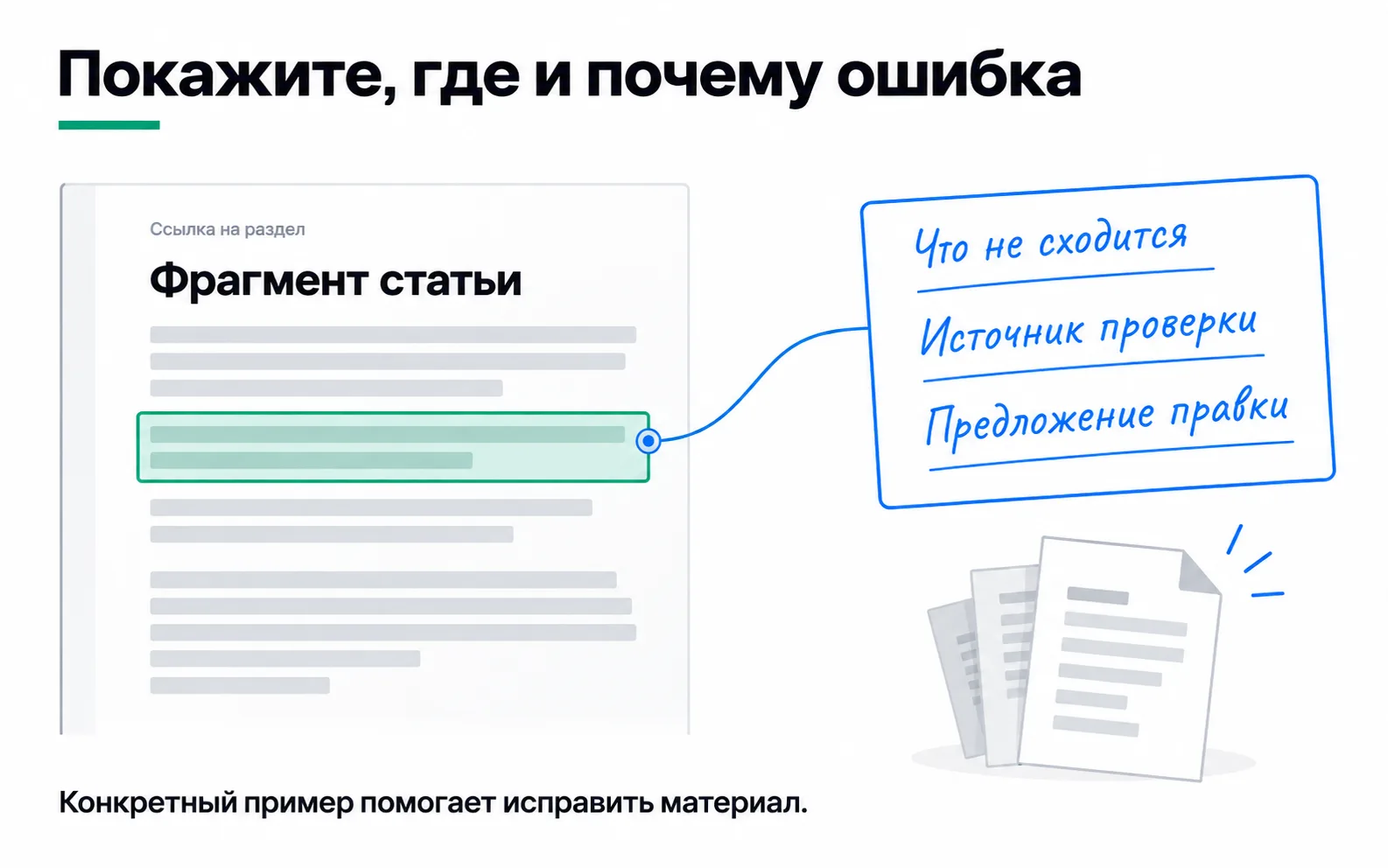
Show exactly what doesn't add up
Keep the observation apart from your explanation of the cause. "The results disappeared after I selected a module" is an observation. "Search is broken" is still a hypothesis: search may have carried on working inside the selected module.
For a factual error, attach the primary source and the date you checked it. Specify the product, the region and the conditions if the rule depends on them. Don't pass off an old screenshot as evidence of the current interface.
An example message:
The section on conversion compares 20 buyers out of 1 000 visitors with 20 buyers out of 100 leads. The text calls this growth. The denominators are different, so a direct comparison is not valid. I suggest saying that these are two metrics from the same funnel, and comparing the periods separately using one definition.
A report like that can be checked without a long exchange of messages.
Offer a case study with enough context
A useful case study includes the original problem, the conditions, the change, the way it was measured and the result with its limits. It doesn't have to show record growth. A write-up of a hypothesis that failed, or of a mistake you found, often explains a topic better than a flattering percentage.
If the result rests on a before-and-after comparison, list the other things that changed during the period. Don't call the whole difference the effect of one campaign without solid grounds.
For a teaching version you can replace the data with synthetic figures and say so plainly. Don't include real names, contact details, credentials or a client's internal documents unless sharing them has been agreed. A company name and a published logo are not the same thing as the right to disclose its operating data.
Frame a missing topic as a problem
Instead of "we need an article about CRM", describe a decision that is hard to make right now. For example: "How do I compare the cost of a customer when one channel has a lot of repeat enquiries?"
Add what you have already read and the point at which the question was left open. That helps show whether what is needed is new material, another example, or a clearer link between existing articles.
Suggesting a topic or a case study does not mean it will be published automatically. The material has to be checked, the context clarified and the amount that can be disclosed agreed.
Send a short message
A link, a description of the problem and your evidence are enough. You can send it through the published Goodlabs contacts: write to us about the material. Don't attach a customer database or any secrets to demonstrate a mistake.
After the discussion, keep the useful conclusion in your own working notes. Even if the article's wording turns out to be correct, the question can show which explanation the reader was missing.
Exercise: improve the report
A reader wrote: "The chart is wrong." What information is enough to make that report checkable?
Answer: the article's address, the specific chart, the underlying values and a description of the mismatch. For example: "The labels read 20 and 40, but the heights measured from zero are not in a one-to-two ratio." If the problem is with the meaning, explain that separately: the chart may be comparing groups of different ages. Propose a fix and say what it is based on.