An IELTS preparation centre in Almaty is getting ready for a lead test on Meta. The owner sees a competitor's ad on Instagram every day and asks: "Raise our bid so we get shown as often." But the Meta auction is not won by the biggest bid. An ad the person is more likely to respond to can beat a competitor who pays more. In Google Ads, too, the bid is only one of six factors. Before raising it, it pays to understand what it competes with and to see what competitors show people: their ads are open in Ad Library. This lesson looks at both.
The Meta auction: bid, prediction and quality
An auction runs every time there is a chance to show someone an ad (how Meta describes the auction). Every advertiser whose target audience includes that person takes part. The ad with the highest total value wins, provided its value is not below the minimum price. Total value is made up of three parts.
The bid is what the advertiser is willing to pay for the result they want: a lead, a purchase, a message. Estimated action rates are Meta's prediction of how likely this person is to take that action after seeing this ad. Ad quality is judged from the feedback of people who saw or hid the ad, and from signs of low quality: withheld information, sensationalised language, engagement bait.
Meta calls estimated action rates and quality the ad's relevance. They are part of total value together with the bid, so a relevant ad can win an auction against ads with higher bids.
Why a 900 ₸ bid beats a 1,500 ₸ bid
In a lead campaign you bid per lead, but what is sold is an impression. Meta converts one into the other: the bid per impression equals the bid per action multiplied by the estimated action rate (about bid cap). Here is how that plays out, with made-up numbers, when two ads compete for one impression to the same person:
| IELTS centre | Competitor | |
|---|---|---|
| Bid per lead | 900 ₸ | 1,500 ₸ |
| Estimate: chance of a lead after the impression | 0.10% | 0.04% |
| Bid per impression | 0.90 ₸ | 0.60 ₸ |
If both ads have the same quality, the impression goes to the centre, even though the competitor is willing to pay more than one and a half times as much per lead. The centre's ad is about a trial IELTS lesson and shows the course price; the competitor runs a generic "English for everyone" banner. In this example the system expects someone preparing for the exam to submit the form on the centre's ad with a probability two and a half times higher.
Ad quality is also part of total value, but Meta does not publish its weight, and it does not show advertisers its estimates. The rates in the table are of the same order as in the Meta lead test: 11 leads from 12,000 impressions, about 0.09%.
You do not have to set the bid by hand. With the Highest volume bid strategy, Meta bids for you, aiming to get as many results as possible from your budget, and when auction competition increases, the cost per result may go up with it (about Highest volume).
Why a thousand impressions costs different amounts
Nobody sets the cost per thousand impressions (CPM): it adds up from the auctions you win. Three things push on it.
The first is competition: the more advertisers want to reach the same people, the higher the bids you have to beat. The second is estimated action rates: an ad people respond to more readily wins with a lower bid, as in the table above. The third is quality. Meta says that ads with a lower quality ranking tend to cost more, get less delivery and bring fewer results (about ad quality), while relevant ads cost less and bring more results.
After launch you can see how your ad compares with other ads competing for the same audience. Ads Manager has three columns for this: Quality ranking, Engagement rate ranking and Conversion rate ranking. They appear for ads with at least 500 impressions and do not affect the auction. They hint at what to change: the creative, the audience or the landing page.
What Ad Library shows about competitors
Anyone can search Meta Ad Library. Choose Kazakhstan as the country, "All ads" as the type, and enter a competitor's name or a phrase from your niche, such as "IELTS Almaty". The library holds all active ads, and each card shows:
- the creative, the copy, the button and the address it leads to;
- the Active status and the date the ad started running;
- platform icons: Facebook, Instagram and others;
- a note that the ad has multiple versions, if it runs in several variants;
- more under See ad details, including information about the form if the ad collects leads with an instant form.
What is missing. For ordinary ads that are not about politics and are not delivered in the EU or the UK, Meta publishes neither spend, nor impressions, nor reach, nor targeting (what Ad Library shows). A competitor's bids, CPM, leads and sales are not there either. And such ads are not archived: only active ones are visible. Everything the competitor switched off is gone, so you are looking at the ads that survived and none of the failed tests.
Which signals you can read
Signals are what the competitor feeds the algorithm: the creative, the offer and the action they ask for. They let you form hypotheses about the cost of the competitor's impressions, but Ad Library cannot confirm them.
| What you see | Part of total value | Hypothesis about impression cost |
|---|---|---|
| Course price and terms right in the copy | Quality: nothing withheld | An ad like this irritates people less, so impressions may cost less |
| "The 8.0 secret in a month, DM us" | Quality: withheld information and bait | Meta counts these as signs of low quality, so impressions may cost more |
| The button opens a chat in WhatsApp or Direct | Estimate: an easier action than a lead | A conversation has a higher predicted rate, so the competitor wins with a lower bid per action and impressions may cost them less, but they get conversations, not leads |
| Started running three months ago, several versions | None directly | The ad may be paying off, since it is still on. Or someone forgot to switch it off |
The Google Ads auction: Ad Rank
In Google Search, Ad Rank decides whether an ad shows at all and in which position. Google names six factors:
- The bid.
- The quality of the ad and the landing page at auction time.
- The Ad Rank thresholds: the minimum below which an ad does not show at all. Google ties these to quality too.
- The competitiveness of the auction.
- The context of the search: the query itself, the person's location and device, the time, and the other ads and results on the page.
- The expected impact of assets and other ad formats.
The bid here is a ceiling. What you actually pay per click, Google says, is in most cases less.
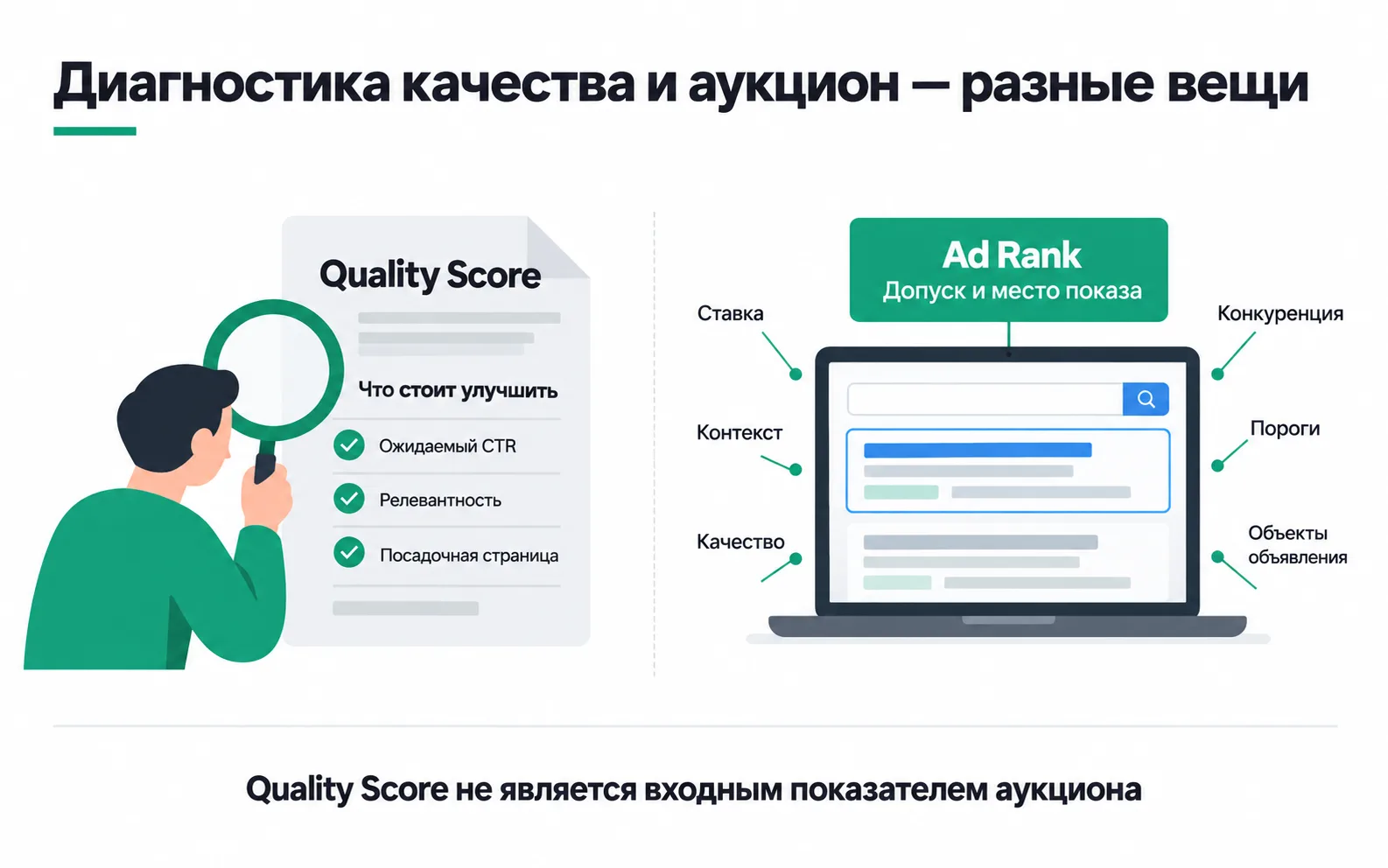
Ad Rank is easy to confuse with Quality Score. Quality Score is a diagnostic tool: a score from 1 to 10 for each keyword. It is made up of expected clickthrough rate, ad relevance and landing page experience. Google states plainly that Quality Score is not an input in the ad auction. In the auction Google looks at quality at the moment of the impression, and Quality Score is a summary for you, so you can see what to fix.
Here is a problem that shows the difference. A competitor bids up to 800 ₸ per click on "IELTS courses Almaty" and sends people to a language school's home page. The centre bids 500 ₸ and sends them to its IELTS preparation page with the timetable and price. Who ends up higher? Two bids will not tell you: Google does not publish a formula, and the context and threshold differ for every search. You can assume that a page that answers the query will help the centre win some impressions with a lower bid, and then watch how impressions and cost per click change after the page is fixed.
Budget and bid are different levers. The budget caps daily spend, while the bid or bid strategy sets how you take part in each auction. If the ad does not answer the query, neither of them will fix that.
Before you raise the bid
A higher bid helps when the ad is good and runs into competition: people respond, but there are not enough impressions. If the ad answers people poorly, a higher bid only makes every impression you win more expensive. So first find the step where the problem is:
| What you see | What to look at first |
|---|---|
| No impressions or very few | Ad status and any rejection reason, budget, location and schedule |
| Expensive impressions, little response | The offer and the creative: estimated action rates and quality depend on them |
| Clicks but no leads | The landing page, the form and the lead event |
| Leads but no customers | The path from lead to job: qualification and lead handling |
The algorithm learns from the event you give it. If Lead fires when the form opens, the system looks for people who open forms, and no bid will fix that. Fix a broken form straight away instead of waiting for the campaign to "learn". And write down what you changed and when: results arrive with a delay, and without notes a week later you cannot tell which change moved them.
Exercise: three competitors in Ad Library
This is a week 2 task of the Start track.
Stick to what you can see. "The competitor spends more than we do" or "their CPM is lower" is something the library will not show you; it is a guess with no data behind it. A useful sentence looks like this: "School A has been running three videos since March with the course price in the copy and a button that opens WhatsApp. A conversation is an easier action than a lead and has a higher predicted rate, so School A needs a lower bid per action to win the auction and its impressions may cost less than ours, but it gets conversations, not leads." Or this: "School B promises 'the 8.0 secret in a month' and does not say what it sells. Meta treats withheld information as a sign of low quality, so its impressions may cost more than ours if our ad names the course and the price."
After the week 2 test, come back to these five sentences. You will have your own cost per thousand impressions (in the example Meta lead test it was 9,860 ₸ for 12,000 impressions, about 822 ₸), and ads with at least 500 impressions will show quality, engagement and conversion rankings. You will never learn what the competitors pay for impressions, but you will see how your ads compare with others reaching the same audience, and you can revise your hypotheses.
Video: the auction and quality metrics
The video is in English and covers the Google Ads auction.