An online analytics school in Almaty spent 80,000 ₸ on Google Search and 120,000 ₸ on Instagram ads in one week. Now the admin of a Telegram channel for marketers is offering a sponsored post for 50,000 ₸, and the owner asks whether that is expensive or cheap. You can't compare these amounts head to head. On Google the school pays for clicks, on Instagram for impressions, and for the post whatever the admin asked. The numbers in this lesson are made up for the example.
Paid advertising means buying attention where people already spend their time: in search, in the feed, in a channel they like. There are two ways to buy it, and the way you buy decides who sets the price.
Fixed price and auction
The post is simple: the seller sets the price. The admin names a sum, the school pays before publication, and how many people read the post and submit the form only becomes clear afterwards. A banner on a news site and a roadside billboard are sold the same way. You know the price in advance, not the result.
On Google and Meta nobody knows the price in advance. When someone types a query or scrolls the feed, the platform runs an auction among the advertisers whose audience that person belongs to or whose keywords match their query, and it does so every time: Google runs a separate auction for every ad slot, Meta for every opportunity to show an ad. The school sets a budget and a bid ceiling, or leaves bidding to the system. What an impression or a click ends up costing is decided by the auction: who else is in it and how well the school's ad fits this particular person.
The other difference is what you are charged for. It is not always the action you launched the ads to get:
| Where | How it is bought | Who sets the price | What you are charged for |
|---|---|---|---|
| Post in a Telegram channel | A deal with the admin | The admin | The publication |
| Google Search | Auction | The auction; the advertiser sets a bid ceiling | A click |
| Instagram and Facebook | Auction | The auction; Meta can bid for you | Impressions, for many goals |
The school's Instagram campaign is set up to get leads, yet the school pays for impressions. For many optimization goals Meta charges per thousand impressions, and only some let you choose to pay per link click instead. Cost per lead (CPL) is an outcome here, not a rate card: you work it out afterwards by dividing spend by leads.
Who sets the price of a click on Google
In Search the school uses the Maximize clicks strategy and has set a maximum cost-per-click limit of 300 ₸. That is a ceiling, not a price. Google charges for a click whatever it takes to keep the ad's rank above the minimum and just above the rank of the competitor directly below you. If no competitor has a high enough rank, the click costs the reserve price. That is why the actual cost per click is usually below the maximum, sometimes far below it.
Google calculates Ad Rank from scratch in every auction, and the bid is just one of six factors. The rest are about the quality of the ad and the landing page, the context of the search and the competition.
Why the same click costs different amounts
In the school's keyword report for the week, the average cost per click for the keyword "data analytics courses" is 260 ₸ and for "evening analytics course" it is 110 ₸. Both have the same 300 ₸ ceiling. Where does the gap come from? Every click was bought in its own auction, and the set of competitors in it changes from query to query, from city to city, with the device and the time of day. Google also takes into account exactly what the person typed, where they are, what device they search on and when.
You can see who the school competes with in Auction insights. The report lists the other advertisers in the same auctions: how often their ads appeared alongside the school's and how often they ranked higher. It shows no competitor bids or prices, and if your ad got less than 10% of the impressions it could have had, the report does not appear at all. Say it shows five schools for "data analytics courses" and one for the evening query. Then the difference in click price makes sense at least in broad strokes: more advertisers are fighting over the general query.
Impressions on Meta get pricier and cheaper the same way. When auction competition rises, the cost of a result may rise too, and an ad people respond to more readily wins Meta's auction even with a lower bid.
The ad and the page answer the same query
Google rates the quality of the ad and the landing page, including whether the page matches the ad. Ad Rank favours ads that answer the query, so such an ad can beat a competitor with a higher bid.
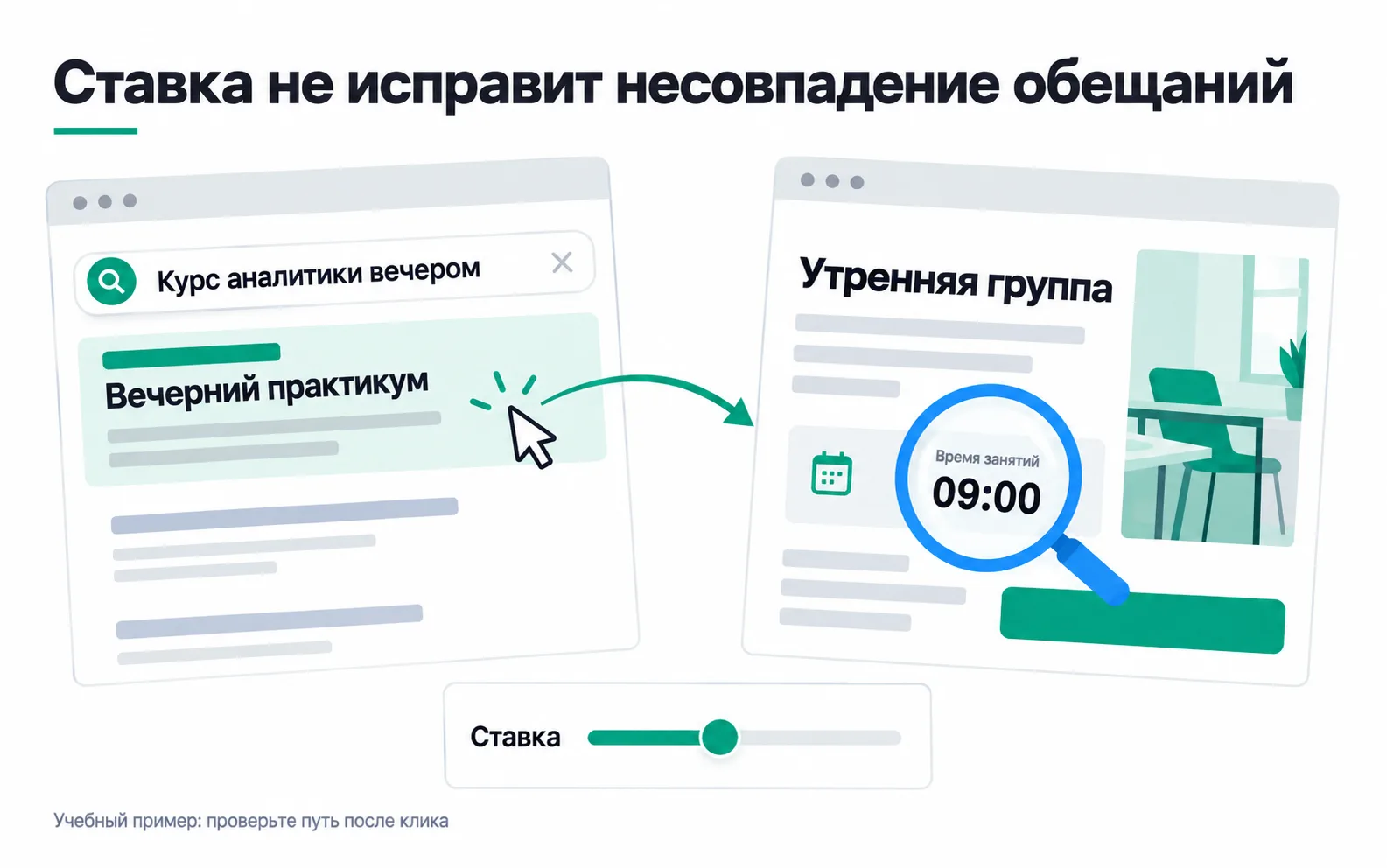
This is exactly where the school tripped up in one ad group. The query "evening analytics course" showed an ad for an "Evening workshop", but the link went to the morning group's page, with classes at 09:00. The query and the ad match, the page doesn't. Someone who can only study after work closes the tab, and the click is already paid for. And since Google checks the page against the ad, this combination may also lose rank to schools whose page does show an evening group.
A higher bid will buy more of the same clicks. The fix is the link: the ad should lead to the evening workshop page with the 18:00 group.
What the auction learns from
Meta, and Google with conversion-based bidding, both rely on a prediction: how likely this person is to take the action you defined as the result. Smart Bidding in Google uses that prediction to set the bid at auction time. If the school only sends form submissions to its ad accounts, the systems go looking for people who like filling in forms, not people ready to pay 25,000 ₸ for a course.
Google Ads also accepts the later steps from a CRM, as qualified lead and converted lead goals. For that, a lead in the CRM needs a Google click ID (GCLID) or a phone number to match it by with enhanced conversions for leads, a status and a payment mark. They will come in handy once the school moves from Maximize clicks to conversion-based bidding.
The school's three prices in the same units
Back to the owner's question. Clicks, impressions and a post are compared by what they brought in. The school keeps 15,000 ₸ from each 25,000 ₸ course sale, and the leads and payments for the same week are in its end-to-end report:
| Google Search | Post: to pay for itself | ||
|---|---|---|---|
| Spend | 80,000 ₸ | 120,000 ₸ | 50,000 ₸ |
| Leads in the CRM | 18 | 34 | about 17 |
| Cost per lead | 4,444 ₸ | 3,529 ₸ | up to 2,941 ₸ |
| Payments | 6 | 6 | at least 4 |
| Ad spend per payment | 13,333 ₸ | 20,000 ₸ | up to 12,500 ₸ |
| Contribution after ads | +10,000 ₸ | −30,000 ₸ | +10,000 ₸ or more |
Instagram brought the cheapest leads, but each payment from it cost more than the school earns on it. The post pays for itself if it brings at least four payments: 50,000 / 15,000 = 3.3. In the school's report there are about 4.3 leads per payment (65 leads for 15 payments), so the post needs to bring about 17 leads, provided its leads pay at the school's average rate.
Before paying, ask the admin for the results of earlier sponsored posts and look at how many views the latest posts get: every post in a channel has a view counter. Tag the link with the sponsored-post row of the UTM scheme, utm_medium=paid. Without the tag, leads from the post blend in with the rest, and a week later you won't be able to tell whether it paid off.
Exercise: how you buy advertising
Take your own project or a friend's business.
The table is done when, for every place, it is clear who sets the price and what the money goes on. The wording gives the mistakes away. "On Instagram I pay for leads": if you are charged for impressions, money goes out on days without leads too, and you work out CPL yourself. "On Google I set the click price": you set a ceiling, and the auction sets the price. "The post is cheaper, 50,000 ₸ is less than 120,000 ₸": you compare not the sums but what one sale costs. If your page had no answer to one of the queries, you already have your first fix, and it costs less than a higher bid.
Video: setting up Google Ads
The Google Ads interface may have changed since the recording, so check button names against your own account.