An online school in Almaty sells an analytics course for 25,000 ₸: 15 payments a week, 60-65 a month. At the team meeting the marketer brings a post from a Telegram channel, "7 neuro-triggers that make people buy", and wants to roll out all of it at once. A price of 24,990 ₸ instead of 25,000 ₸. A "registration closes in 23:59:59" timer, which the owner has been asking for. The "Graduate club, 1,000 ₸ a month" box ticked in advance again, as it was in June, when three and a half times as many buyers took the club. And less text, because "the brain processes images 60,000 times faster". The owner asks you which of it works. The numbers are illustrative.
To answer, you have to pull apart three things such posts mix together: measurements of the brain, effects from psychology experiments, and impressive numbers with no source.
Neuromarketing: what gets measured and what it tells you
Neuromarketing means measuring how the brain responds to a product, a price or an ad. A person lies in a scanner (fMRI) or wears a cap of electrodes (EEG), and researchers watch the activity change while they choose. In their review "Neuromarketing: the hope and hype of neuroimaging in business" (Nature Reviews Neuroscience, 2010), Dan Ariely and Gregory Berns give the costs: an hour on a university scanner averages about $500 (2010 prices), but scanner time is the smaller part of the bill, since at least three quarters of a project's budget goes on people and overheads. In their view, these measurements won't become cheaper than ordinary research any time soon.
The authors illustrate what these measurements deliver with a 2007 study by Brian Knutson and colleagues. Activity in one brain area, the nucleus accumbens, was linked to whether a person liked a product. But the participants' own answers predicted purchases better, and the scanner data added little to the forecast. Ariely and Berns also warn against reasoning backwards: "the pleasure centre lit up, so the person wants to buy." The same area takes part in many processes, so its activity gives you a probability, not a reading of someone's mind.
The marketer's post contains no brain measurements at all. The timer, the price ending in nine and the default tick box come from behavioural economics and cognitive psychology, where they were found in experiments with choices and purchases. So the school should test them on its own leads and payments, not on brain scans.
Three effects that have been confirmed more than once
A cognitive bias is a systematic error of judgement: people stray from the calculation not at random but in a predictable direction. Three effects that have both a classic experiment and confirmation from other studies are useful for a course page.
The default effect
People keep an option chosen for them in advance more often than they would pick it themselves. The best-known example is organ donation. Eric Johnson and Daniel Goldstein (Science, 2003) compared European countries: where everyone who hasn't opted out counts as a donor, consent rates were several times higher than where people have to opt in. Their online experiment with the same choice was repeated in 2023, and the effect replicated.
For the school, the default is the tick box next to the graduate club. The effect is strong, and that is exactly why a pre-ticked paid option is dangerous: it lumps together people who didn't notice the box and people who wanted the club. The numbers below show it.
Anchoring
The first number a person sees shifts their estimate of the next one, even when it is random. In Amos Tversky and Daniel Kahneman's experiment (Science, 1974), participants saw a number on a wheel of fortune and then estimated what share of UN member states are African. Those who got a higher number gave a higher share. Anchoring was one of 13 effects that the Many Labs project repeated across 36 samples. There the anchor was a high or low number in the question itself, people were asked to estimate things like the height of Everest or the population of Chicago, and the effect replicated.
On a course page the anchor is a struck-through price: "40,000 ₸, now 25,000 ₸". It works precisely because people compare against the first number, which is why it has to be real. The school's course has always cost 25,000 ₸, so there is no old price to strike through.
The left-digit effect
In five experiments, Manoj Thomas and Vicki Morwitz (Journal of Consumer Research, 2005) showed that a price ending in nine feels smaller than a price one cent higher, but only when the leftmost digit changes, as with $2.99 and $3.00.
Thomas and Morwitz tested a change in the leftmost digit, whereas between 24,990 and 25,000 it is the second digit that changes. Similar jumps turned up in US used-car sales, though in the mileage rather than the price: at the leftmost digit, each 10,000-mile mark, a car sold for about $150-200 less on average, and at the second digit, each 1,000-mile mark, for about $20 less (Lacetera, Pope and Sydnor, 2012). The gain from 24,990 ₸, if there is one, is small, while the 10 ₸ the school loses on every payment is certain.
What didn't hold up
A classic experiment is not a law of nature. The Open Science Collaboration repeated 100 published psychology experiments: 97% of the originals had a significant result, against 36% of the replications (Science, 2015). Here is what, among the popular "triggers", failed replication or never had research behind it:
- Willpower depletion. The idea that after one act of self-control the next comes harder, and by evening people buy more impulsively. 23 labs repeated the basic two-task experiment under one protocol with 2,141 participants and found an effect indistinguishable from zero (Hagger et al., 2016).
- Social priming. A word or picture that nudges a decision without people noticing. In the Many Labs project, both priming effects it tested, with a flag and with money, failed to replicate.
- "Choice paralysis" from the 24 jams experiment. A meta-analysis of 50 experiments with 5,036 participants found an average effect of virtually zero, with a wide spread between studies (Scheibehenne et al., 2010). Sometimes extra choice gets in the way and sometimes it doesn't, so test it on your own page.
- "Attention spans are shorter than a goldfish's: 8 seconds." The BBC programme More or Less traced the figure to a 2015 Microsoft Canada report, which cited a website called Statistic Brain with no research behind it.
- "Images are processed 60,000 times faster than text." The figure goes back to a 1997 3M brochure that cites no study at all.
Keep arguments like these away from clients. And if a client sends you such a post, go through it together and find out where the number came from.
Worked example: a 1,000 ₸ a month tick box
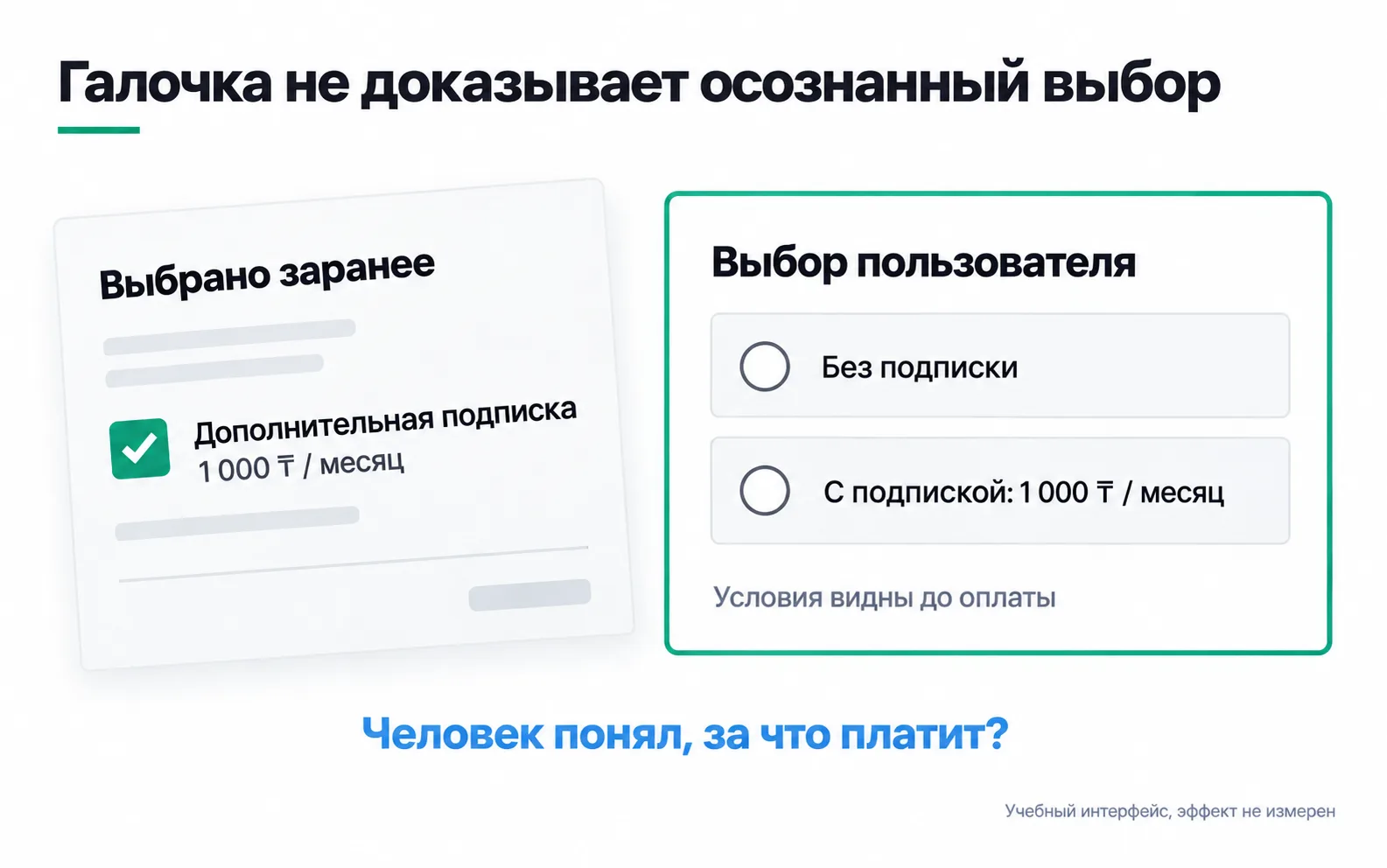
The school's graduate club is two online reviews a month plus job openings from partners, for 1,000 ₸ a month. In June the payment builder ticked the club box on its own, as on the left of the picture; in July someone noticed, and the school switched to an explicit choice, as on the right. Each month brought 60 course payments.
| What we count | June: box ticked in advance | July: person chooses |
|---|---|---|
| Paid for the course | 60 | 60 |
| Also paid for the club | 42 | 12 |
| Asked the manager what the 1,000 ₸ charge was | 8 | 0 |
| Asked what the club includes | - | 5 |
| Cancelled the club after the second charge | 17 | 1 |
| Still paying for the club in month three | 25 | 11 |
In June, 17 people cancelled the club after the second charge, and eight asked the manager what the charge was. By month three, 25 of the June buyers are paying for the club against 11 of the July buyers, but the 17 who cancelled had already paid for it twice, and the eight questions about the charge show that some buyers simply didn't know about the club. June and July are different months, not an A/B test, so the table can't give the exact difference. But 42 against 12, out of the same 60 payments, is too wide a gap to put down to the months alone: some of the June subscriptions rested on the tick box rather than on wanting the club.
This trick has a name. The FTC report "Bringing Dark Patterns to Light" (2022) counts a pre-checked box for an add-on among the dark patterns and calls it sneak-into-basket. In the EU, a buyer who "agreed" to an extra payment through a default option is entitled to get that payment back (Directive 2011/83/EU, Article 22). In Kazakhstan, the Law "On Consumer Protection" lists obligations for additional paid services imposed by the seller among the terms that violate consumer rights (Article 8-1(2)(3), as amended up to 20 August 2026). It says nothing directly about default tick boxes; as we read it, a paid box ticked in advance is that kind of imposition.
So a paid tick box gets removed rather than tested against an explicit choice. What's worth testing is whatever helps people decide for themselves: how the club is described, where the offer sits, what it costs. Keep defaults where they serve the buyer, such as pre-selecting the next stream.
From trigger to hypothesis
After this review, little of the marketer's list is left, and the first thing to filter out is anything untrue. A registration timer that restarts when the page is reloaded is fake scarcity, not urgency. A struck-through price the course was never sold at is a false statement about price. When things like these get into advertising, as we read it, they run into the law. The Law "On Advertising" calls advertising unreliable when it contains false information about price (Article 7(2)(3)) or about research results and scientific terms (Article 7(2)(11)), and as we read it, that point, along with Article 7(2)(6) on expected results, also covers lines like "scientifically proven: our format activates memory" when no study has shown it. This is our reading of the laws "On Consumer Protection" (as amended up to 20 August 2026) and "On Advertising" (as amended up to 17 May 2026), not legal advice.
Whatever is left gets written up as a hypothesis, using the template from hypotheses for a landing page: if we change, then, because, we'll check. For the graduate club it reads like this:
If the payment form describes the club in one line ("two reviews a month and partner job openings") instead of the word "subscription", more course buyers will choose the club and cancellations after the second charge won't rise, because in July 5 of the 12 who chose the club asked the manager what it includes. We'll check club payments and cancellations over two months.
There's no point waiting for an A/B test on a change like this. To tell 20% of buyers choosing the club from 25%, at the usual 5% significance level and 80% power, a test needs about 1,100 course payments per variant. The school has 15 payments a week, 60-65 a month, so the test would run for about three years. Sample size is worked out in advance, as in A/B testing, and when that size is out of reach, the change is made and observed: log the date, watch club payments and cancellations, and report what you saw without claiming a cause.
Exercise: take apart the triggers on your own page
Take the landing page and ads of your own project, or the project from the Start track.
The review starts with the second item. If all you found behind a trick is a post or a book with no references, it is an idea, not an effect, and it goes into a client report without the word "proven". If there is research but the conditions on your page differ, as with the left digit at 24,990 ₸, expect less from the trick than the study found and keep it among your low-confidence hypotheses.
And a question you'll be asked on your first project. In August the school rewrote the club description following this hypothesis, and more buyers chose the club than in July. The marketer writes in the report: "We reduced cognitive load and activated the reward centre." Which part of that sentence do the data support?
Only that more people chose the club in August than in July. Two months can't tell you why: the stream, the ads or the season could have changed in that time. And nobody measured a reward centre, so the sentence describes a method the school never used. The report should state what was seen: how many course and club payments there were in July and August, on what date the description changed, and what else changed in the same weeks.
Video: cognitive effects
From the LPgenerator channel. Run each example in it through the questions from the exercise: is there research behind it, and does it hold for your page?