The three competitors of an IELTS prep centre in Almaty promise much the same: a free trial lesson at two of the three, "7.0" at two, "experienced teachers" at the language school. The centre stands out from them with a plan built around the exam date, but it fights for the same people as everyone else, the ones who have already decided to take a course. Meanwhile, more than half of the first university applicants who did come to the centre had prepared on their own before. Of the 30 people who attended trial lessons, 10 bought the course.
W. Chan Kim and Renée Mauborgne call a market where everyone competes on the same factors for the same customers a red ocean. A blue ocean is demand you create by changing the set of factors itself, above all for people who currently buy from nobody. They offer three tools for this: the strategy canvas, the three tiers of noncustomers and the ERRC grid. We will go through all three with the centre, whose regular course runs for three months at 45,000 ₸ a month in groups of eight. The figures in this lesson are illustrative.
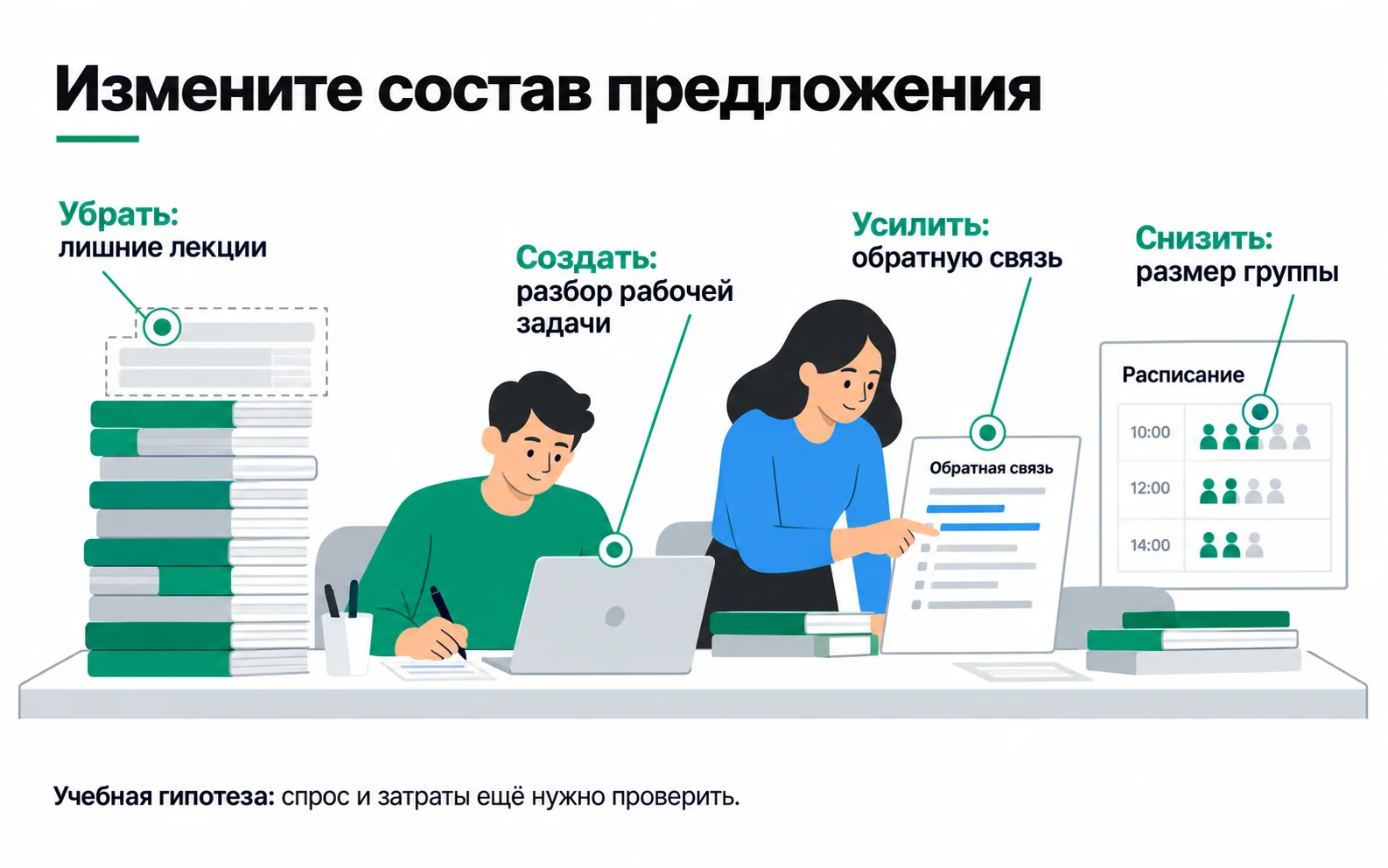
The picture shows the same four actions at a different school, one that teaches a profession.
The strategy canvas: what everyone competes on
The horizontal axis of the canvas lists the factors the industry competes on and invests in; the vertical axis shows how much of each factor buyers receive. One player's line across all the factors is called its value curve. A table is a convenient way to keep a canvas. The marketer scored each option from 0 to 5 based on ads, websites and reviews on 2GIS, where 5 means "the most".
| Factor | Language school | "7.0 Guarantee" | Centre | Self-study |
|---|---|---|---|---|
| Price for the whole course | 3 | 5 | 4 | 0 |
| Length and commitment | 5 | 4 | 4 | 0 |
| Group lessons on grammar and vocabulary | 5 | 4 | 4 | 0 |
| A promised score | 0 | 5 | 0 | 0 |
| Mock exams | 1 | 4 | 3 | 1 |
| Speaking and writing reviewed by a teacher | 1 | 3 | 4 | 0 |
| Freedom of schedule | 1 | 1 | 1 | 5 |
The curves of the three schools run almost parallel: all of them sell three months of group lessons and argue about details. The centre leads on reviews, "7.0 Guarantee" on the promised score, and the language school is the cheapest of the three. Self-study is a mirror image: free and whenever you like, but with no review at all. Precisely where self-study scores zero, the centre is strong.
Who isn't buying, and why
Kim and Mauborgne divide noncustomers into three tiers. The first sits on the edge of the market: it buys only when it has to and leaves at the first chance. Closest to it are students who pay month by month and are unsure they need the next month: four from the August intake have already left after the first. The second tier considered what the industry offers and turned it down. Of the 20 people who attended a trial lesson and did not buy the course, 13 applicants and people relocating belong here, while the other seven are schoolchildren studying "for the future" and people who want conversational English. Those who deliberately prepare on their own are in the second tier too. The third tier has never thought of preparation as an option, and the centre is a long way from them for now.
The manager called eight of those thirteen and asked how they were preparing now and what they were missing. Five were preparing on their own, and their answers were similar. They had the materials. What they lacked was a sense of their current speaking and writing score and of what to fix in the month before the exam. Three months at 45,000 ₸ comes to 135,000 ₸, mostly for lessons they don't need.
Five similar answers are a hypothesis rather than demand. Some noncustomers manage perfectly well on their own and need nothing beyond a textbook. Only money in a pilot will show whether the demand is there.
The ERRC grid: a new offer
ERRC asks four questions. Which factors the industry has long competed on should be eliminated? Which should be reduced well below the industry's standard? Which should be raised well above it? Which should be created that the industry has never offered? The grid makes you think about all four at once, so that you look for a difference and lower costs together instead of simply adding services.
| Action | What changes | What it does to costs |
|---|---|---|
| Eliminate | Group lessons on grammar and vocabulary, the three-month commitment | Fewer group hours for the teacher |
| Reduce | Length to four weeks, price to 60,000 ₸ in total instead of 135,000 ₸ | Less revenue per person |
| Raise | A speaking review and a writing check every week, attention to each person: six in a group instead of eight | More one-to-one hours and fewer people per teacher in a group |
| Create | A weekly mock exam under exam conditions and a final report on where the person loses points | Preparing the tasks and the administrator's time |
The grid produces an offer:
A four-week intensive before IELTS for people who prepare on their own. Every week a mock exam, a speaking review and a writing check by a teacher, and at the end a written report on where you lose points. 60,000 ₸ for everything.
Here the grid promises no savings: there are fewer group hours but more one-to-one hours, and only the calculation shows how that ends.
Count the teacher hours
| Per participant per week | Time |
|---|---|
| Speaking: 15 minutes of answers and 15 minutes of review | 30 minutes |
| Writing check | 30 minutes |
| Group session on typical mistakes, 90 minutes for six people | 15 minutes |
| Total | 1 hour 15 minutes |
Over four weeks that is 5 hours per participant. On the intensive the teacher is paid by the hour, unlike the course, where pay goes per student. The owner turned down the per-student raise the teachers asked for in the autumn and offered them these hours instead, so the course still leaves the centre 16,000 ₸ per student per month. At 6,000 ₸ per teacher hour the intensive costs 30,000 ₸ per participant, and the centre keeps 60,000 - 30,000 = 30,000 ₸ from each one. The administrator's time for the mock exams is left out.
For comparison, students in the August intake paid for the course for 2.5 months on average and left the centre about 40,000 ₸ each (the centre's cohort table). The intensive brings in less per person, but almost twice as much per month, and all of it up front.
The bottleneck is hours, not ads. The senior teacher has 15 free hours a week, which means 15 / 1.25 = 12 participants at a time, two groups of six.
Is it still a blue ocean?
Before celebrating an empty space, go through the competitors once more. On 2GIS, "7.0 Guarantee" is praised precisely for its mock exams, and the tutor with the blog could add a "mock with a review" within a week. The centre is entering a market with competitors in it; what is new is a different set of factors for people who currently pay nobody.
This is where the model lets a small business down. Silence around an idea means one of two things: either there is no demand, or nobody has noticed it yet, and only a pilot with real money can tell them apart. A competitor will copy the novelty as soon as it sees people in the niche. What holds the niche is having learned to serve it before anyone else: the review template, the report, the mock exam timetable.
A 12-seat pilot
Before sending the first invitation, write down the rules of the pilot:
- who it is for: someone preparing on their own, with the exam 4-8 weeks away and an entry test level at which the teacher will take on a month of work instead of recommending the full course;
- seats and price: 12 seats, 60,000 ₸, with the price shown up front;
- what we count: how many people paid, how many sat all four mock exams, how many hours the teacher actually spent on each person, how many participants later bought the full course;
- when we continue: the groups filled up and each participant took no more than five teacher hours.
The first to hear about the pilot are those of the twenty who did not buy after a trial lesson and have their exam 4-8 weeks away. Not all of them can be contacted: first check what they consented to, and what the law requires of consent.
The scores from the first and the last mock exam across twelve people are only a signal. With so few people, a rise is impossible to tell apart from people simply getting used to the format.
Suppose the groups filled up and the participants are happy, but each of them needed two more hours of one-to-one help. Hours per person went from 5 to 7, the cost from 30,000 ₸ to 42,000 ₸, and the contribution fell to 18,000 ₸, close to a regular month of the course. With 15 free hours, the teacher can now take 8 people at a time instead of 12: seven hours over four weeks is 1.75 hours a week, and 15 / 1.75 = 8.6. It is too early to call the format scalable. First find out where the extra hours went. If the help went to people whose level turned out lower than assumed, raise the entry test threshold and run the pilot again.
Exercise: ERRC for your own product
Take a product from your own project or a client's.
If only "raise" and "create" are filled in, you have added services to the old product. That costs more, and the offer stays the same. If "eliminate" includes something your current customers pay for, the new offer will pull them away from the old one, and it is worth working out how much money will leave the main product.
When your curve on the canvas matches the competitors' curves and you could not find any noncustomers, start with five conversations rather than a table. And if the pilot rules have no stop condition, the pilot will end with someone extending it.
Video: blue ocean strategy
After watching, write down one change to your offer and what it does to your costs.