In the IELTS prep centre's CRM, Kamila and Sanzhar look almost identical. Both are applying for a master's abroad, both need 6.5 in IELTS Academic, both came to the free trial lesson. Sanzhar paid for the first month that same evening, while Kamila went to a tutor who is paid lesson by lesson. Their profiles won't show you the difference. The interview will, if you ask how each of them got to the trial lesson and what held them back.
For a newcomer, JTBD (Jobs To Be Done) works best as a language of questions inside an in-depth interview: the same conversations, plus questions about the moment the person decided to change something. Below, the centre's marketer rereads two of the six interviews through JTBD. Names and numbers are made up.
The job people buy for
Clayton Christensen and his co-authors set out the approach in the book "Competing Against Luck" (2016) and in the Harvard Business Review article "Know Your Customers' Jobs to Be Done". As the Christensen Institute defines it, a job is the progress towards a goal that a person is trying to make in their own circumstances. Christensen's best-known example is a fast-food chain's milkshake: in the morning people bought it to make the commute pass, in the afternoon as a treat for a child.
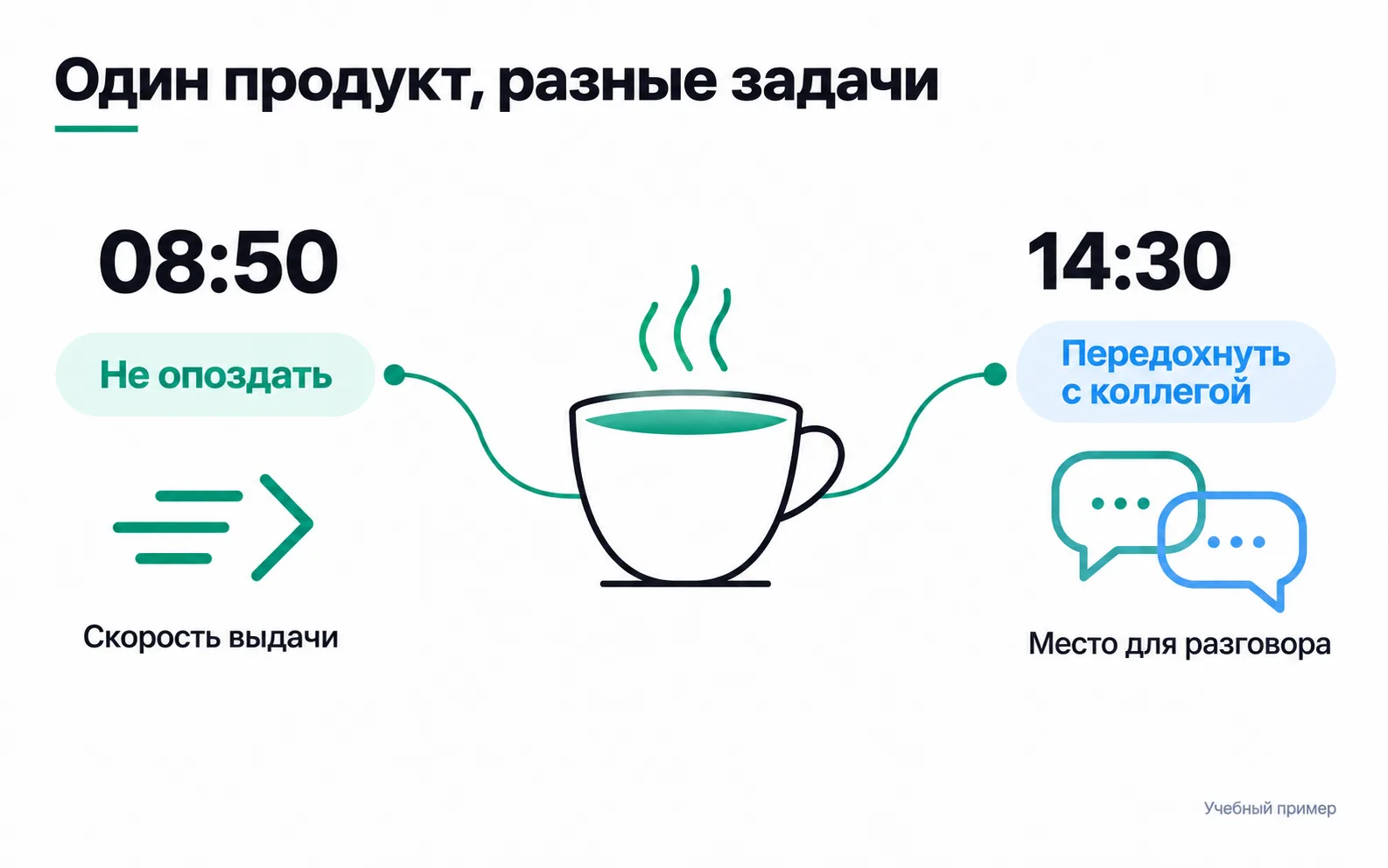
The picture shows the same idea in a coffee shop. It's one cup, but at 08:50 people take it so they aren't late and choose by how fast it's handed over, while at 14:30 they take it to unwind with a colleague, and then they need somewhere to talk.
For Kamila and Sanzhar the job sounds the same: get 6.5 by the application deadline and start studying this year rather than next. "Learn English" is the centre's wording, not theirs. People "hire" different things for this job. Kamila, whom the marketer talked to in an in-depth interview, went to two lessons with a tutor at 8,000 ₸ each, and after the trial lesson moved to another tutor, also paid per lesson. Nurlan, who took the exam last year, bought a ready-made plan from a tutor, some went to another centre, some put off applying for a year. All of these are competitors, even though only one of them is called a centre.
City, budget and age still matter: they limit what's available to a person. JTBD adds the answer to why the person started looking right now and what they are trying to change.
Questions about the moment of switching
Bob Moesta and Chris Spiek have a switch interview for exactly this: you start from the purchase and work backwards until you reach the first thought that something had to change. Their timeline has six marks: first thought, passive looking, a first event, active looking, a second event, and decision with purchase and use. People usually place the first thought later than it really happened, so you keep asking what was going on before that until you reach the beginning.
These questions get added to the in-depth interview:
- When did you first think you wouldn't make it on your own? What happened then?
- What did you do between that thought and messaging us?
- What else did you consider, and why did you drop it?
- What almost stopped you before you paid?
- What were you using until you found us, and are you still using it?
- If you didn't buy: what did you choose instead, and why?
Here is Sanzhar's timeline, pieced together from his answers.
| Mark | What happened for Sanzhar |
|---|---|
| First thought | The university sent a conditional offer: a 6.5 certificate needed in four months. "If I don't pass, I lose a year" |
| Passive looking | Studied on his own with videos, noticed course ads, but didn't contact anyone |
| First event | A free online test showed 6.0, a second one a week later 5.5: "I don't even know my level" |
| Active looking | Asked two tutors for prices and messaged two centres on WhatsApp |
| Second event | At the trial lesson the teacher's speaking feedback showed him three mistakes he hadn't known about |
| Decision and purchase | Paid for the first month that same evening |
Notice where the search turned active. By Sanzhar's own account, he started looking in earnest after two tests with different results, not after an ad. If the marketer had asked "Why did you choose us?", he would have heard about the speaking feedback and never learned about the tests or the four-month deadline.
The four forces: why one paid and the other didn't
Moesta and Spiek break a switch into four forces. Two lead towards the switch: the push of the situation (what's wrong now) and the pull of the new solution (how the person pictures the future with it). Two hold them back: anxiety about the new and habit of the present. A person switches when the first two outweigh the second two.
| Force | Sanzhar, paid | Kamila, went to a tutor |
|---|---|---|
| Push of the situation | Conditional offer, four months to the deadline, tests giving different levels | Mock test at 5.5 against the 6.5 she needs, exam in three months |
| Pull of the centre | The feedback showed three mistakes he hadn't known about | "The first time I heard where I lose points" |
| Anxiety about the new | Afraid of paying and being disappointed, until he heard the feedback | "Signing up for three months straight away, what if it doesn't help?" |
| Habit of the present | Studied on his own, had never paid for preparation | Pays a tutor lesson by lesson |
The top rows look alike: the deadline presses on both, and both liked the feedback. The difference is at the bottom. For Sanzhar the trial lesson eased the anxiety, and he had no paid habit to give up. Kamila is held back both by the fear of three months and by her familiar way of paying per lesson.
This is a reading of two stories, not a law. Two people can't tell you which force usually decides, but they do show what to check. Both liked the feedback at the trial lesson, so that isn't the first thing to work on. Anxiety is harder. The free trial lesson, which the value proposition offers as the answer to that fear, didn't convince Kamila: she was there. Nobody told her the main thing: the course is paid month by month. Just count later how many pay for the second month: a student who leaves after the first one is a loss for the centre. Habit can't be talked away; all you can do is record it and count it.
Later, when the centre was choosing its positioning, these questions moved into the CRM: "how did you prepare before us" records the habit and the alternative, "why did you choose us" records the pull. How many people came from self-study and how many from a tutor then shows up in these fields across twenty applicants (11 on their own, 6 with a tutor, 3 from another centre), not two.
A Job Story without the product's name
The outcome of the interviews is written as one sentence in the Job Story format: "When ..., I want to ..., so I can ...". The format comes from Intercom, and Paul Adams tells how it happened. The sentence starts with the situation rather than a user persona.
A weak version: "When I'm choosing IELTS courses, I want a centre with experienced teachers, so I can prepare well." The solution has already been picked, "experienced teachers" comes from ads rather than interviews, and nobody knows what "well" means.
A strong one: "When the application deadline is three or four months away and my mock test is below the score I need, I want to find out where I lose points and prepare to a plan built for my date, so I can start studying this year rather than next."
Every part of the sentence comes from the interviews. Both had a mock score below what they needed. "Where I lose points" is Kamila's phrase. "A plan built for my date" comes from the story of Nurlan, whose plan followed the textbook. "This year rather than next" is Sanzhar. The centre's name isn't in the sentence, and that's how it should be: a tutor, a centre, or the person on their own with a good plan could all do this job. A Job Story describes the job, and the list of what people have already tried shows who you compete with for it.
If different interviews produce sentences that can't be reconciled, don't glue them into one like "the customer wants quality preparation". They may be different segments. Someone moving abroad for work and taking General Training is in a hurry too, but for a different deadline, and needs a different plan.
Exercise: a Job Story from three interviews
Take the notes from the three interviews in the in-depth interview exercise and go through four steps. You'll end up with three timelines, one forces table and one or two Job Story sentences.
- For each person, build a six-mark timeline like Sanzhar's. Leave empty marks empty and ask about them in the next conversation.
- Put all three into one four-forces table: forces as rows, people as columns.
- List everything people "hired" for the same job before you.
- Write a Job Story, "When ..., I want to ..., so I can ...", without your product's name, and next to each part note whose interview it came from.
If the "when" part describes the person ("when I'm a student", "when I own a café"), go back to the timeline: the situation is the first thought or the event that started the search. If your product's name is still in the "I want to" part, remove it. If the sentence stops making sense, you described a feature, not a job. If the anxiety row is empty for all three, you probably didn't ask what almost stopped them, so ask it in the next conversation. And keep the list of what people "hired" before you: those are your real competitors, and there may not be a single company among them.
Video: an introduction to JTBD
As you watch, keep the person's job separate from the product feature that's offered to do it.