The owner of an IELTS prep centre comes back from the trial lessons pleased: "Everyone loves the idea of a plan built around the exam date. I ask whether they'd sign up, and they all say yes." Yet of the 16 applicants who came to a trial lesson, seven paid for the course. A yes to a question about the future costs the person saying it nothing and tells the person asking nothing.
An in-depth interview is a one-to-one conversation in which the person tells you what they have already done and you mostly listen. In this lesson the centre's marketer runs six of them with applicants. Names and numbers are made up.
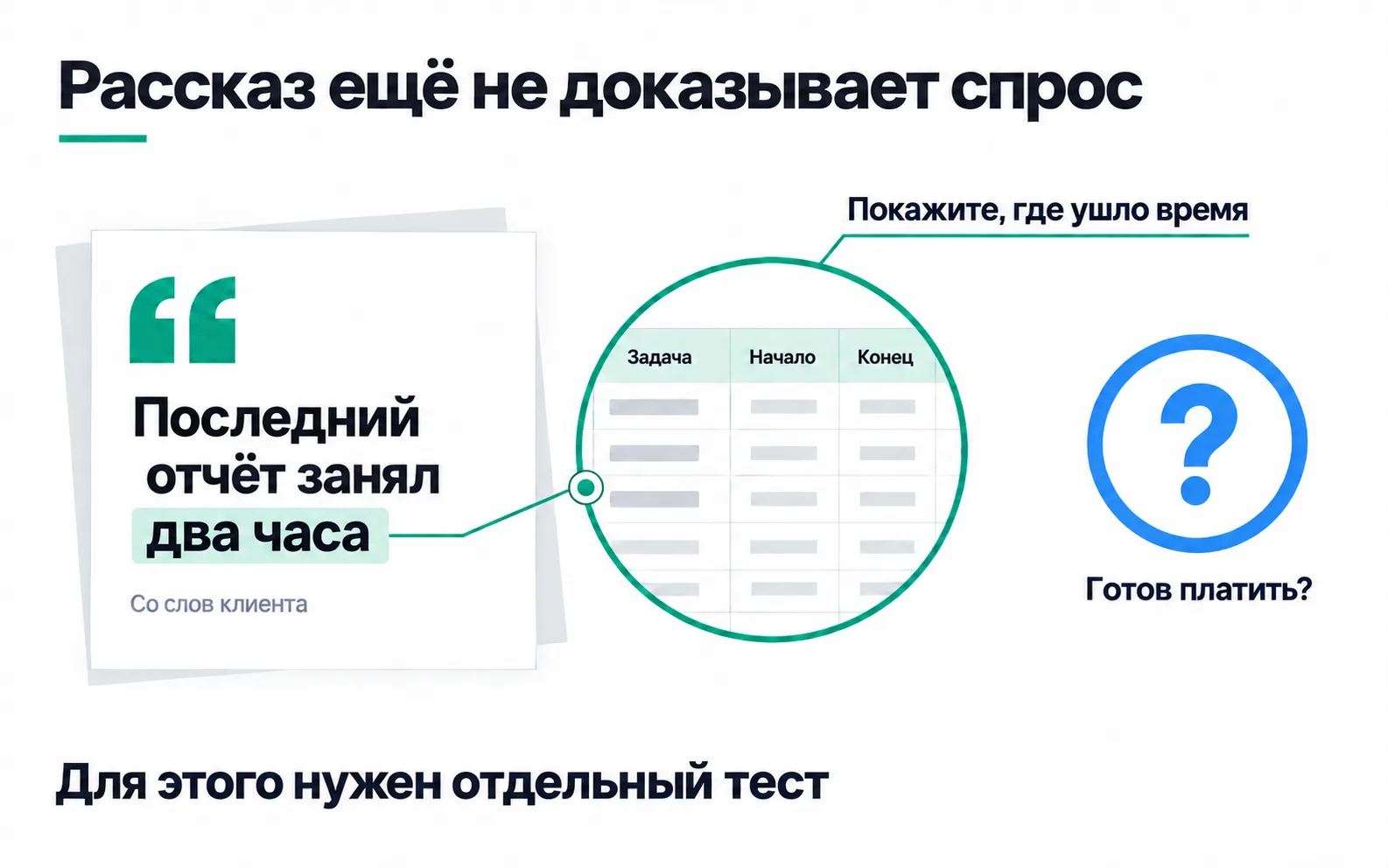
The picture shows the same rule for a reporting service. "The last report took two hours" is the customer's own claim. Where the time went becomes visible when they walk you through the steps, and whether they would pay is checked by a separate test. The useful question there sounds like this: "How did you put together your last report, where did you get stuck, and what have you already tried?"
Interviews are a CustDev tool
Customer Development, or CustDev, was described by Steve Blank in "The Four Steps to the Epiphany" (2005): assumptions about the product and the business are tested as hypotheses against data from customers (Agile Alliance definition). The first step, customer discovery, checks whether you have understood the need correctly, and its main tool is the interview, while whether people will buy is checked later with a priced offer.
Write down a hypothesis before the conversations; the centre's reads: "Applicants whose exam is three to four months away need a plan built from their date, and what they pay for is making the application deadline." The interview finds out whether that's true, what people have already tried and what stops them, rather than confirming the hypothesis.
Who to invite
Invite the people who handle the job you're asking about themselves. The centre's marketer picked six applicants:
- two who came to a trial lesson and paid for the course: they'll explain what tipped the balance;
- two who came to a trial lesson and left without paying: they'll tell you what stopped them, and that isn't in the CRM;
- two who took IELTS Academic last year and are already studying abroad: they went the whole way and know which parts of their preparation turned out to be useless.
Leave out the owner's friends and people outside the segment: the first will try to spare your feelings, the second will tell you about a different job. If parents pay for the course, talk to them separately.
The invitation goes out briefly on WhatsApp: we'd like to understand how people prepare for IELTS, there's nothing to buy, it takes half an hour. And nobody offers the course during the call either.
Ask about the past
In The Mom Test (2013), Rob Fitzpatrick boils the technique down to three rules: talk about the person's life instead of your idea; ask about things that have already happened instead of opinions and plans; listen more than you talk.
| Question | What you get | How to ask instead |
|---|---|---|
| Would you sign up for a course with a plan built around your exam date? | A promise about the future: a yes costs nothing | How did you prepare for your last mock test, where did you get stuck, and what have you already tried? |
| What do you think of our sample plan? | An opinion of a mock-up: "looks nice" | Show me the plan you're following right now |
| How much would you pay for the course? | A number made up on the spot | How much have you already spent on preparation, in money and in hours a week? |
| Do you often pause during speaking? | A prompt: you said the word "pause", the person didn't | What did you do when you realised your speaking wasn't good enough? |
The right-hand column never mentions the centre, the plan or the price, yet the story shows what the job has cost the person, and so how much it matters to them.
The conversation: from the general to a specific case
You prepare five to seven questions like these, and everything else is follow-up: "And then?", "Why?", "Could you show me?". A conversation takes about half an hour, and it's better if a second person takes notes so the one asking only listens.
Here is part of the conversation with Kamila. She came to a trial lesson and didn't pay for the course.
Marketer: "Tell me how you prepared for IELTS before the trial lesson with us."
Kamila: "On my own for six months, with a book of practice tests and YouTube videos. A month ago I did a mock test and got 5.5, and I need 6.5 for my master's. The exam is in three months."
Marketer: "What did you do after that test?"
Kamila: "I recorded my speaking on my phone, and every couple of sentences there's a pause while I look for a word."
Marketer: "And then?"
Kamila: "I went to two lessons at 8,000 ₸ each with a tutor from Instagram. He gave me topics, but never told me what was wrong."
Marketer: "And after our trial lesson?"
Kamila: "I liked the feedback, it was the first time I heard where I lose points. But signing up for three months straight away, what if it doesn't help? For now I'm going to a different tutor, where you pay per lesson."
The questions say nothing about the centre's plan, yet you learn the main things: her goal and deadline, what Kamila tried, what she spent, what stopped her and what she chose instead. "Every couple of sentences" is her estimate, not a measurement.
When someone praises the idea
Nurlan took IELTS last year and is studying in the UK. Near the end of the conversation he asked what the centre does and, on hearing about the plan built around the exam date, said: "Great idea, I'd recommend it to everyone I know."
Praise tells you nothing about demand. The tempting follow-ups are "Would you recommend us to your friends?" and "What else should we add to the programme?", but the first asks for another promise and the second collects wishes nobody has to pay for. You learn more by taking the conversation back into the past:
Marketer: "When did you last put a preparation plan together yourself? How much time or money did that take?"
Nurlan: "I bought a twelve-week plan from a tutor for 15,000 ₸. I dropped it after a month: it followed the textbook rather than my date, and I couldn't tell whether I was on track."
The fact: he has already paid for a plan and dropped it after a month. The reason is his version: the plan followed the textbook rather than his date. An answer like that outweighs any amount of praise.
The customer's words in one place, your conclusions in another
After each conversation the marketer sorts the notes into three columns. A log like this keeps what happened apart from the team's explanation of it.
| What they said | How we read it | How to check |
|---|---|---|
| "Every couple of sentences there's a pause while I look for a word" | Pauses in speaking cost points | The teacher notes pauses in the CRM for everyone who comes to a trial lesson |
| "Signing up for three months straight away, what if it doesn't help?" | The commitment is the scary part, not the monthly price | Say at the trial lesson that the course is paid month by month, and watch how many who came pay for the first month and how many of them pay for the second |
| "It followed the textbook rather than my date" | People pay to make their deadline | Count how many applicants in the CRM have an exam date recorded |
Together the six conversations gave this. All six mentioned the deadline before the goal: "the exam is in three months", "applications close at the end of the month". Four brought up pauses before anyone asked them about speaking. Three didn't know their level, and three were afraid of signing up for three months and being disappointed, including both who left after the trial lesson. One asked about the SAT.
These findings later grew into the centre's value proposition: a plan built from the exam date, speaking feedback and a level test at the free trial lesson, while the SAT became a product boundary best stated up front.
How many interviews you need
Abbie Griffin and John Hauser ("The Voice of the Customer", Marketing Science, 1993) analyse 30 interviews with potential buyers of coolers and picnic baskets: on average, 20 of them surfaced over 90% of the needs named across all 30 (Hauser's note for an MIT course). For very different segments, Hauser writes, 10-20 interviews each may be needed.
The centre has six conversations, fewer than even Hauser's lower bound of 10: enough for words for ads and hypotheses for the trial lesson, but not for a full list of needs or for shares. What follows is a practitioners' rule, not a research finding: stop when two or three conversations in a row repeat what you've already heard. You can miss a rare need that way: in Griffin's data, 38 needs were mentioned by only one person out of thirty. How many people think the same way is something the CRM or a survey will show.
Recording the conversation and personal data
It's better to record the conversation: the notes hold your retelling, the recording holds the person's own words. But in an interview you collect personal data, and in Kazakhstan that is governed by the Law on Personal Data and Its Protection (as amended up to 14 September 2026). What follows is a summary of the law, not legal advice.
- Article 6 names an image of the face as an identifier, so a video call with the camera on is personal data, and it's safer to treat phone numbers and voices the same way.
- Consent can be given "in another way that allows receipt of consent to be confirmed" (Art. 8(1)), and it's the centre that will have to prove it (Art. 25(2)(5)). Keep consent in the chat: ask the person to reply "yes" on WhatsApp. The recording is deleted once transcribed, and the chat is kept.
- Data is used for the purpose it was collected for (Art. 14). Inviting someone to an interview using the number from their trial lesson form is a new purpose too, unless the consent under the form covered it; agree the wording of that consent with a lawyer.
- Databases holding personal data are stored in Kazakhstan (Art. 12(2)), so ask the same lawyer about keeping recordings on a cloud drive.
In practice three habits help: say at the start who will hear the recording and when it will be deleted, use codes instead of names in the notes ("A3, master's, came to the trial lesson, didn't pay"), and keep names and phone numbers only in the CRM.
Exercise: three interviews on your own project
Take the questions from the "Interviews" row of your project's research plan.
"Interesting", "convenient", "need" in your notes are opinions, and what's worth copying out is what the person did. If nobody mentioned time or money already spent, your questions were about the future, and the next conversation should start from the last time the person dealt with the job. Rewrite "customers value..." as "two out of three told us that...". And if none of the three left without buying, you don't yet know what stops the rest.
Video: the in-depth interview
As you watch, note which questions take the person back to what they did and which ask them to rate an idea.