An IELTS prep centre in Almaty has decided to start with people applying to universities abroad, and the owner now wants "proper market research": a poll on Instagram, how many people in Kazakhstan sit IELTS, a review of every competitor. Meanwhile the marketer opens the CRM. Of the 40 applicants who submitted the form, 16 came to the free trial lesson and 7 paid for the course. Nobody knows why nine people walked away after the lesson, and neither a poll of followers nor the size of the market will tell them.
Research starts with the decision that depends on it, and the method comes second. We'll follow that path on the same centre: a three-month course at 45,000 ₸ a month. The numbers are illustrative.
Start with a decision you can still change
"Study the IELTS market" is a task with no end. You can spend a month collecting competitor prices and exam statistics and still not know what to change in next week's ads.
A workable version reads as a choice: "We are deciding what to fix first: the ads, the manager's first message or the trial lesson. To decide, we find out why applicants don't pay after the trial lesson." Each possible answer leads to its own action. If people were unclear on what they'd get over three months, the first message and the site get rewritten. If the lesson missed what they came for, the lesson changes. If you keep hearing "too expensive", that goes to the owner, because the owner sets the price.
Write down the options before you collect anything, and next to each one the answer that would make you pick it. If no answer would change the plan, you are collecting background information, and the time is better spent elsewhere.
Three questions call for three kinds of evidence
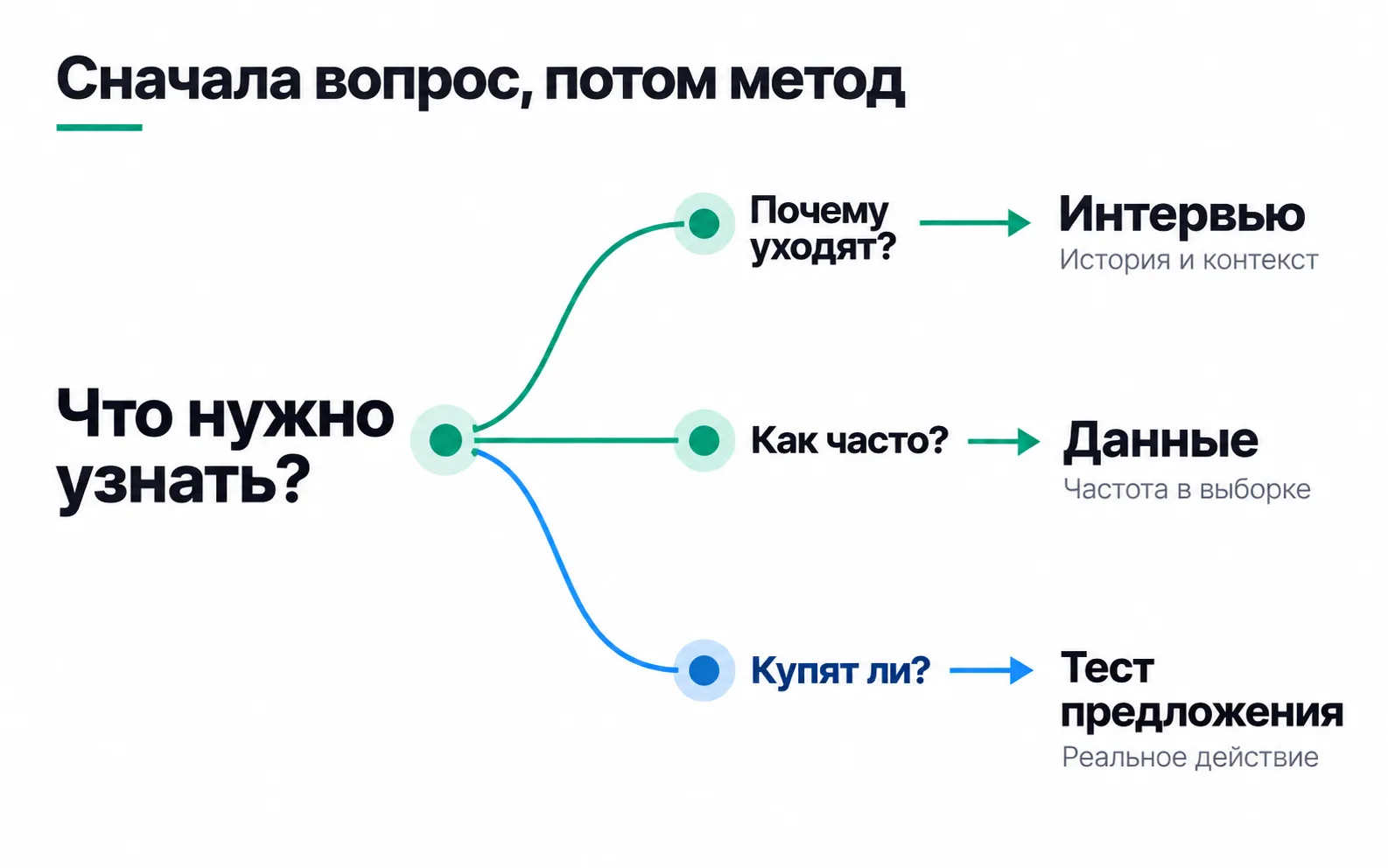
The diagram has three questions, each with its own method. The order depends on what you already have to hand: some answers are sitting in the CRM, and for others you will have to call people.
| The centre's question | What to collect | What this method won't tell you |
|---|---|---|
| Why did 9 of the 16 applicants leave after the trial lesson? | Interviews with those who left and those who paid: what happened before, during and after the lesson | How many applicants share the same reason |
| How many leads come from applicants, and how many of them get as far as paying? | Leads tagged in the CRM over a defined period | Why people didn't get as far as paying |
| Will people come to a trial lesson from an ad, and what will each one cost? | An ad test with a budget and a count of who showed up | Whether the cost holds once the budget grows |
An interview gives you a story: what the person did, what they tried, where they got stuck, and the words they use for it. But it is a story told from memory, and memory gets dates wrong and drops details. Where you can, ask them to show you: the mock test result, the chat with a tutor, a recording of their own speaking. In an in-depth interview you ask about the past, so the person recalls what happened instead of guessing what they would do.
Data answers "how many" once you have settled what you are counting, over what period and among whom. "Lots of applicants" and "40 leads out of 120" are different levels of precision. And the second figure describes this centre's 120 leads, not everyone sitting IELTS in Almaty: people who never reached the centre never made it into the CRM.
An offer test shows what people do under set conditions. A click, a lead, showing up for the lesson and paying are four different events, and you count the one that answers your question. The centre's week 2 test works exactly like that: 9,860 ₸, 11 leads, three people came to the trial lesson, 3,287 ₸ each. It gave the cost per person who came, but it can't tell you why the other eight didn't.
What you can learn without leaving your desk
Desk research means working with what someone has already collected. For the IELTS centre four sources are enough:
- the IELTS site, which explains how Academic differs from General Training: the first is taken to study at university, the second to migrate, work or study below degree level;
- the pages of the universities applicants mention in their messages: what score they need and the application deadline;
- competitors' ads and reviews on Instagram and 2GIS, which the centre will later pull into a positioning table;
- the centre's own CRM and WhatsApp chats: what people ask in their first message.
For every entry keep the date, the link and what the entry refers to. A university requirement may belong to a different programme or to last year, a competitor's price to a summer promotion, a review to another branch. Five posts retelling one article are still one source.
The US Small Business Administration (SBA) recommends existing sources for general questions you can answer with numbers: industry trends, demographics, incomes. Asking people yourself takes longer and costs more, but it shows you your own audience in detail. The Library of Congress research guide adds that published research doesn't cover every market, and then companies run their own surveys and focus groups. That is how it went for the centre: no report anywhere explains why applicants don't pay after the trial lesson.
The centre's research plan
The marketer put the questions into one table and wrote down which decision hangs on each answer.
| Question | Method | Source | Decision that depends on the answer |
|---|---|---|---|
| How many leads come from applicants, and how many of them pay? | Data | The last 120 leads tagged in the CRM and WhatsApp | Confirm the choice of applicants |
| Why did the 9 applicants who came not pay for the course? | Interviews | Six in-depth interviews with applicants | What to change: the first message, the trial lesson or the price |
| Will people come to a trial lesson from an ad, and what will each one cost? | Offer test | The week 2 test on Meta, three ads | How much to pay per person at the lesson, up to 8,000 ₸ by plan |
The centre didn't pick this order at random. The data is already in the CRM and costs nothing, so it comes first: tagging leads by the customer's job gave 40 applicant leads, 16 who came and 7 who paid, and the centre started with that group. Interviews come second, because ad copy is built from customers' own words. The test comes last: one of the three ads opens with the applicants' own words, and the test shows whether those words work in an ad.
Exercise: a research plan for your project
First, the centre's case, jumping ahead a little. In the six in-depth interviews the marketer ran after tagging the leads, four people brought up pauses in speaking before anyone asked them about it. The owner wants the ad to say: "Most applicants lose points because of pauses." Can it?
The line "pauses in speaking cost you points" can go into an ad: those are the applicants' own words, and a test will show whether people recognise themselves in it. A claim about all applicants is another matter, and six interviews can't carry it. The marketer chose who to talk to, and all six were already preparing for IELTS. Only data can give you a share, for example the teacher's CRM notes on pauses at the trial lesson, and even then it describes the people who came to the lesson, not everyone applying.
Now your own project. Write the decision in one sentence: "We need to choose ..., so we are finding out ...". Then fill in a three-row plan, one row per method, and note the date and link of every find from the CRM or open sources.
| Question | Method | Source and date | Decision that depends on the answer |
|---|---|---|---|
| Data | |||
| Interviews | |||
| Offer test |
If your first sentence has no "choose" in it and says "understand the audience" or "study the market" instead, there is no decision yet and the research will sprawl. Rewrite the sentence until it holds two or three options. If a row has nothing in the "Decision that depends on the answer" column, cross the question out: its answer won't change anything. And if you're tempted to put a survey in all three rows, look for a "why" question among them. A survey gives you shares of the answers you wrote in advance, and a reason you never thought of turns up only in a conversation. The questions in the "Interviews" row go into in-depth interviews, and if you need the size of the market, there is a separate method for that, TAM, SAM and SOM.
Video: types of research
As you watch, put a question from your own list next to each type of research. Being easy to run doesn't make a method the right one.