The owner of an IELTS prep centre in Almaty asks you to run ads "to everyone learning English, aged 16 to 45". The reasoning is simple: the wider the audience, the more leads. But the centre prepares people for an exam; it doesn't teach conversational English. An ad like that will also bring in parents looking for English for their kids "for later" and adults who need the language for work. The manager will end up chatting with every one of them, and the course won't suit them all.
STP is three decisions that settle this argument before any ad goes live. Segmentation splits the market into groups of people with a shared job to be done. Targeting picks which group to start with. Positioning tells that group why it should choose you rather than another option. We'll go through all three on this centre: a three-month course at 45,000 ₸ a month. The numbers are illustrative.
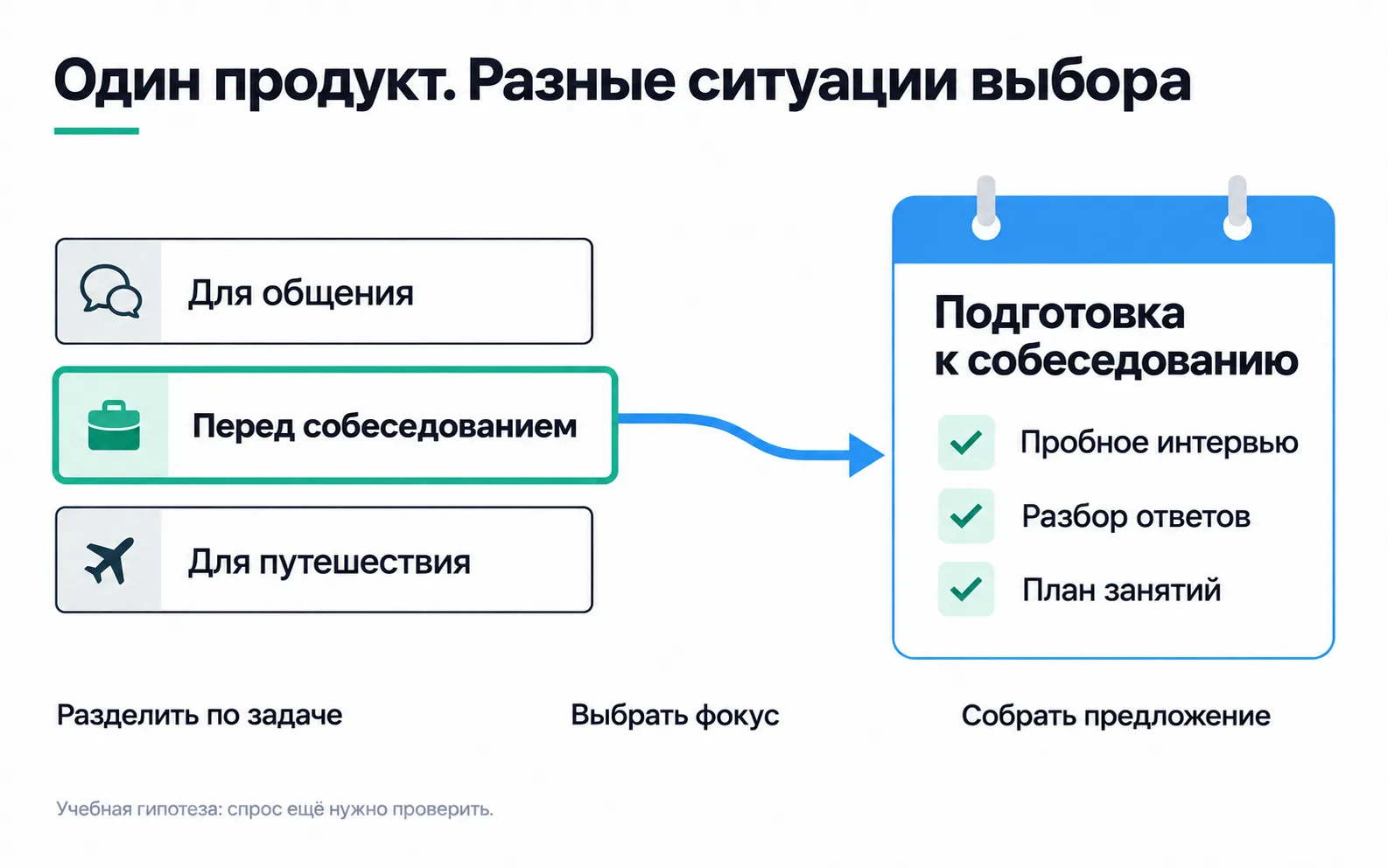
The picture shows the same three steps at an ordinary language school. Out of three things its adult students want, it picks interview preparation and builds an offer around it.
A segment is a shared job, not an age bracket
Age, gender and district are easy to pick in an ad account, but the course doesn't change with them. A graduate applying for a master's in the UK and a peer planning to work in Canada fall into the same age bracket, yet they need preparing for different exams. IELTS comes in two versions: Academic for university study, and General Training for migration, work and study below degree level (which version is for what). Listening and Speaking are the same in both, but Reading and Writing differ, so these two need different materials and most likely different groups.
A segment is useful when it changes your decision: what you sell, what you say or where you look for people. So you split by why the person needs the course and by when. Age and district come in only if something depends on them, such as the timetable.
The centre had never done any research, so the jobs came from the chats. In the very first message, the centre's manager asks why the person needs IELTS and when the exam is. The marketer read the last 120 leads in the CRM and WhatsApp and tagged each one by the answer. Four groups came out:
| Segment | Job | Deadline | Who decides | What changes for the centre |
|---|---|---|---|---|
| Applying to a university abroad | Get an IELTS Academic score for admission | Exam booked to meet the application deadline | The applicant or their parents | A preparation plan built back from the exam date |
| Relocating or going abroad to work | Pass General Training | Each has their own | The person themselves | Different Reading and Writing, evening groups for people who work |
| Schoolchildren "for later" | Brush up their English, IELTS some day | No date | Parents | A long course, talking to the parents rather than the student |
| Need English, not IELTS | Speak at work or when travelling | None | The person themselves | The centre has no such course |
And here is how many people from each group got as far as paying:
| Segment | Leads | Came to the trial lesson | Paid |
|---|---|---|---|
| Applying to a university abroad | 40 | 16 | 7 |
| Relocating or going abroad to work | 30 | 6 | 2 |
| Schoolchildren "for later" | 20 | 5 | 1 |
| Need English, not IELTS | 30 | 3 | 0 |
| Total | 120 | 30 | 10 |
Overall it's the centre's usual picture: one lead in four comes to the trial lesson, and one in three of those pays. Inside, the groups differ. 7 of the 40 applicant leads paid, against 2 of the 30 relocator leads. The gap catches the eye, but numbers this small can't prove it: had five applicants paid and four relocators, the rates would be almost level. What is clear is something else: 30 leads out of 120, one in four, came from people the centre had nothing to sell to.
Which segment to take first
Targeting in STP is deciding who gets your money and effort first. To make that call, run each segment through four questions:
- Do these people share a job? If one offer suits the whole group, one ad can speak to all of it.
- Can you reach them? You know where they look and what they need to see. Applicants search Google for IELTS prep themselves and recognise themselves in an ad about the exam date. Schoolchildren "for later" have to be reached through their parents, and the ad would be for the parents.
- Does the business solve their job? The centre has a programme and teachers for Academic. General Training needs other materials, and for conversational English there is nothing.
- Will advertising pay off? The segment brings in enough payments that ads aimed at it don't cost more than the business is willing to pay for a customer.
The OpenStax marketing textbook has a similar list: you can reach the segment at an affordable cost, it differs from its neighbours, you can build a profitable strategy around it, it can be measured, and it is big enough.
The last question is answered in money. The centre keeps 48,000 ₸ per student over three months, and the owner is willing to spend up to half of that, 24,000 ₸, on advertising. If all 120 leads had come from ads at the planned 2,000 ₸, they would have cost 240,000 ₸ and produced 10 students, exactly 24,000 ₸ each. No headroom at all. On top of that, a quarter of the budget, 60,000 ₸, would have gone on people who wanted conversational English. The applicants' leads would have cost 80,000 ₸ for 7 students, about 11,400 ₸ each.
The centre starts with applicants. They share a job and a deadline, they look for prep themselves, the Academic programme already exists, and the small numbers at least don't contradict the choice. For the pilot, the rule fits on one line: applying to a university abroad, taking Academic, exam within the next three to four months. The centre doesn't turn everyone else away at the door: if someone taking General Training writes in on their own, the manager will talk to them, and anyone who wants conversational English hears straight away that there is no such course, which spares the manager half an hour of chat. But the ads, the website copy and the manager's first message are written for applicants, and the centre will come back to General Training once it has enough people for a separate group. OpenStax calls a bet on one segment concentrated marketing and links it to smaller companies with limited resources.
Choosing a segment vs. setting up the ads
"Targeting" is also a word from every ad account, so choosing a segment is easy to confuse with setting up an audience. Meta has no checkbox for "applying to a UK university, exam in March". In an Advantage+ audience, the only hard limits are location, minimum age, languages and exclusions (audience controls and suggestions). Age, gender and custom audiences can be made hard limits separately, but when you optimise for leads, Meta still expands interests such as "studying abroad" if it expects more leads from other people (how Meta expands interests). None of these settings tells an applicant from a relocator. The ad itself does the selecting: copy about Academic and an exam date stops the applicant, and everyone else scrolls past. That is how this centre's lead test in Meta works too: a broad audience across Almaty and three creatives about exam prep.
Two other things get mistaken for choosing a segment. The first is to borrow the audience of the biggest language school in town: the same interests, the same ages. Its audience is huge, but its students came for conversational English, and the size of that audience says nothing about whether they need your course. The second is to start with a slogan for everyone, like "English for everyone", and only then look for who needs it. The applicant and the relocator are each looking for something different, and a generic line hooks neither. In the example from the Meta auction breakdown, a competitor's banner like that loses the impression to the centre's ad about an IELTS trial lesson, even though the competitor is willing to pay more per lead.
Positioning: why they will choose you
With the segment chosen, the centre now needs positioning: the place among the other options it wants to hold in these people's minds (positioning in the OpenStax textbook). For applicants, the core of the centre's positioning is a plan built back from their date, rather than working through the textbook in order, as they would preparing on their own. They can see this before paying, at the free trial lesson.
The segment decision is written down together with the condition for revisiting it. For example: if after a month of ads aimed at applicants a lead costs more than 2,000 ₸, the centre goes back to the segment table. Without a condition like that, a choice is easy to defend forever.
Exercise: STP for your own project
Take your own project, the business from the Start track, or a business you know that takes leads in WhatsApp.
If your segments came out as "women 25-35" and "men 35-45", you split people by a form, not by the job they need done. Ask yourself what the business would do differently for those groups. If nothing, it's one segment. If the same person lands in two segments at once, the rule is fuzzy. At the centre, a final-year school student applying to a university abroad belongs with the applicants, not with the schoolchildren "for later": they have an exam date, and the deadline decides, not the age.
If your positioning names no other option you're compared with, what you have is a description of a service. Add what the person would do without you. And don't pick a segment on five leads per group: a difference of one payment there may well be chance. With small numbers, the choice rests on the customer's job and on what the business can do, and the figures only show whether they contradict it.
Video: the three STP decisions
While you watch, keep the IELTS centre in mind and pull three things apart: how people are split into groups, who the money goes to, and what those people are promised.