The owner of an IELTS prep centre in Almaty wants to double the ad budget aimed at people applying to universities abroad. He has a reason: of the centre's last 120 leads, 40 came from applicants, and seven of them have already paid for the course. Sixteen turned up to the free trial lesson, more than the centre usually gets, but nobody has looked at why the other 24 did not. If they were lost after the ad did its job, a doubled budget will double the losses too.
The marketing mix is a handy way to find where people drop out: the 4P model and its 7P extension. These are the seven decisions an offer is made of, and each has an owner inside the company. Let's lay out the centre, which has already chosen its segment, along those lines and see where the 24 people went. The numbers in this lesson are illustrative.
4P: four decisions about the offer
4P stands for Product, Price, Place and Promotion. The OpenStax textbook describes Place as the decision about how and where the product reaches the buyer, and for a course that is first of all the timetable. The address is only part of it.
For the centre, the four decisions look like this:
| Decision | What the centre has decided | Who decides |
|---|---|---|
| Product | Three months of IELTS Academic prep: a plan built back from the exam date, speaking answers reviewed, mock exams | Owner and teachers |
| Price | 45,000 ₸ a month, paid monthly, the trial lesson is free | Owner |
| Place (availability) | Classrooms in the city centre, trial lesson booked through the site or WhatsApp | Owner |
| Promotion | Instagram ads across Almaty and Google search ads, promoting the trial lesson and the plan to the exam date | Marketer and media buyer |
This table is worth filling in on the first call with a client, before anyone talks budget. Half an hour of questions shows what in the offer is settled, what is up in the air, and who to go to if the problem is not the ads. The last column matters most. A marketer will not rewrite the syllabus or open a new classroom, but they need to know who can.
What 7P adds
Someone buying a course gets three months of classes with real people, and how those classes go matters as much as the price. That is why services add three more Ps to the four: People, Process and Physical evidence. They are described below the way the UK's Chartered Institute of Marketing (CIM) explains them.
People. Everyone who deals with the customer: the manager writing on WhatsApp and the teacher at the trial lesson. CIM points out that many customers cannot separate a service from the person who provides it. For someone at the trial lesson, the course is the teacher who has just gone through their speaking answers.
Process. The steps the customer goes through. At the centre: the lead, a message from the manager within the hour, a trial lesson with a level test and a speaking review, payment for the first month, the plan to the exam date, mock exams and payment for the following months. Speed of reply to a lead belongs here too.
Physical evidence. Everything a person can see before and during the purchase to understand what they are paying for: a sample plan on the site, the level test result after the trial lesson, 2GIS reviews, the classrooms themselves. A service cannot be touched in advance, and in CIM's words the buyer needs help to "see" it.
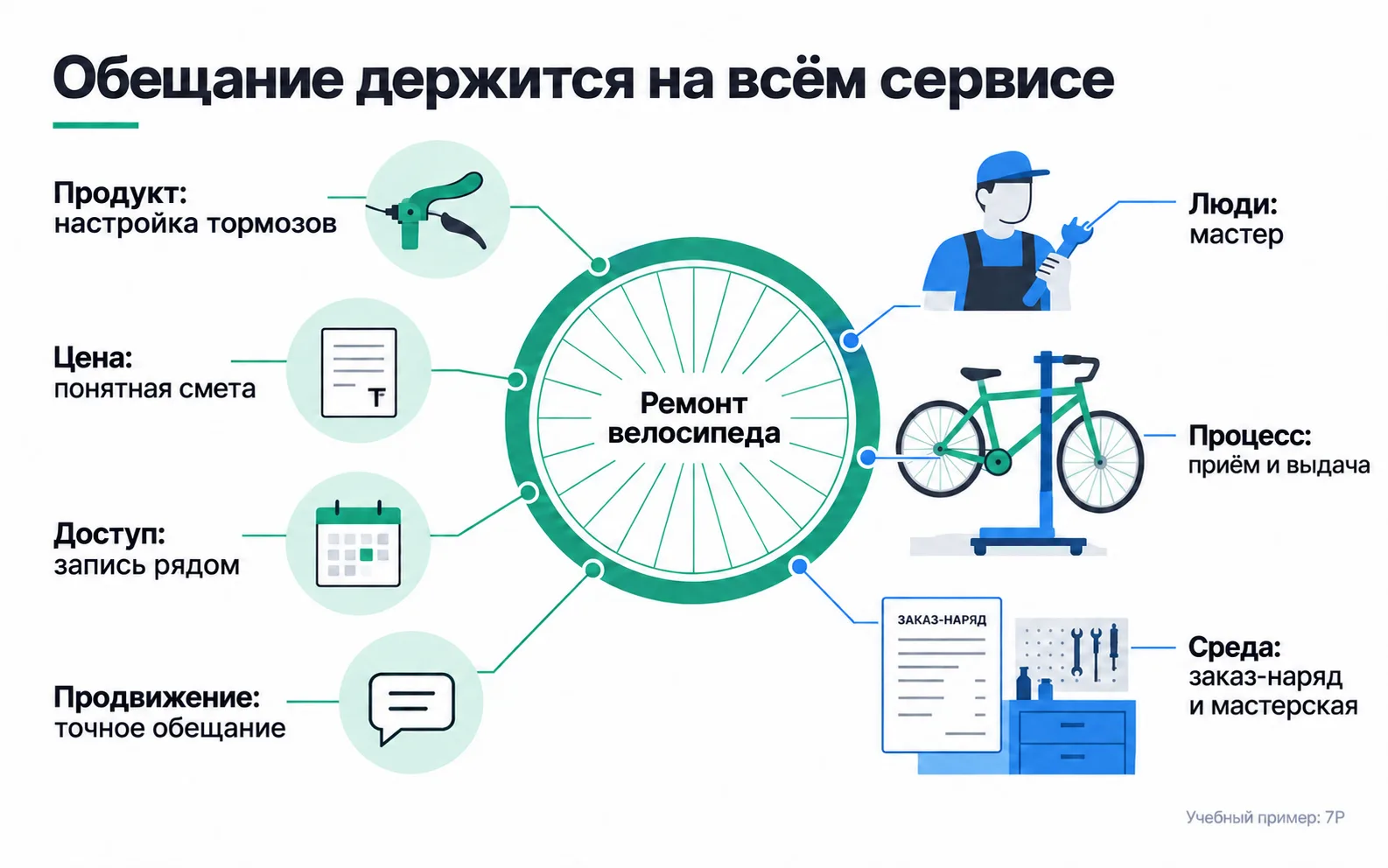
The picture shows the same seven decisions at a bike repair shop.
Where the model helps: 24 leads that never reached the lesson
Back to the 24 applicants who submitted the form and did not turn up. The manager notes in the CRM how each conversation ended, and those notes sort the leads into the 7P rows:
| What the manager noted | Leads | 7P row | Who decides |
|---|---|---|---|
| Replied that they are applying, then vanished after the invitation to a trial lesson | 9 | Process or promotion | Sales, media buyer |
| Too far to travel: live in outlying districts, over an hour each way | 7 | Place | Owner |
| Next free trial lesson a week or more away | 4 | Place and process | Owner and teachers |
| Already preparing with a tutor or at another centre | 4 | None: the person has already chosen | - |
| Total | 24 |
The last row is the easiest. Four people have already picked a tutor or another centre, and why they picked someone else the model will not tell you. The centre competes for people like that through positioning: what it gets compared with and how it wins that comparison.
The nine who vanished are the biggest group and the one we know least about. The model offers two explanations and does not choose between them. If the invitation went out half a day later or the lesson time was inconvenient, the process is broken, and the chat shows it. If they were invited straight away and still disappeared, look at what the ad they came from promised. Until someone rereads those chats, the nine leads belong to no row at all.
That leaves eleven people who wanted to come and could not: seven live too far away, four could not get a slot within the week. In practice this is one problem. The course exists, but people cannot get it where and when it suits them.
Place: they want to buy but cannot get it
If people want to buy but cannot get the product (the courier does not deliver to their district, the centre is over an hour away, the next lesson is a week out), the work belongs to Place, meaning availability and distribution. More ads will not help, and neither will a discount. Ads will bring in more people in the same position, and a discount will not shorten the journey or free up a slot in the timetable.
There are two kinds of decision here, made by different people.
The media buyer can stop inviting people the centre cannot serve. In Meta, a location can be set as more than a city: you drop a pin on the centre's address and adjust the radius. It takes minutes, and there will be fewer leads from distant districts, though not zero: Meta also shows ads to people who were recently inside the circle, for example because they work in the centre. If all 40 applicant leads had come from ads at the planned 2,000 ₸, the seven "too far" ones would have cost 14,000 ₸.
But that only stops the centre paying for people it cannot serve. Selling them a course takes a decision about availability, and that is the owner's call: open an online group, run trial lessons more often, rent a second classroom closer to the residential districts. There is no online group yet, so the manager puts anyone who still gets in touch from a distant district on a waiting list, which shows whether a group would fill. An extra day of trial lessons costs teacher hours, but it answers directly the reason those four people gave.
The marketer's job is to bring the owner the table and say how many people hit each constraint. Eleven people are too few to predict how many would buy if the constraint were removed. But one thing is clear: 11 of the 24 losses come down to availability, and more ad money will not take that wall down.
Where the model misleads
The model tells you where to look but does not explain what happened, and it easily turns into an argument about letters. The trial lesson booking form belongs to both place and process; reply speed belongs to both people and process. Half an hour spent debating which row to put it in changes nothing for the person who got their invitation half a day late. What matters is that the row has an owner and a next step.
And all seven Ps are the seller's decisions, while the buyer compares the centre with a tutor, YouTube and the school down the road, and none of those comparisons is in the table.
Exercise: a 7P table for your own project
Any business will do where someone will show you the last 20-30 leads along with the chats: your own project, a client or a company you know.
If "marketer" appears in almost every cell of the "who decides" column, you filled the table in through a marketer's eyes. Price and the timetable are not the marketer's decisions, and the managers do not report to them. The owner should see which person on their team each row goes to.
If the biggest group turns out to be people who vanished after the first step, do not assign them to any letter until you have reread the chats: they tell you whether this row goes to sales or to the media buyer. If you found a "wanted to but could not" group, that is Place, and your third sentence to the owner reads something like: "Another N people are blocked by availability: the address, the timetable or delivery. Ads will not bring them back; it needs a decision about where and when a customer can get the product."
And if you have fewer than twenty leads, the groups will hold two or three each. That is enough to name the places to look, but not to compare groups in percentages.
Video: the marketing mix explained
Keep one service of your own in mind: for each P the video covers, note who on your side is responsible for it.