After a five-day Meta test, a junior marketer at an IELTS prep centre sends the owner an AIDA report: attention 12,000, interest 171, desire 11, action 3. It looks tidy, four letters and four numbers, each smaller than the last. Except that 12,000 is impressions, and nobody knows how many people behind them actually noticed the ad. And the "action" row holds the three people who came to the free trial lesson, while the centre pays for ads to get course payments.
A model about the message has been stretched over the numbers in a report, and now neither the model nor the numbers are much use. AIDA, the customer path and the funnel are three different tools. AIDA helps you write and review a message. The customer path shows how a person really made the choice. The funnel counts how many actions or people fall on each step that can be counted at all. Let's go through all three on the same test; the numbers in this lesson are illustrative.
AIDA: four questions to ask of an ad
AIDA stands for Attention, Interest, Desire, Action. The OpenStax textbook covers it in the chapter on personal selling and calls it one of the most common consumer response models. The same page says marketers plan ad campaigns around it and salespeople build scripted pitches on it. Today it is a handy way to review an ad and the first screen of a site: by the end, the person should have an answer to each letter's question.
Here is the "Problem" ad from the test and the first screen of the site it leads to:
| Letter | The person's question | What answers it at the centre |
|---|---|---|
| Attention | Is this about me? | The ad's first line: "Pauses in speaking cost you points" |
| Interest | What am I being offered? | IELTS Academic prep on a plan built back from the exam date |
| Desire | Why should I believe it? | A free trial lesson with a level test and a speaking review |
| Action | What do I do now, what does it cost and what happens next? | A "Book a trial lesson" button, the course price above it and the line "A manager will message you on WhatsApp within the hour" below it |
The model is most useful when you write a brief for a designer or pick apart someone else's creative. If the "desire" row says "experienced teachers", there is no answer to "why believe it": any centre could say that about itself. If the "action" row says only "Submit", the person does not know what happens after the click. At the centre the table finds one more hole: the "Problem" ad itself has no price; only the site shows it. AIDA cannot tell you whether the ad will work; the leads will show that. But it finds the empty row before you have paid for impressions.
Why the letters cannot label the numbers
The temptation is easy to see: a funnel also has several steps, each narrower than the one before. But AIDA describes what should happen in a person's head, while a report counts what the system saw. Here is the funnel for the same test, with the source of each number:
| Step | Count | What it counts | Where the number comes from |
|---|---|---|---|
| Impressions | 12,000 | Times the ad reached a screen | Ads Manager |
| Link clicks | 171 | Clicks; one person may have clicked twice | Ads Manager |
| Leads | 11 | People who left a number | Your own lead list |
| Replied on WhatsApp | 7 | People a conversation started with | The manager's chats |
| Came to the trial lesson | 3 | People | CRM |
| Paid for the first month | 1 | People | Assumption based on the centre's history |
The payment is assumed the same way as in the metrics glossary: there was none during the five days of the test, but by the centre's history one in three of those who come pays for the course.
An impression is not attention: a person may scroll past without noticing, or see the ad three times. A click is not interest; some people tap by accident. And a lead is not a desire to buy the course: this same centre has seen people leave their number for a free checklist without a thought of the course. Label 12,000 impressions as "attention" and a 1.4% CTR starts being read as the share of people who got interested, when it is a share of impressions.
Each step of the funnel has its own denominator. 11 leads out of 171 clicks is 6.4%, 3 attendees out of 11 leads is 27%, and one payment per 12,000 impressions is less than a hundredth of a percent. Without the denominator, "27% conversion" means nothing. A funnel shows at which step people are lost, but not why. Eleven leads are too few to name a cause, so funnel analysis records it as a hypothesis and plans how to test it.
The customer path loops
A funnel lines people up in a queue of steps, but a real path loops. In the picture, the buyer opens the syllabus, goes off to read reviews, comes back to the syllabus, then visits the site once more and only then pays.
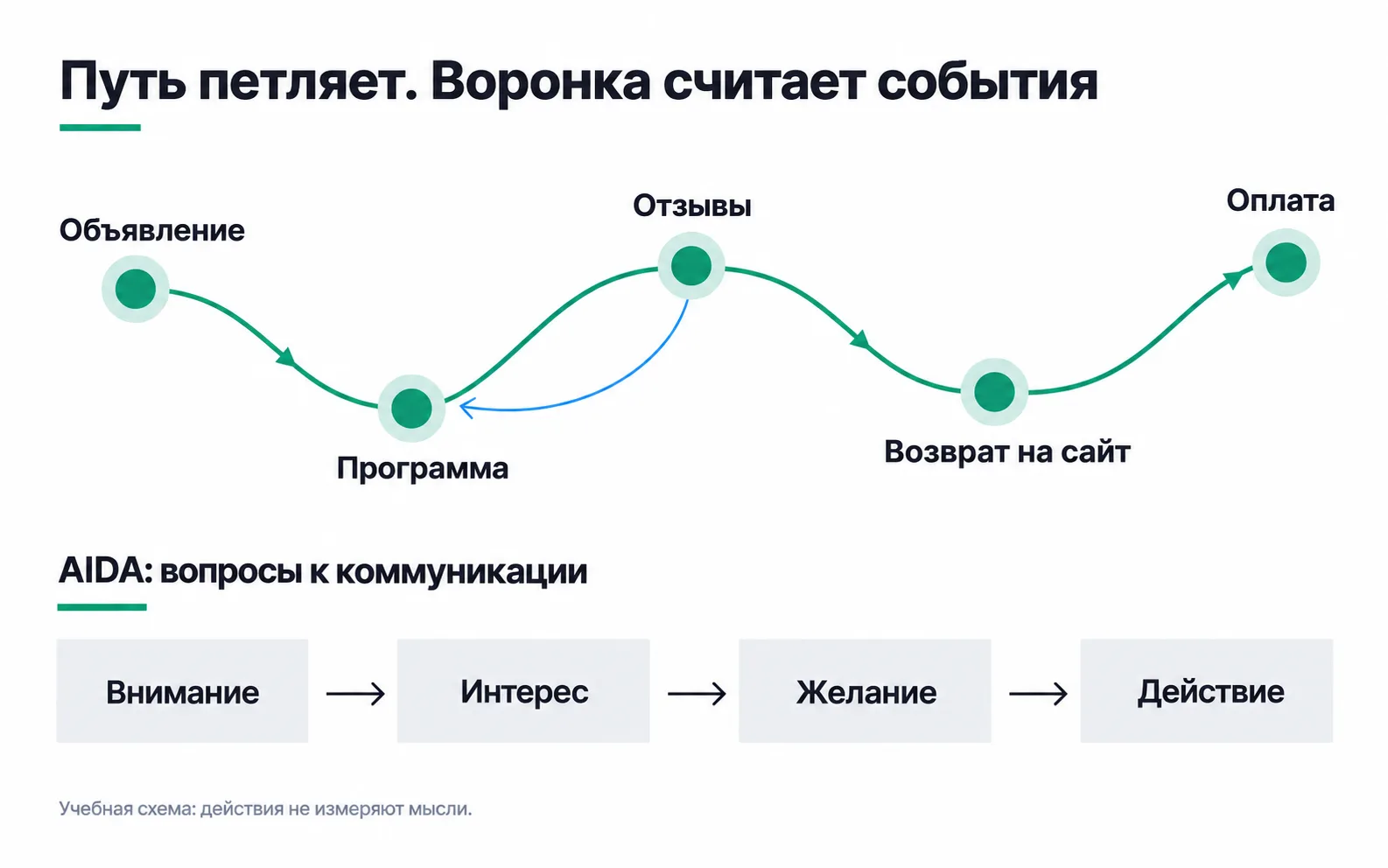
The centre gets paths that never show up in the test report. Say a student saw the ad on Instagram and did not tap it. A week later she asked a friend who had studied at the centre, read the 2GIS reviews, found the site through Google and messaged the manager on WhatsApp. Ads Manager will not have this lead: there was no click, and she did not submit the form. GA4 will record a visit from search. The CRM will get a chat with no source, unless the manager asks how the person heard about the centre.
Even among the test's eleven leads, not every path started with the ad. One person visited the site from Google search before clicking the ad, and attribution models split a lead like that between channels in different ways.
Some models do not pretend the path is straight. The analyst Avinash Kaushik proposed the See-Think-Do framework on his blog, which groups the audience by intent: people who simply fit the product (See), people already thinking about buying (Think), people buying now (Do). He keeps people who buy from you repeatedly as a separate group. The author himself admits that buying does not always move through the stages as neatly as the diagram suggests, and says AIDA looks at buying through the eyes of the marketing department. For the centre this is a useful correction. A final-year school student sitting IELTS in a year sees the same ad as someone with the exam in three months, but they are at a different stage, and inviting them to a trial lesson is premature.
A purchase opens the next stretch of the path
AIDA ends at action, while for the centre the main part starts after the first payment. The course is paid monthly, the centre keeps 16,000 ₸ a month per student, and the owner is willing to spend up to 24,000 ₸ on ads per student. By the calculation of what a student may cost, the ads pay back only in the second month, and a student who leaves after the first one is a loss.
The second and third payments depend on the classes; the ad no longer has any say. This stretch has a feedback loop too: a student who kept to the plan writes a 2GIS review, and that review becomes someone else's "desire" on the next round. The funnel from the first month to the third is built separately and counted by the month in which people started studying, as in cohort analysis.
Which tool for which job
| Job | Tool | Where the data comes from |
|---|---|---|
| Review an ad or a first screen | AIDA: an answer for each letter | The creative and page copy |
| Find the step where people are lost | A funnel with denominators | The ad account, the lead list, the CRM |
| Understand how a person chose | The customer path | Conversations with customers, a "how did you hear about us" field in the CRM |
| Split credit between channels | Attribution | GA4 and the ad accounts |
The confusion starts when one row answers another row's question: the funnel gets labelled with AIDA letters, and attribution gets mistaken for the customer path.
Exercise: AIDA, a funnel and three real paths
You need a campaign where you can see both the ad and the leads, such as the week 2 test from the Start track.
Replace a "desire" row made of adjectives with something the person can check before paying: at the centre, the trial lesson with a speaking review. If a funnel step has no source, within a month it will fill up with ad account events instead of people from your list.
And if a customer's path does not match the source in the report, nothing is broken: the report sees only the touchpoints the system recorded. Note the gap next to the report and, if leads come in on WhatsApp, ask the manager to ask everyone how they heard about the company. Three conversations are too few to judge which channel works better. But they are enough to show the client what their report cannot see.
Video: applying AIDA
Along the way, mark where the talk is about the message copy and where it is about a step you can count, and write down the numerator and denominator for every number.