In October, 37 people paid for the course at an IELTS prep centre in Almaty, about half the trial lesson seats were taken, and yet there was no extra money at the end of the month. The teachers want a raise, a centre in another district advertises a "7.0 Guarantee", and the owner wants to cut the price from 45,000 to 40,000 ₸ a month "so people stop leaving for the competition". Before touching the price, work out who is actually taking money from the centre. The centres down the road are only one side out of five.
Porter's five forces split the pressure on profit into five directions: rivalry among those already in the market, new entrants, substitutes, buyers and suppliers. The Institute for Strategy and Competitiveness at Harvard Business School describes the model as a way to understand the forces at work in an industry and how the money gets divided among the players in it.
The course runs for three months. After paying the teacher and for materials, the centre keeps 16,000 ₸ per student per month. October's 37 students are 14 from the August intake, 11 from September and 12 new ones (the centre's cohort table), so October's contribution is 592,000 ₸, and rent and the administrator's salary still come out of that. The figures in this lesson are illustrative.
The diagram shows the same five forces for language courses in general.
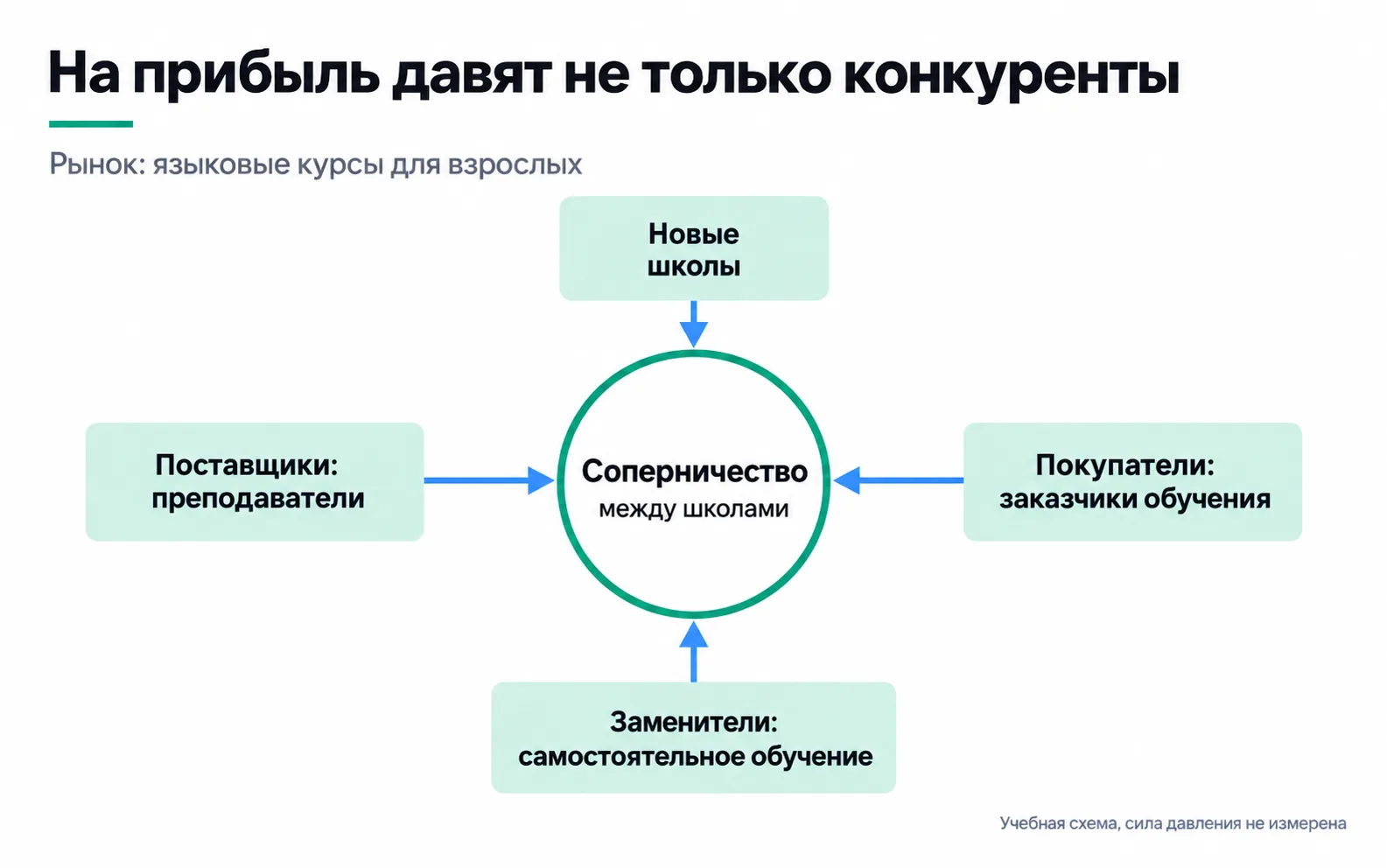
Draw the market boundary first
Who counts as a rival and who as a substitute depends on where you draw the boundary. The centre wrote it down like this: paid IELTS preparation for people living in Almaty, offline and online. Inside the line are other centres, language schools with IELTS groups, and private tutors. Outside it is everything that does the same job without paid preparation: books, videos, apps, free practice tests.
Narrow the market to group courses and the tutor moves from rivals to substitutes. The numbers stay the same; only the column you file the tutor under changes. So the boundary goes in one line above the table and stays put for the whole analysis.
It is better to ask customers who they really compare you with. At the trial lesson the centre's manager asks how the person prepared before and records the answer in the CRM, in a "how did you prepare before us" field that the centre set up when it chose its positioning. Of the first 20 university applicants, 11 had prepared on their own, 6 had worked with a tutor, and only 3 had been to another centre. For these people the main alternative is not the centre down the road at all.
The five forces at the centre
Rivalry: three competitors and the temptation to cut prices
The centre has three competitors: a language school with an IELTS group advertising "English for everyone" at 35,000 ₸ a month, the centre in another district with its "7.0 Guarantee", and a tutor with a blog called "IELTS from zero to 7.0". According to HBS, rivalry gets fiercer when competitors are numerous or roughly equal in size, the industry grows slowly, and high fixed costs create an incentive to cut prices.
Let's run the owner's numbers. At 40,000 ₸ the centre keeps 11,000 ₸ per student per month instead of 16,000, because the teacher's pay stays the same whatever the discount. To earn the same 592,000 ₸ it would need 54 students instead of 37 (592,000 / 11,000 = 53.8). That is almost half as many again, while the centre runs two trial lessons a week with eight seats each. The eight seats hold only while two teachers work each lesson, since the centre's rule is no more than four people per teacher. Growth runs into exactly those seats. The language school can answer with a discount of its own, and then the centre is left with a smaller contribution and the same number of students.
The centre answers rivalry with something the rivals lack rather than with price. None of the three promises a preparation plan built around the exam date in its ads.
New entrants: a tutor only needs an account
HBS lists the barriers to entry: economies of scale, the cost of building brand awareness, access to distribution channels, government restrictions. A new centre needs premises, an administrator, a timetable and reviews on 2GIS. A tutor needs a certificate with a high score, Instagram and a video call, so for tutors the barrier is close to zero.
One of the centre's own teachers could easily become a new entrant. The teacher knows the programme and the students, and the students know the teacher. If that teacher starts a blog and takes five students along after the first month of the course, the centre loses 5 × 2 × 16,000 = 160,000 ₸ of contribution for the two remaining months. The centre has no way to forbid anyone to leave. What it can do is make sure the value of the course rests on more than one person. The plan built around the exam date, the mock exams and the speaking review template should belong to the centre, and more than one teacher should be able to run the review.
Substitutes: self-study costs nothing
HBS says a substitute is a threat when it offers an attractive price-performance trade-off and switching to it costs the buyer little. Self-study is free, and there is nothing to switch. That is exactly where more than half of the first twenty applicants started.
But those people came to the centre in the end, so somewhere self-study let them down. The applicants name the spot themselves: pauses in speaking cost them points, and nobody hears their own mistakes without a teacher. The centre holds its ground against the substitute on exactly this. Free speaking graders already exist, but they do not yet show where a person loses points against the IELTS criteria, and the centre tracks them in its PESTLE.
There is a substitute of a different kind too: another exam. If the university an applicant is aiming for accepts tests other than IELTS, the applicant may not need IELTS preparation at all. The list of accepted tests is on the university's website.
Buyers: they pay monthly and decide again every month
A single student has no power to dictate terms to the centre. But HBS says buyer power is high when offers barely differ and moving to another seller costs almost nothing. Monthly payment makes moving free: every month the student decides again whether to keep paying. Of the 20 people in the August intake, 16 paid for the second month and 14 for the third.
Each student who left after the first month brought the centre 16,000 ₸ of contribution, while the centre is prepared to spend up to 24,000 ₸ on advertising per student (how that ceiling was worked out), so that student never paid back the ads. On top of that, some applicants have the course paid for by their parents, and according to the manager, the first thing parents ask about is the monthly price.
The centre's answer is a mock exam at the end of every month. Then the student and the parents decide about the next month on the basis of scores, not price alone.
Suppliers: teachers, rent and ad platforms
The centre's strongest suppliers are its teachers. HBS calls a supplier powerful when only one or two can provide an essential input, or when switching suppliers is expensive or slow. A teacher with a high score who can review speaking takes more than a week to find, and replacing one mid-course hits the very students who are deciding whether to pay for the next month.
Now the teachers' request in numbers. An extra 3,000 ₸ per student per month comes to 111,000 ₸ in October (37 × 3,000). Contribution per student falls from 16,000 to 13,000 ₸ a month, and, under the centre's plan where everyone finishes, from 48,000 to 39,000 ₸ over the course. If the owner still spends half of the contribution on ads, the ceiling per student drops from 24,000 to 19,500 ₸, and the maximum cost per lead, at 12 leads per student, from 2,000 to 1,625 ₸. The media buyer will be the last to hear about it, even though their plan is the first thing to change.
The other two suppliers are the landlord and the ad platforms. The centre does not set its own cost per lead in Meta or Google. The ad auction sets it, and there the centre competes with everyone who wants to show ads to the same people.
Template: the five forces in one table
Bring the analysis together in a table. Any row where a tenge figure can be worked out should have one, because that figure shows where to start.
| Force | Who it is for the centre | Observation and source | What it costs | The centre's response |
|---|---|---|---|---|
| Rivalry | Language school, the "7.0 Guarantee" centre, tutor | Prices and promises on Instagram and 2GIS | A price of 40,000 ₸ needs 54 students instead of 37 | Leave the price alone, sell the plan built around the exam date |
| New entrants | Tutors, including the centre's own teachers | The "IELTS from zero to 7.0" blog signs up students without premises | Five students leaving after month one: 160,000 ₸ of contribution | The plan, the mock exams and the review template stay with the centre |
| Substitutes | Self-study, another exam | More than half of the first applicants prepared on their own, CRM field | Can't be costed: the substitute is free for the customer | A speaking review nobody can do alone |
| Buyers | Students and their parents | August: 20, 16 and 14 payments by month, CRM | A student leaving after month one brought 16,000 ₸ against up to 24,000 ₸ of ads | A mock exam at the end of every month |
| Suppliers | Teachers, landlord, Meta and Google | Request for 3,000 ₸ more per student | 111,000 ₸ a month, leads no dearer than 1,625 ₸ | Cost the raise together with the ad plan before answering the teachers |
The largest monthly figure is the teachers' request, 111,000 ₸. Five students following a teacher into private tutoring would cost 160,000 ₸, but over two months, and for now it is only a risk. Cutting the price would cost more, 185,000 ₸ a month with the same 37 students, but that is the owner's own decision rather than market pressure, and the owner can simply decide against it. The discussion started with competitors, and the first item in the queue turned out to be a conversation with the teachers.
Don't give the forces "high, medium, low" ratings and add them up into a total like 17 out of 25. The total looks precise, but there is no method behind it, and it points to no decision. A tenge figure with its source next to it does.
Where the model lets a small business down
The five forces describe an industry. In HBS's words, they determine the competitive structure of an industry and its profitability. A centre with 37 students has no influence on the industry, and its money depends far more on how many trial attendees pay and how many students stay to the third month. For a small business the model works as a list of dependencies: who can raise your costs, take your customers or replace your product. Whether IELTS preparation is a good business to be in is a question it leaves open, and the answer would not change your plan for next month anyway.
The table is also a snapshot. HBS notes separately that changes in regulation can change both the intensity of rivalry and the barriers to entry. External shifts like these are easier to catch with PESTLE and SWOT, and the forces table gets rebuilt when one of them moves.
Exercise: the five forces for your own project
Take your own project or a business you work with.
Take the buyers row first. "Customers want it cheaper" is an impression rather than an observation. Find the people who left in the CRM and see after which month they left and what they said. If the substitutes row is empty, reread what your five customers said about how they managed before you. Anything other than a paid service in your market is a substitute, including "did nothing".
If the same player ends up among both rivals and substitutes, your market boundary is blurred, so rewrite it. And if the largest figure belongs to a decision of your own, like the centre's price cut, strike it from the forces. That is a choice rather than market pressure, and it should be weighed against what comes from outside.
Video: the five forces
While you watch, slot the players from your own market into each force.