In November the owner of an IELTS prep centre in Almaty is deciding where to put money next year and asks the marketer for a SWOT by Friday. The first draft takes half an hour: "experienced teachers" under strengths, "small budget" under weaknesses, "launch TikTok" under opportunities, "competitors" and "a crisis" under threats. Not one item says what to do in December. A SWOT like that could be written about any school in the city without opening the CRM.
A SWOT is four lists. Strengths and weaknesses describe the business itself, the things it can change. Opportunities and threats are what happens outside and does not depend on it. PESTLE helps you look for that outside world in six directions: political, economic, social, technological, legal and environmental (the list as the CIPD gives it). Below, both tools are filled in for the centre, whose course runs for three months at 45,000 ₸ a month and which had 37 paying students in October. The figures in this lesson are illustrative.
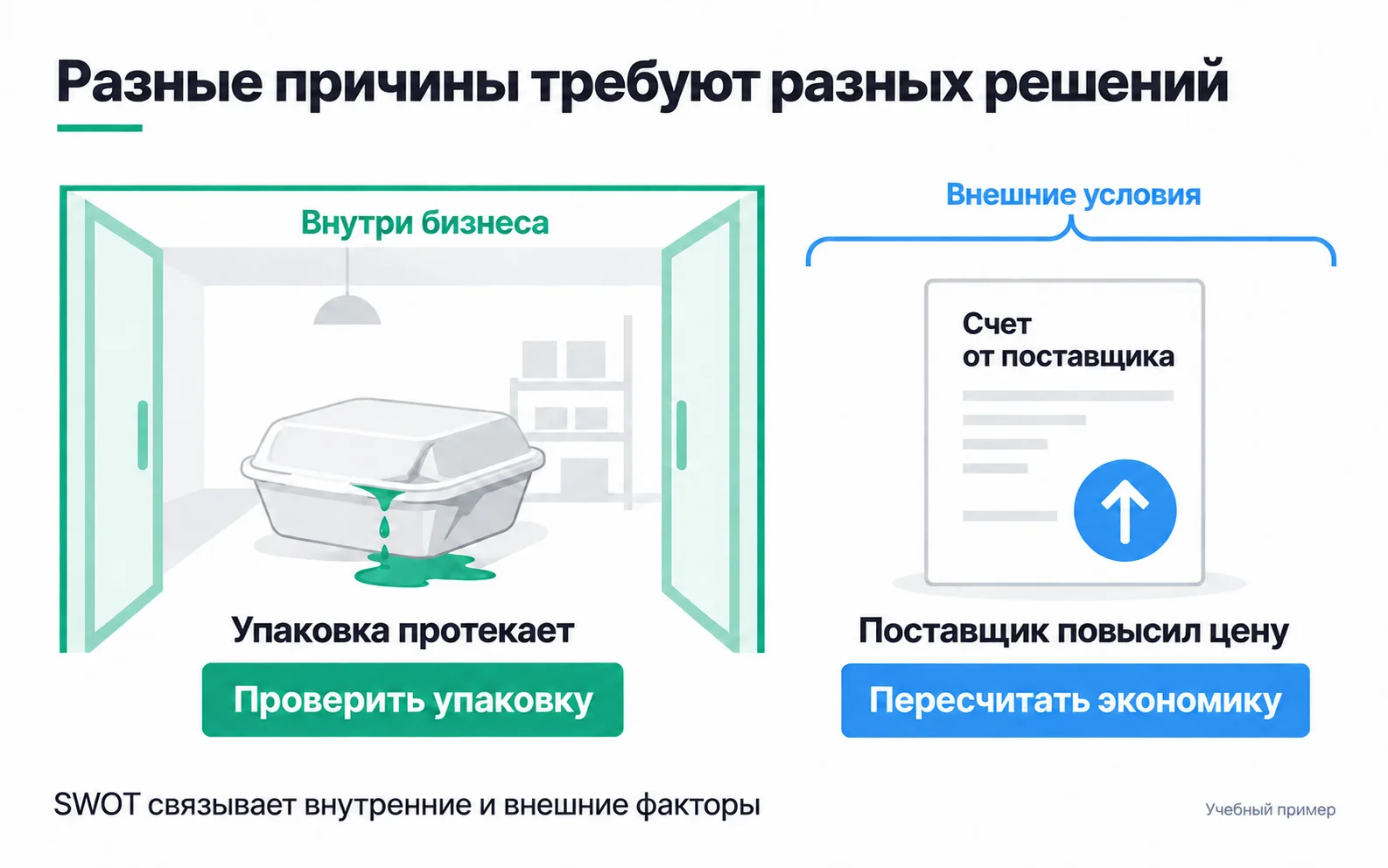
The picture shows the main rule on a different business, lunch delivery: two problems with different causes call for different fixes.
Goal first, then the four lists
The same fact can help one goal and hurt another, so a SWOT starts with a goal written as a number. For the centre it is this: next year, enrol 20 students a month in the Academic groups, as in August, and pay no more than 2,000 ₸ per lead. Right now 12-15 new students arrive each month.
Every item then goes through two questions. Can the centre change it? If yes, it is a strength or a weakness; if no, an opportunity or a threat. And does it help the goal or get in the way?
Sometimes a fact lands in two places at once. Only one senior teacher can run the speaking review the way applicants praise it. That is a strength, since the review is why people choose the centre. It is also a weakness: if the teacher leaves, the difference leaves too. Write the fact into both parts, because each leads to a different decision.
Actions do not go into a SWOT at all. "Launch TikTok" is something the centre can do, and nothing about it happens outside. An opportunity would be an observation such as "applicants look for prep courses on TikTok and competitors don't advertise there", and even that would need confirming. An action with no outside fact behind it got into the table out of habit rather than from analysis.
PESTLE: what outside could shift the plan
PESTLE easily turns into a news digest. To prevent that, each letter gets one question: which number in the centre's plan for the year would this change? The CIPD also warns that capturing too much data can lead to paralysis by analysis, and advises repeating the review regularly.
| Factor | What the centre watches | Where to look | What it changes in the plan |
|---|---|---|---|
| Political | Student visa and admission rules in the countries applicants are going to | University and embassy websites | If a country tightens admission, demand for Academic among those heading there may fall |
| Economic | The tenge exchange rate: studying abroad is paid in foreign currency | The National Bank's exchange rate | If the tenge weakens, some families may put off applying, so watch applicant leads month by month |
| Social | Who decides on the course: the applicant or the parents | A CRM field | Parents need different ad copy and a different time for the call |
| Technological | Free tools that check essays and analyse spoken English | Try them yourself, ask students | If they start showing where a person loses points in speaking, the centre loses one of its two differences |
| Legal | Personal data in leads, licensing and ad language, bloggers' posts, taxes | adilet.zan.kz, egov.kz, kgd.gov.kz | Rules below, questions for a lawyer and an accountant |
| Environmental | Nothing for the centre | - | An empty row beats an invented one |
The "Technological" row is no longer hypothetical. Free speaking graders already exist: Speak & Improve, a research project from Cambridge English, gives a score on the CEFR scale after each part of a test for free. Its tests are based on the Linguaskill exam, and it does not yet show where a person loses points against the IELTS criteria. That gap is what the centre's review still rests on. Try such tools yourself once a quarter.
Law and taxes in Kazakhstan
What follows is a summary of the rules, not legal advice. The texts were checked against the editions given in brackets; before you decide anything, open the current edition on adilet.zan.kz.
- Leads. The name and phone number from the trial lesson booking form are covered by the Law on Personal Data and Their Protection (as amended up to 14 September 2026). A phone number is not on the list of identifiers in Article 6, but it is safer to treat it as personal data. Among other things, the consent states the list of data, the period and any transfer to third parties (Art. 8(4)). The data has to be stored in a database in Kazakhstan (Art. 12(2)) and used for the stated purpose (Art. 14). If the consent named only booking a trial lesson, a mailing about a new course to those numbers is a different purpose. Where the centre's CRM is hosted and what to write under the form are questions to settle with a lawyer.
- Advertising. Under the Law on Advertising (as amended up to 17 May 2026), if the advertiser's activity is subject to licensing, the ad gives the licence number and the body that issued it (Art. 6(4)). Whether exam prep courses need a licence is something to check on egov.kz or with a lawyer. Ads are distributed in Kazakh, and internet resources are exempt from that rule, but the same Art. 6(2) requires compliance with the Law on Languages in the Republic of Kazakhstan (as amended up to 12 July 2026), and its Art. 21 speaks of ads in the state language. Whether a Russian-only banner on the website is enough does not follow clearly from the text. The safer course is to make a Kazakh version too, or to ask a lawyer.
- Bloggers. If the centre pays a blogger for a post, the Law on Online Platforms and Online Advertising (as amended up to 2 March 2026) requires that ad to be recognisable and labelled (Art. 19(1)), with the sponsor named (Art. 21(1)). The blogger adds the label, but agree the text and the label with them before the post goes up: the advertiser is primarily responsible for the ad's content (Art. 20(1) of the Law on Advertising).
- Taxes. Which tax regime the centre is on and what will change for it next year are questions for an accountant, and official guidance comes from the State Revenue Committee at kgd.gov.kz. Such a change goes into the SWOT threats only once it is known and costed.
The centre's SWOT with sources
Now the four parts, two or three items each, every item with a source and what it means in money or people. "Experienced teachers" is missing from the table: every school in the city says that about itself, and nobody chooses on those words.
| Part | Observation | Source | What it means |
|---|---|---|---|
| Strength | A preparation plan built around the exam date, which none of the three competitors advertise | Competitors' ads and listings on Instagram and 2GIS | A difference that removes any need to cut the price |
| Strength | A speaking review that applicants mention unprompted | The "why did you choose us" CRM field | An argument for the ads and the trial lesson |
| Weakness | Only one senior teacher can run the review that way | Timetable, student reviews | If that teacher leaves, the difference leaves too |
| Weakness | 16 trial lesson seats a week, and only with two teachers at each lesson, no more than four people per teacher | Timetable, the centre's rules | A ceiling of about 64 leads a week, beyond which ads pay for people with nowhere to go |
| Weakness | Every fourth lead comes from someone who wants conversational English | Tagging of 120 leads | At the planned cost per lead, 60,000 ₸ of 240,000 ₸ goes on people the centre has nothing to sell |
| Opportunity | More than half of the first applicants had prepared on their own | The "how did you prepare before us" CRM field | Nearby there are people who pay nobody for preparation yet |
| Opportunity | 30 of 120 leads come from people relocating, and the centre has no General Training group | Lead tagging | Demand the centre lets go for now, though only two of those 30 paid |
| Threat | A centre in another district promises a "7.0 Guarantee" | Instagram, 2GIS | Anyone who wants a promised score rather than a plan goes there |
| Threat | A teacher may leave to become a tutor with a blog | Tutors' blogs on Instagram | If the teacher takes five students after month one, the centre loses 160,000 ₸ of contribution |
No new research was needed for this table. The lead rows come from tagging leads by the customer's task, the competitor rows from checking their ads and reviews, the trial lesson ceiling from the ad growth plan, and the cost of a teacher leaving from the five forces analysis.
Pair the lists into decisions
There are no decisions in the table: they come from pairs. A strength plus an opportunity, a weakness plus a threat, and sometimes a weakness set against the goal. The centre has three such pairs.
- The plan and the review plus people who prepare on their own. Offer them what self-study lacks: a short intensive with mock exams and reviews, without three months of group lessons. The owner is responsible; the check is a 12-seat pilot of the intensive.
- One teacher plus the drift into tutoring. A second teacher learns to run the review using the centre's template, and the plan, the mock exams and the template itself stay with the centre. The director is responsible. The check: by February the second teacher runs the review in two groups unaided.
- 16 seats against the goal of 20 students a month. If one in three trial attendees pays, 20 students need 60 people at trial lessons a month, about 14 a week. That leaves almost no slack out of 16 seats, so a third trial lesson opens before the ad budget goes up. The owner is responsible; the check is weekly trial lesson occupancy.
A General Training group is missing from the decisions. Two payments out of 30 are too few to open a group for, and the centre writes down a condition: come back to it once there are enough people for a separate group. Deciding not to act is a decision too, as long as you write down when you will revisit it.
Where SWOT and PESTLE let you down
A SWOT is a list without weights. "Competitors" and "the only teacher who runs the review leaves" sit side by side as equals, although the second item has a figure and the first has none. Sort the items by money or people, or the decisions will go to the loudest items rather than the most expensive.
A business writes its own strengths, and they easily turn into compliments. Only what customers name or what competitors lack goes under strengths.
In a small business PESTLE quickly becomes a news summary: the exchange rate, elections, neural networks. Keep a row only if you can say which number in the plan it changes and where you will track it.
Exercise: SWOT and PESTLE for your own project
Take your own project or a client's business that has at least a month of leads.
Begin with the strengths. If a word like "quality" or "experience" is still there, ask whether a single customer has named it and whether competitors have the same. With no answer, the item goes.
There should be no verbs under opportunities. "Open", "launch", "boost" are decisions taken before the analysis: find the outside fact each one responds to, or remove it. A "Legal" row that just says "comply" is no use either. It needs an article number, an edition date and the question you will put to a lawyer.
Finally, look at the decisions at the end. If all three are about ads while the largest figures sit among the weaknesses, the decisions did not grow out of the table, and the table is worth reading again.
Video: working with SWOT
While you watch, keep an eye on the opportunities column: if the examples put actions there, make a note of it.