Every month Aliya orders a kilo of beans and a box of drip bags from an online coffee shop, and takes some of it to work. Her colleagues try it, ask where she gets her coffee, and within a month two of them place a first order. The shop finds out by accident: one of the colleagues writes "recommended by Aliya" in the order comment. Aliya got no money or discount for it, and did not ask for any.
Customers like her are called brand evangelists or brand advocates. It is the same shop as in the lesson on RFM analysis, where Aliya is one of the regulars. The owner wants more evangelists, and his first idea is to pay 2,000 ₸ for every friend a customer brings. The numbers are illustrative.
Evangelist, ambassador and NPS promoter
An evangelist recommends a brand on their own, with no contract and no payment. They tell colleagues and friends, and post on their own social accounts. The people listening know they get nothing for the recommendation, and that is why they believe it.
An ambassador talks about a brand under a contract: regularly, for several months, for money, product or a discount. An example is the deal the shop made with a blogger after a successful post, for a series of posts over several months. The line between the two is the agreement. The moment the shop promises Aliya free coffee in exchange for posts, she becomes an ambassador, and as we read the rules, her posts would then have to be labelled as advertising.
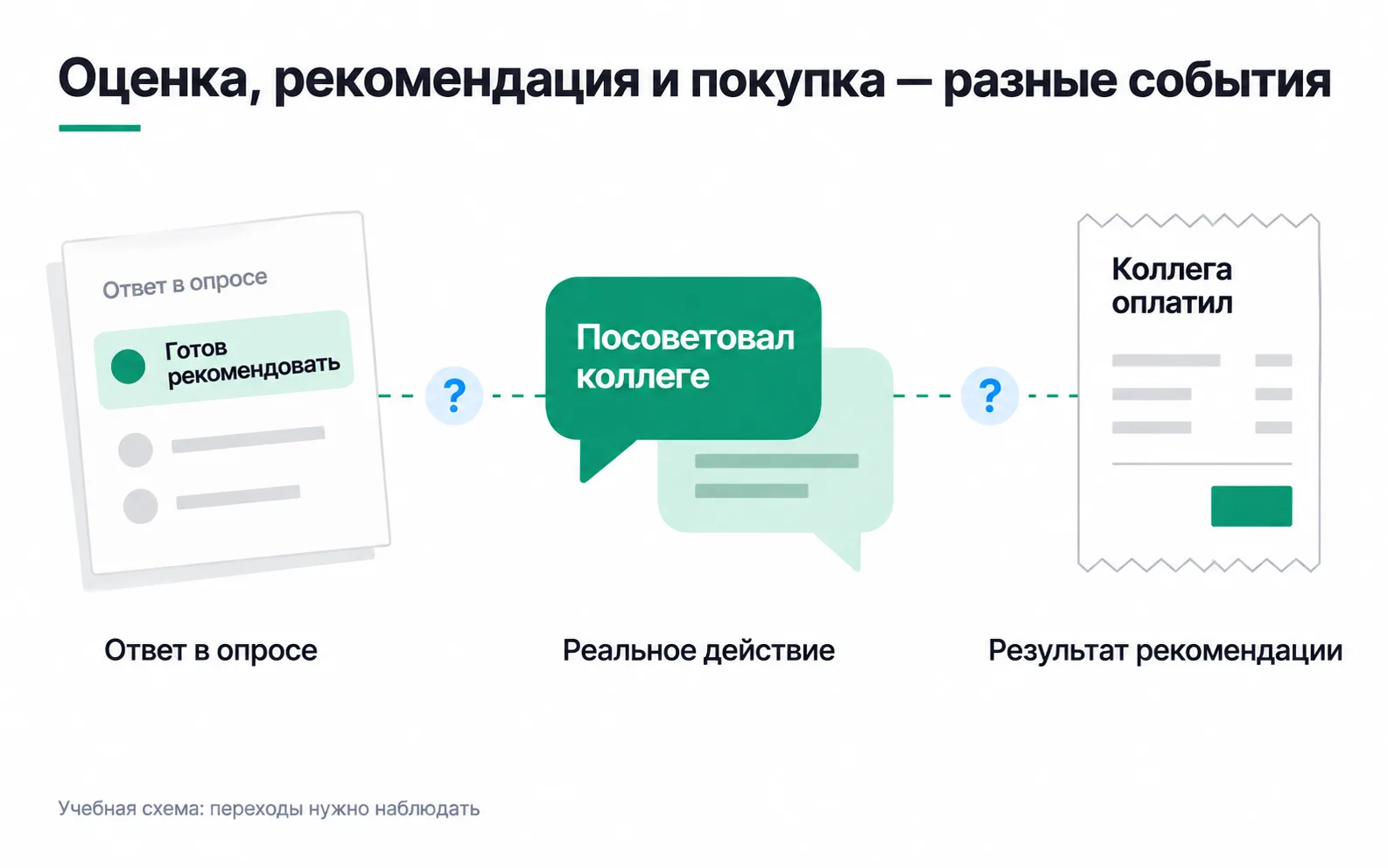
An NPS promoter is a third concept. In Bain's methodology that is the name for people who answer 9 or 10, on a scale from 0 to 10, to the question "How likely are you to recommend us to a friend or colleague?". That is an intention in a survey. The survey has no way of knowing whether the person actually recommended you to anyone, or whether that person bought: there are two steps between the answer and the friend's payment, and each has to be observed on its own.
Why customers recommend
People recommend what they have something to say about. Aliya talks about the taste and about the coffee at work never running out without warning: the new bag arrives before the old one is empty. The shop cannot make her talk, but it can avoid giving her a reason to stop. One bag with a roast date three months old, and next time Aliya tells a colleague: "It used to be better." That is why criticism from regulars gets the same attention as praise: if a complaint is answered with action, Aliya may tell her colleagues about that too.
Three things here depend on the shop. The promise is kept every time: the date on the bag, the delivery time. The person has something to show: a bag with the roast date, a description of the coffee they can forward to a colleague. And recommending is easy: there is a link or a code that gets the friend something nice with their first order.
Make recommending easy
Instead of 2,000 ₸ per friend, the marketer suggested starting with something simpler: putting a "For a friend" card into regular customers' parcels. It carries a personal code, and with it the friend gets a trial set of three drip bags with their first order, the same gift viewers got with the promo codes from bloggers. The set costs the shop 1,000 ₸. The person who recommends gets nothing.
The bonus was put off for two reasons. A recommendation the person earns nothing from sounds more convincing: Aliya's colleagues know it makes no difference to her whether they order. And a bonus needs rules: what it is paid for, when, what happens if an order is returned, whether you can invite yourself from a second phone number. If you do decide to pay for friends, put those terms in full on the card and on the site before launch. A customer who posts their code on Instagram to collect bonuses is in effect already advertising the shop.
What not to do: write reviews on customers' behalf, ask staff to leave reviews posing as customers, promise a gift only for five stars. A recommendation is valuable because a real person gave it of their own free will, and a fake review, once exposed, destroys the trust the recommendation rests on.
What follows is a summary of the rules, not legal advice. In sponsored content, the law "On online platforms and online advertising" (as amended up to 2 March 2026) requires recommendations and reviews to be genuine and verifiable (Article 21(3)). If a customer gets coffee or a bonus for posts, those posts, as we read it, become advertising and are labelled by the same rules as blogger advertising. That said, the labelling Rules (order No. 59-НҚ of 16 February 2024, with no other editions as of 13 October 2026) define a blogger as someone who publishes "for the purposes of entrepreneurial activity", and whether an ordinary customer fits that is not obvious. But the law on online platforms requires online advertising to be "identifiable and labelled" (Article 19(1)), so we would ask such a customer to add an "ad" label too.
Example: six weeks of "For a friend" cards
The pilot ran for six weeks, from 17 August to 27 September 2026: the card went into every parcel for regular customers, about 300 of them by the count at the start of the pilot. Printing cost 30,000 ₸. Here is what the CRM shows:
| Metric | Value |
|---|---|
| Regular customers whose code was used | 17 of 300 |
| First orders with the codes | 23 |
| Contribution from those orders, 23 × 6,000 ₸ | 138,000 ₸ |
| Gift sets, 23 × 1,000 ₸ | 23,000 ₸ |
| Printing the cards | 30,000 ₸ |
| Left after gifts and printing | 85,000 ₸ |
Printing per new customer comes to 1,304 ₸ (30,000 / 23), against 4,138 ₸ for the blogger with the AROMA code; the gift is the same in both cases. But it is too early for a head-to-head comparison, because regulars' friends were coming to the shop before the cards too. In the "How did you hear about us" field, "recommended by friends" was recorded for 14 new customers in the six weeks before the pilot. In the six weeks of the pilot there were 28 recommendations: 23 with a code and 5 without.
It looks as if the cards added something, but 14 people is more likely the ceiling of the gain than its size. Before, "recommended by friends" was recorded only when the customer mentioned it, while a code records every recommendation. Customers like Aliya's colleagues would have come without a card; now they simply have a code. Six weeks are not enough to tell the two groups apart: the gain is most likely somewhere between zero and fourteen. Even that ceiling is not firm: in early August, two weeks before the pilot, a rival roastery opened. It was open for all six weeks of the pilot but only the end of the window before it, and some new customers may have gone there.
Whether the cards paid off depends on where in that range the truth lies. If all 23 would have come anyway, the shop wasted 53,000 ₸ on gifts and printing. Each person who came specifically because of the card brings 6,000 ₸ of contribution, so the cards pay off if there are at least 9 such people (53,000 / 6,000 ≈ 8.8). Nine sits inside the range from zero to fourteen, so there is no answer yet.
A comparison would give a sharper answer: a random half of the regulars gets the card, and three months later you see which half brought more new customers by recommendation. With 300 people only a large difference shows up, so the owner kept the cards for everyone for another quarter and will run that comparison once there are more regulars. In the worst case, if everyone would have come anyway, the quarter costs about 115,000 ₸ in gifts and printing, and that is the ceiling of the risk.
What to count
A recommendation goes through several steps, and each has its own place in the data:
| Event | Where you see it | What it shows |
|---|---|---|
| A 9 or 10 on the NPS question | Survey | An intention to recommend |
| A friend's code in an order | CRM | A recommendation that reached an order |
| "Recommended by friends" in the "How did you hear about us" field | CRM, in the customer's words | A recommendation without a code, if the customer mentioned it |
| The friend's second order within 60 days | CRM | Whether the friend became a customer or just took the gift |
Recommendations do not all weigh the same. McKinsey suggests counting their strength alongside their number: advice from someone close about something you need right now works better than words from a stranger. For the shop, that means a code in the hands of Aliya, who treats her colleagues to her coffee, is worth more than the same code in a general chat of a thousand people.
Exercise: find your evangelists
If the CRM shows no such customers, most likely nobody ever asked, and the first job is a "How did you hear about us" field with a "recommended by friends" option. In the conversations, listen to the words. If people praise you for the same thing you promise in your ads, the promise got through; if for something else, that may be your real point of difference. Pick the friend's gift from your own product: a sample shows what you are recommended for. Work out the break-even point as in the example and compare it with how many people came by recommendation before launch. If the break-even point is higher than that number, the programme pays off only if recommendations more than double, and it is better to start with a free method, such as a link in the message after delivery.