An online coffee shop in Almaty, the same one as in the lesson on RFM analysis, needs new customers. It ships beans all over Kazakhstan, and the average order is 15,000 ₸. The owner has been offered three bloggers: an Instagram creator who covers coffee in Almaty, from coffee shops to beans for home, a TikTok creator who brews coffee at home, and a YouTube channel that reviews grinders. They ask between 90,000 and 150,000 ₸, and the owner wants to know which to pick and how to tell afterwards whether the money paid off. The figures in this lesson are made up.
Four questions before you pay
A follower count and a post price don't tell you how many customers a placement will bring. Before paying, you need answers to four questions:
- Does the audience fit: do the viewers live where the shop delivers, and do they brew coffee at home.
- Is the audience real: have the views and comments been inflated.
- Does the format fit: how will the blogger show the beans, and how long will the post stay alive.
- How will you measure the result: each blogger gets their own link and their own promo code.
The answers show how many customers a post could bring while the money is still yours. A blogger with 180,000 followers who mostly live outside Kazakhstan can cost the shop more than one with 42,000, and a cheap post can turn out expensive once you count it per customer.
But first work out how much you're willing to pay for a customer. On a 15,000 ₸ order, after beans, roasting, packing and delivery, the shop keeps 6,000 ₸; that's its contribution per order. With a blogger's promo code, a new customer gets a trial set of three drip bags with their first order, which costs the shop 1,000 ₸, so a first order with a code leaves 5,000 ₸. The owner doesn't count on repeat orders: of 2,400 customers in the past year, 1,560 ordered once. A 120,000 ₸ placement pays off from 24 first orders.
What each platform shows
Only the blogger can see their audience stats, so you ask for a screen recording: a screenshot is easy to edit, a recording much less so.
| Platform | What the creator's stats include | How the platform wants ads marked |
|---|---|---|
| Top countries and cities for followers and for viewers over 7-90 days, age and gender | A paid partnership label with the brand tagged | |
| TikTok | Whatever the creator shows you: ask for a screen recording of follower stats | The Disclose commercial content setting, Branded content option, Paid partnership label |
| YouTube | Countries in the Top geographies report; city data is available too | The paid promotion checkbox in the video's settings |
On Instagram, ask for a recording of the Viewers section for the last 30 days: it shows the geography of everyone who saw the content, not only followers. Meta calls these figures estimates.
How many people will see the post
Take the blogger's last 10-15 regular posts, leaving out ads, and find the median view count. The median, not the average: one video that happened to get a million views drags the average up, but it won't repeat in your placement. Multiply the median by the share of your country or city, divide the post price by those views and multiply by a thousand. That gives you the price per thousand relevant views, which is how you compare bloggers.
| TikTok | YouTube | ||
|---|---|---|---|
| Followers | 42,000 | 180,000 | 25,000 |
| Median views per regular post | 18,000 | 60,000 | 9,000 in the first month |
| Kazakhstan's share in the stats | 81% | 21% | 64% |
| Views from Kazakhstan | about 14,600 | 12,600 | about 5,800 |
| Placement price | 120,000 ₸ | 150,000 ₸ | 90,000 ₸ |
| Price per 1,000 views from Kazakhstan | 8,230 ₸ | 11,905 ₸ | 15,625 ₸ |
| First orders needed to break even | 24 | 30 | 18 |
The TikTok creator has the biggest reach, but four in five of their followers live outside Kazakhstan, and they turned down about 100,000 ₸, the price at which a thousand Kazakhstan views would cost the same as on Instagram. YouTube costs the most per thousand views, but grinder reviews are watched by people who brew at home, and the blogger says his videos keep gathering views for months. The Instagram creator fits the audience: under his posts about beans, people ask where to buy them and how to grind them. The shop takes Instagram and YouTube, and decides to count YouTube orders for four weeks instead of two.
Signs of fake engagement
You look for inflated numbers in a blogger's account the same way as for inflated views in Telegram channels: by several signs together, never one. With bloggers, add the comments: generic, repeating from post to post ("nice", "fire"), and under past sponsored posts nobody asked about the price or delivery. Don't look for a market benchmark for ER; compare the blogger with themselves: engagement on regular posts against sponsored ones, this month against last. If you still have doubts, buy one post and decide on the rest by its result.
The brief and the contract
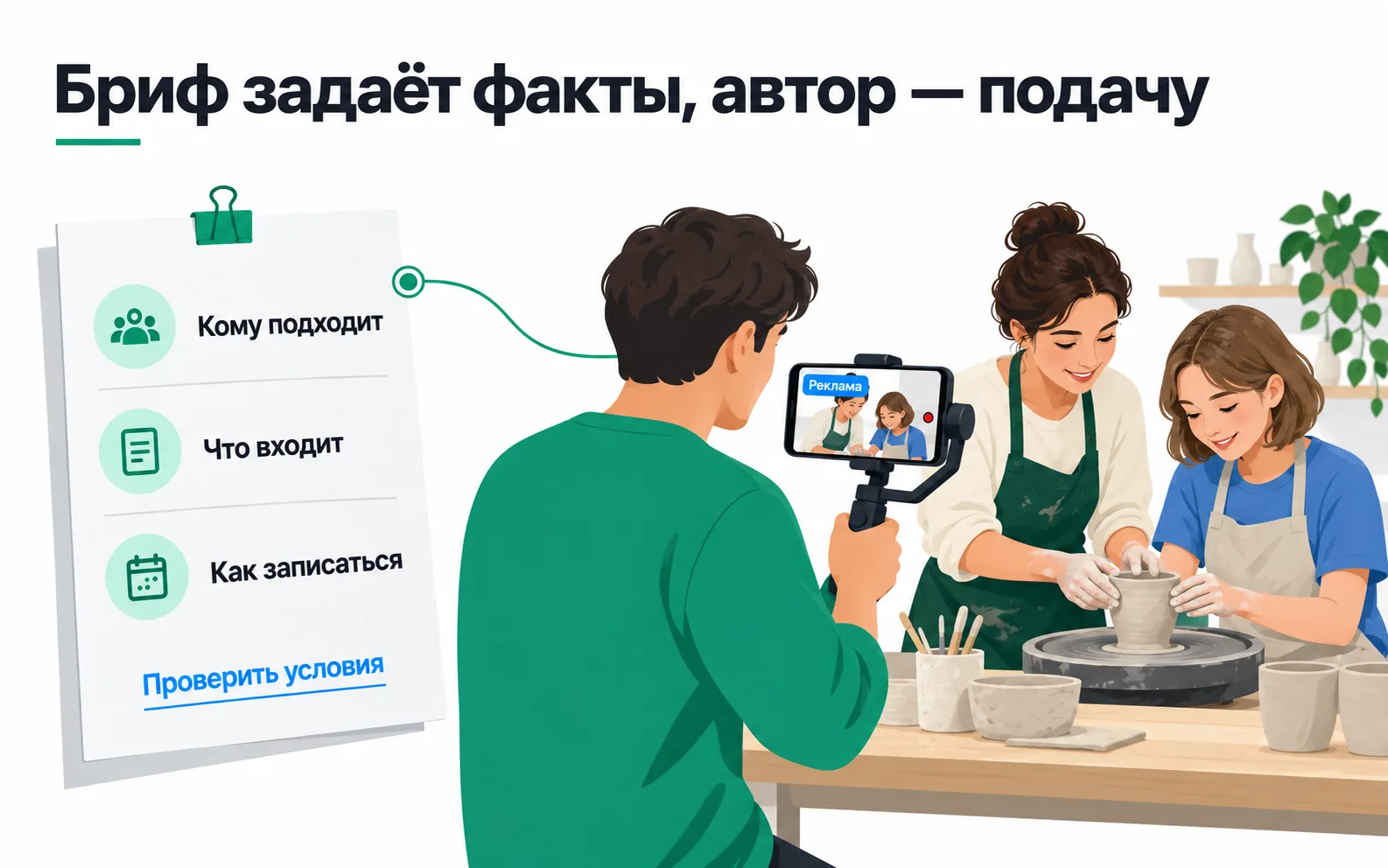
The brief holds the facts the blogger can't know: who it suits (people who brew coffee at home), what's included (freshly roasted beans, delivery across Kazakhstan, payment by card or Kaspi QR to the courier) and how to order (the link, the promo code, and the fact that the code only works on a first order). Separately, list what not to say: discounts that don't exist, delivery faster than the real one, or that the beans are better than the roaster's next door. The Law "On Advertising" treats all of that as improper advertising. The blogger tastes the coffee themselves and talks about their own experience. Leave the story and the words to them; they know what their viewers watch.
In the contract, besides the price and the publication date:
- Approval: the blogger sends the text and a draft of the video before publishing, because the shop is responsible for the ad.
- Lifetime: the YouTube video and the link in its description stay up for at least six months.
- Stats: how soon after publication the blogger sends a screen recording of reach and viewer geography. Instagram is easier: if the blogger tags the brand with the paid partnership label, the shop can see the post's insights directly.
- Right to promote: to run the blogger's Reel as an ad from their account, Meta has partnership ads. The blogger grants permission in the app and can withdraw it at any time, so the term and price of that right go into the contract separately from the post price.
- Labelling: which label, where, and at what point in the video. On TikTok the label can't be changed after publishing, so Branded content is switched on before the post goes out.
- Paperwork: a blogger registered as a sole trader (IP) will issue an invoice; for a contract with a private individual, talk the taxes through with your accountant, barter included.
If the blogger agrees to a share of sales instead of a fixed price, the contract also needs an attribution window and rules for overlaps, as in an affiliate programme.
Labelling blogger ads in Kazakhstan
What follows summarises the rules on adilet.zan.kz and isn't legal advice. As of 13 October 2026, the Rules for Labelling Online Advertising (Order No. 59-НҚ) have one edition, dated 16 February 2024; the Law "On Online Platforms and Online Advertising" is as amended up to 2 March 2026, and the Law "On Advertising" up to 17 May 2026.
The Rules for Labelling Online Advertising require an influencer's (blogger's) ads placed "on a commercial and (or) contractual basis" to be labelled. Links to discounted goods and to the advertiser's website or accounts are named outright in their list of cases (clause 3). Barter is not named directly; as we read it, goods in exchange for a post fit clause 3(2), where the blogger gets "exclusive terms for using the advertised goods", and the agreement about the post provides a contractual basis anyway, so we would label it as well.
The label is text (clause 4), so saying реклама out loud isn't enough, and the wording comes from a closed list: реклама, на правах рекламы, жарнама and others (clause 5). In video the label goes "before the start of the online advertising" (clause 4). We read that as: if the whole video is the ad, the label goes at the start; if the ad is a segment in the middle, before that segment. The safer option is both: the label in the first line of the caption and as on-screen text at the start of the video and before the sponsored segment.
A platform's label is interface text, and its wording depends on the platform and on the viewer's app language. On Instagram, once the brand approves the tag, a viewer with a Russian interface sees a Russian "Sponsored by …" line and one with an English interface sees "Paid partnership" (labels on paid partnership posts), and neither is on the clause 5 list. So the creator writes a phrase from the list, such as реклама or жарнама, themselves.
The Law "On Online Platforms and Online Advertising" requires sponsored content to name the sponsor (Article 21(1)), to contain no opinions, voice, photos or video of third parties without their consent (Article 21(2)(2)), and to keep recommendations and reviews genuine and verifiable (Article 21(3)). So the blogger tastes the coffee themselves, and a barista or a guest in the shot agrees to be filmed in advance.
The Law "On Advertising" calls an ad with false information about price or delivery unreliable (Article 7(2)(3-4)) and a comparison with other people's goods unfair (Article 7(1)(1)). For the content and language of an ad, it holds the advertiser liable unless the ad producer or distributor is proven to be at fault (Article 20(1)). A blogger can be both, but it's the shop that would have to prove the blogger's fault. The advertiser keeps the video and the text, with all later changes, for a year after the ad was last distributed (Article 16). A review that stays up on YouTube for at least six months under the contract is, as we read it, being distributed all that time, so the year runs from the day it comes down. The law doesn't require keeping the correspondence, but it will serve as evidence in a dispute under Article 20. A licence number and the issuing body (Article 6(4)) aren't needed for a coffee shop, but a clinic or a microfinance organisation needs them.
The Rules exempt ads in messengers (clause 6(1)), but they don't say outright whether that covers public Telegram channels. Meanwhile, the online platforms law itself requires online ads to be identifiable and labelled (Article 19(1)), and recognisability (Article 6(1) of the Law "On Advertising") and naming the sponsor (Article 21(1)) apply even without a label under the Rules. So a Telegram post gets a label and the shop's name too, and a disputed case is for a lawyer.
A link and a promo code for each blogger
Tag the link using the UTM scheme, the same way as a paid post in someone else's Telegram channel: the platform as the source, utm_medium=paid, the shop's campaign, and the blogger in Latin letters in utm_content. Add a "Blogger" row to the scheme. In GA4, Instagram with paid lands in Paid Social and YouTube in Paid Video (default channel group rules).
Put the link where people can tap it: in Stories with a link sticker, in the YouTube video description. The blogger says the promo code out loud, because a word from a video is easier to remember than a link you have to look for later. Each blogger has their own code: AROMA for Instagram, POMOL for YouTube. The code gives a gift rather than a discount and only works on a first order, so regular customers who stumble on it don't inflate the count of new ones.
The code also catches people whose tags got lost: someone watches the Reel in the app and orders that evening from a laptop, just as happens with paid posts on Telegram. Before the post goes live, open the link from the app on your phone, place a test order with the code, and find it in the CRM with both the tags and the code.
Example: what the two placements brought
Both posts went out in the same week. Instagram was counted for two weeks, YouTube for four, and only paid first orders count:
| Metric | Instagram, 2 weeks | YouTube, 4 weeks |
|---|---|---|
| Views in the post's stats | 24,000 | 10,000 |
| Sessions with the blogger's tags | 480 | 150 |
| First orders via the link | 17 | 5 |
| First orders with the promo code only | 12 | 6 |
| First orders in total | 29 | 11 |
| Needed to break even | 24 | 18 |
| Cost per new customer | 4,138 ₸ | 8,182 ₸ |
| Contribution after paying the blogger | +25,000 ₸ | −35,000 ₸ |
By codes and links, Instagram paid off with five orders to spare, but only thanks to the promo code. The link brought 17 people, which is 85,000 ₸ of contribution against a 120,000 ₸ price. Another 12 entered AROMA without clicking the link. Without the code, the placement would have looked like a loss.
YouTube hadn't paid off after four weeks: 11 first orders out of the 18 needed, seven in the first two weeks and four in the next two. The owner will come back to it in two months: more code orders will have come in, and it will be clear whether these customers ordered again (the shop's median gap between orders is 28 days). Whose customers come back more often can't be compared on 11 and 29 people: on YouTube, one person is 9% of all its customers.
That leaves the question of how many of these people would have come without the bloggers. In the six weeks before the placements, the shop had 30 to 40 first orders a week, median 35, which made 60 to 80 over two weeks. In the first two weeks after the posts went out it had 98, more than in any two weeks before. The shop checked for seasonality the same way as with display advertising: searches for "coffee beans" in Yandex Wordstat barely changed over those weeks. The bloggers seem to have added something, but given the spread the gain lies between 18 (98 − 80) and 38 (98 − 60), while the bloggers' codes and links claimed 36 (29 for Instagram and 7 for YouTube). How many of the 36 would have come anyway, and how many people ordered after seeing the bloggers without a code, two weeks can't separate: all you see is the total gain, 18 to 38. Judged by the gain, the two placements together didn't pay off in the first two weeks: even 38 is less than the 42 needed to cover 210,000 ₸. Whether Instagram paid off on its own, this data can't say. Only a control group (holdout) would answer that more precisely, and with a blogger you can't carve one out: Instagram decides who sees the Reel.
Exercise: assess a blogger for your own project
You need a business that bloggers might suit: your own, a client's or a friend's.
For the coffee shop the figures are: 18,000 × 81% ≈ 14,600 views from Kazakhstan, 120,000 / 14.58 ≈ 8,230 ₸ per thousand, 120,000 / 5,000 = 24 first orders. Counted by revenue rather than contribution, Instagram would have "paid off" at just eight orders (120,000 / 15,000), so the plan states which figure the maths is based on. If the test order reached the CRM without the code, move the publication date: once the blogger has said a code out loud, it can't be changed.
Video: working with creators
The video is in Russian, from the Sherbaevna PRODigital channel.