The marketer at an online booking service for beauty salons in Almaty wants to double the Instagram budget again in December: a sign-up costs 8,000 ₸ there and 12,000 ₸ in Google Search. A salon pays the service 12,000 ₸ a month after two free weeks, and the founder has two questions: how much can we pay for one salon, and when does that money come back? Unit economics, the calculation per customer, answers both. The channels and spend come from the service's September funnel, and the numbers are made up.
The unit is a salon that paid
Unit economics counts money per single unit of the business, and which unit you pick depends on the question. If you want to know whether a delivered order makes money, count the order. If you are deciding how much to give advertising for a customer who will pay many times, count the customer.
For the service, the unit is a salon that paid for its subscription. A sign-up or a salon still on trial won't do: of 200 sign-ups in September, 50 paid, and only those bring the service money.
CAC: divide the spend by the ones who paid
CAC (customer acquisition cost) is what it costs to acquire one paying customer. Here is September by channel:
| Channel | Sign-ups | Paid | Spend | Per sign-up | Per paying salon |
|---|---|---|---|---|---|
| Instagram ads (Meta) | 120 | 20 | 960,000 ₸ | 8,000 ₸ | 48,000 ₸ |
| Google Search | 50 | 16 | 600,000 ₸ | 12,000 ₸ | 37,500 ₸ |
| Booking page link and referrals | 30 | 14 | - | - | - |
| Total | 200 | 50 | 1,560,000 ₸ | 7,800 ₸ | 31,200 ₸ |
A sign-up from Instagram is a third cheaper than one from search, and a salon that paid costs 10,500 ₸ more. One Instagram sign-up in six pays, against almost one in three from search. A cheap sign-up doesn't make the salon cheap, so channels are compared on the cost of a salon that paid.
The 31,200 ₸ average flatters advertising too. It includes 14 salons that came through the link and referrals for free. Divide the spend by the salons that came from ads alone and you get 1,560,000 / 36 = 43,333 ₸. When you decide where the budget goes, use the cost per channel.
All of this is ad CAC: the numerator holds only money from the ad accounts. Full CAC adds everything else spent on acquisition, such as creatives and the marketer's hours. The report says which of the two was calculated, and channels are compared on the same composition. Load the marketer's work onto Instagram but leave search bare, and search wins on paper.
One more thing about timing. The service has a two-week trial, so September's CAC can only be calculated in mid-October, once the last September salon has finished its trial. The cost of a sign-up in one good week is not yet a CAC.
Contribution: what is left from a payment
Out of 12,000 ₸ the service spends about 2,000 ₸ a month on each salon: messages with login codes and reminders to clients, servers, the bank's fee for taking the payment, support hours. These costs grow with the number of salons, which is why they are called variable. What remains is the contribution:
Monthly contribution = 12,000 − 2,000 = 10,000 ₸.
Out of contribution the service pays for acquisition and covers its fixed costs: developers' salaries, the office, the accountant. Fixed costs are not part of this calculation, and contribution is counted before them. Subtract advertising from contribution as well and you get contribution after advertising, which is also counted before fixed costs.
The word "margin" is best spelled out in the table. One person means revenue minus cost of goods, another means what is left after advertising, and their figures differ. Label the row plainly: "contribution = payment minus messages, servers, fee and support".
It is handy to express a salon's cost in months of subscription: the 48,000 ₸ for an Instagram salon is four payments of 12,000 ₸. Payback can't be counted that way. The service keeps 10,000 ₸ from each payment, so an Instagram salon needs five payments to earn back its cost.
Payback: CAC divided by monthly contribution
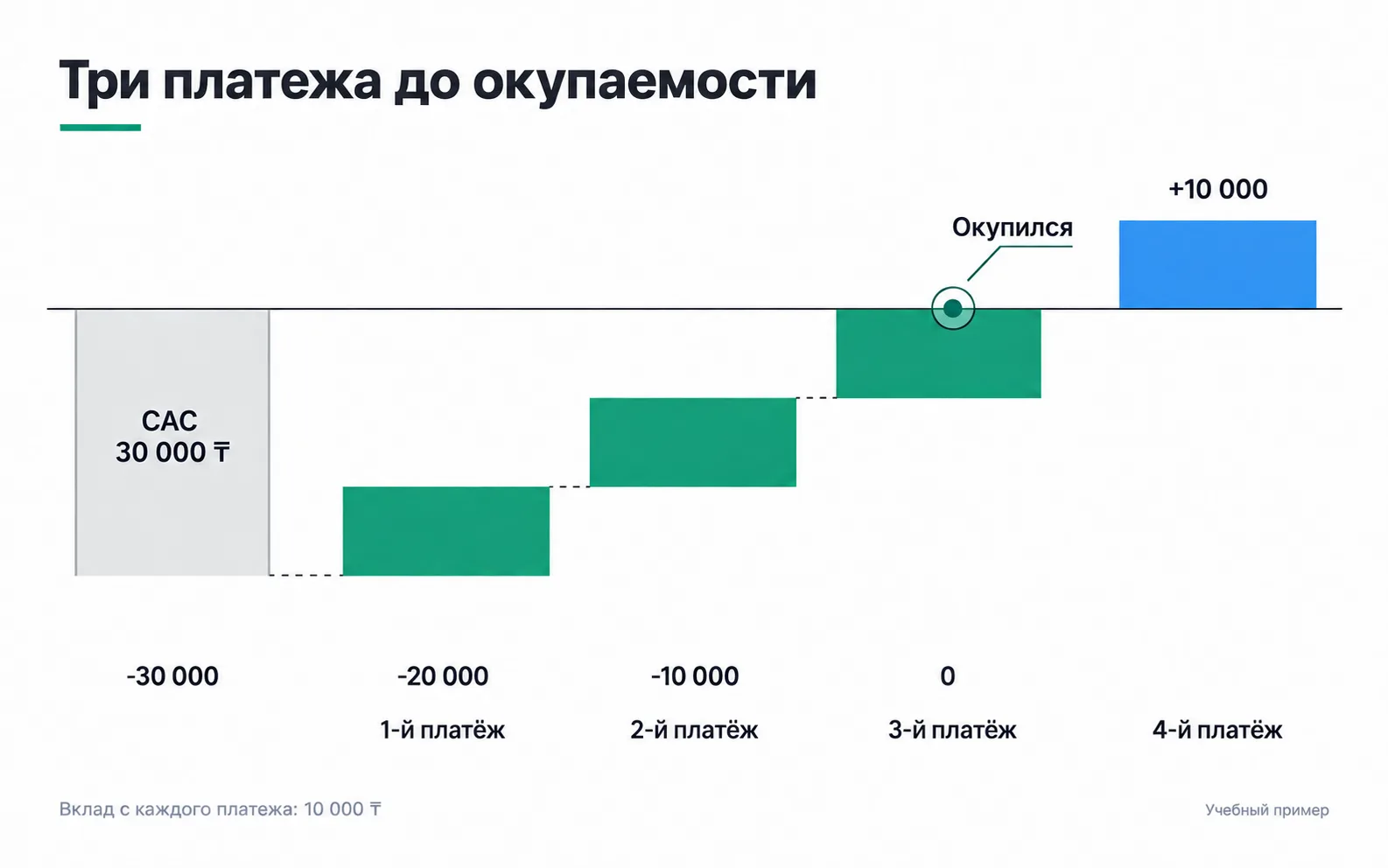
The acquisition payback period is the number of months it takes a customer's contribution to cover their CAC. While the customer pays every month, it is a simple division. On the chart at the top of the lesson, CAC is 30,000 ₸ and contribution is 10,000 ₸ a month: 30,000 / 10,000 = 3, so the acquisition pays back by the end of month three, provided the customer pays for all three months. After the first payment revenue has started, but payback is still 20,000 ₸ away.
Paid back means the money spent on acquiring this customer has returned. Fixed costs are not in the calculation, so it tells you nothing about the service's profit.
Here is the accumulated contribution of a salon that stays, and what is left of it after each channel's cost:
| Payment | Contribution so far | Instagram, CAC 48,000 ₸ | Google Search, 37,500 ₸ | Average, 31,200 ₸ |
|---|---|---|---|---|
| 1 | 10,000 ₸ | −38,000 ₸ | −27,500 ₸ | −21,200 ₸ |
| 2 | 20,000 ₸ | −28,000 ₸ | −17,500 ₸ | −11,200 ₸ |
| 3 | 30,000 ₸ | −18,000 ₸ | −7,500 ₸ | −1,200 ₸ |
| 4 | 40,000 ₸ | −8,000 ₸ | +2,500 ₸ | +8,800 ₸ |
| 5 | 50,000 ₸ | +2,000 ₸ | +12,500 ₸ | +18,800 ₸ |
31,200 / 10,000 = 3.12, and here you round up. A payment arrives whole: the third one leaves you 1,200 ₸ short, so it is the fourth that recovers the cost of the average salon. A salon from search also pays back on the fourth payment, one from Instagram on the fifth.
Churn moves payback
The table above assumes the salon pays every month. Salons do leave, though, and how the September ones behave will only be visible in spring. So you borrow an older cohort as the model. In the March cohort from the product-market fit analysis, 28 of 48 salons are still paying in month six. Multiply the paying salons by 10,000 ₸ and divide the running total by all 48 salons, including those that left:
| Month since first payment | 1 | 2 | 3 | 4 | 5 | 6 |
|---|---|---|---|---|---|---|
| Paying, of 48 | 48 | 40 | 35 | 32 | 30 | 28 |
| Contribution so far per cohort salon | 10,000 ₸ | 18,333 ₸ | 25,625 ₸ | 32,292 ₸ | 38,542 ₸ | 44,375 ₸ |
| Same, two stylists or more (30 salons) | 10,000 ₸ | 19,333 ₸ | 28,000 ₸ | 36,333 ₸ | 44,667 ₸ | 52,667 ₸ |
| Same, one stylist (18 salons) | 10,000 ₸ | 16,667 ₸ | 21,667 ₸ | 25,556 ₸ | 28,333 ₸ | 30,556 ₸ |
The average salon at 31,200 ₸ still pays back in month four, but only just: 32,292 ₸. A salon from search slips to month five. And a salon from Instagram doesn't earn back its cost within six months: by month six the cohort has built up 44,375 ₸ per salon out of the 48,000 ₸ needed.
The bottom rows answer the founder's question of how much to pay. A salon with a team brings in 52,667 ₸ over six months: if it costs 48,000 ₸, like the average Instagram salon, it pays back in month six. A solo stylist doesn't return even the 31,200 ₸ average in the same time. The founder wants acquisition to pay back within six months, so the CAC ceiling is about 52,000 ₸ for a salon with a team and about 30,000 ₸ for a solo stylist. Each owner sets the CAC ceiling themselves: the service's founder chose a six-month payback, while the owner of the IELTS prep centre spends no more than half of a student's contribution on advertising. The service doesn't yet know how many solo stylists each channel brings in, and that is the first thing to count before December.
This table is built from a payments export: a cohort by month of first payment, with every salon in the cohort in the denominator. The March curve is one cohort, and not the September one. Once those have lived six months, the calculation is repeated on their own payments and their own CAC. That is also what a16z recommends: LTV by monthly cohort, next to the CAC of the same month.
LTV and the 3:1 benchmark
LTV (lifetime value) is the contribution a customer brings over their whole time with the business. The last column of the table is the March cohort's observed six-month LTV, 44,375 ₸ per salon, and that is a fact. What a salon will bring in over two years is already a forecast. In a report it goes on its own line, with the retention assumption next to it.
LTV is compared with CAC. In his guide to SaaS metrics, David Skok offers two guidelines: LTV more than three times CAC, and CAC paid back in under 12 months. Many of the best SaaS businesses, he writes, recover CAC in 5-7 months, while many healthy businesses fall short of the guidelines in the early days.
The service meets the second guideline: the average salon pays back in month four. The first is harder: six months give 44,375 / 31,200 = 1.4, and reaching 3:1 takes 93,600 ₸ of contribution per cohort salon. Even if nobody else leaves after month six, the 28 paying salons add 28 × 10,000 / 48 = 5,833 ₸ per cohort salon a month, and 93,600 ₸ is only reached around month 15. So whenever you hear "LTV : CAC", ask straight away over what period it was calculated and whether it is actual or forecast.
Before you raise the budget
A cheap sign-up on Instagram is a reason to run the numbers, and doubling can wait. Before deciding on December you need six answers:
- The cost of a salon that paid, not of a sign-up. For the October salons it will be known after 15 November, when their trial ends.
- Contribution after refunds. If some salons ask for their first month back, that month brings in less than 10,000 ₸.
- Payback with churn. On the March curve, an Instagram salon doesn't pay back within six months.
- Whether the cost holds at a bigger budget. The average can still look fine while every extra salon is already losing money, so look at the cost of the extra customers.
- Whether support can handle twice as many new salons in their first two weeks, while they are setting up.
- Whether there is enough cash: with a five-month payback, December's budget comes back by May.
CTR and cost per click decide nothing here: a click doesn't pay for a subscription.
The calculator on the site
The calculators have no subscription tab, but the "E-commerce marketplace" tab will do if you treat a month of subscription as an order. Enter a CAC of 31200, put the contribution 10000 into AOV (average order value), and set "Gross margin" to 1 so costs aren't subtracted a second time. Zero out discounts, last-mile delivery, storage and the return rate: by default they hold a shop's figures. Set "Orders / yr, Y1" to 12 and "Customer lifespan" to 1.
The calculator will show an LTV of 120,000 ₸, an LTV : CAC of 3.8× and a CAC payback of 3 mo. Three months is 3.12 rounded to the nearest whole number, while the service is 1,200 ₸ short after the third payment. And the 120,000 ₸ belongs to a salon that pays all 12 months.
The calculator knows nothing about churn: how many payments there are in a year is your call. Over six months the March cohort paid 213 / 48 = 4.44 times per salon on average. Put 4.44 into "Orders / yr, Y1" and 0.5 into "Customer lifespan": with a lifespan under a year, the calculator takes all first-year orders. You get an LTV of 44,400 ₸, an LTV : CAC of 1.4× and a payback of 4 mo. The calculator gets payback by spreading LTV evenly over the months of the lifespan and dividing CAC by that average. The month-by-month table is more precise, and the calculator is good for a quick cross-check.
Exercise: your client's unit economics
Take a client with repeat payments or purchases. If you have no client, use the booking service from this lesson.
A question you will get a month later. The marketer brings a week in which an Instagram sign-up cost 6,000 ₸ instead of 8,000 ₸ and the ads' CTR doubled, and suggests doubling the budget right away. What do you say?
Salons pay, sign-ups don't. If one Instagram sign-up in six still pays, a salon will cost 6,000 × 6 = 36,000 ₸ instead of 48,000 ₸, and on the March curve it pays back in month five, when the cohort reaches 38,542 ₸ per salon. That is clearly better than September, but so far it is only arithmetic: how many of that week's salons pay will be known after the two-week trial. CTR says nothing about payment. You can answer the marketer like this: "Let's wait until this week's salons finish their trial, then work out the cost of a salon that paid and the share of solo stylists. If the number holds, we raise the budget one step and watch what the extra salons cost."
Video: another walkthrough of the basics
As you watch, note what the author takes as the unit and which costs he subtracts from revenue.