An online booking service for beauty salons in Almaty charges a salon 12,000 ₸ a month, but for the first two weeks the salon uses it for free, and all that time the team is guessing whether it will pay. The founder wants to know sooner: at what moment does a salon realise it needs the service, and can you see that moment in the data before the trial is over? The numbers in this lesson are made up; the September figures come from the product-led growth breakdown.
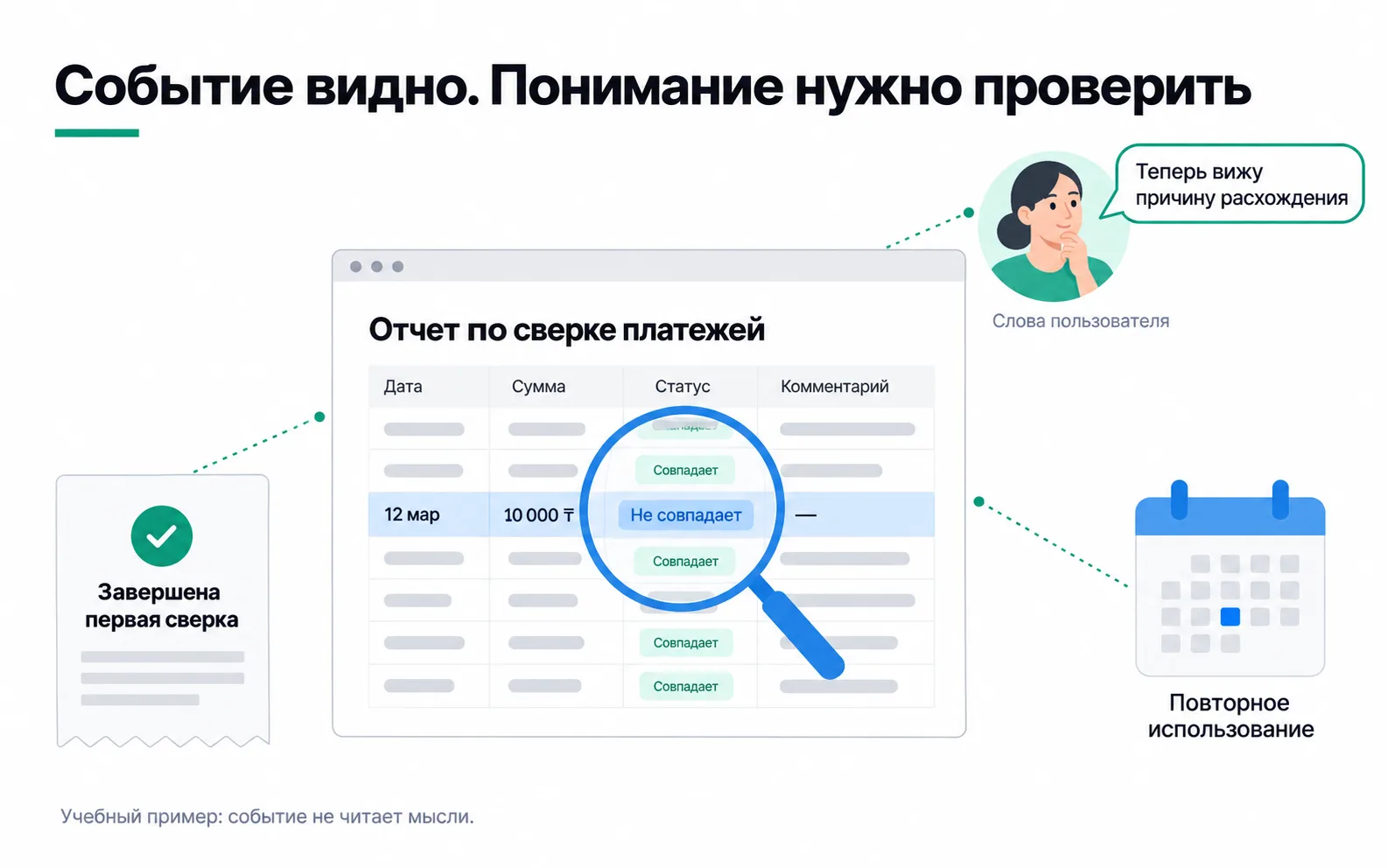
The picture comes from a different service, payment reconciliation, but the three signs are the same: an event in the data, the person's own words, and coming back to the same task.
Product metrics from sign-up to the North Star
The aha moment comes when a person sees the product's value in their own data. For a salon it is the morning when the receptionist opens the calendar and finds a booking a client made herself at 11:40 pm. That morning is not in the data. What is there is an event you believe goes along with it, and next to it the other product metrics, each answering its own question:
| Metric | How the booking service counts it | The question it answers |
|---|---|---|
| Sign-ups | salon_signed_up per month | How many salons ads and referrals brought in |
| Activation | Turned on online booking in the first 7 days | Did the salon reach the step after which the service can help |
| Aha moment | Got its first online booking during the trial | Did the salon see the value with its own clients |
| Time to value | Median days to the first online booking, plus how many salons got there | Does the salon make it within the two free weeks |
| Payment | Paid for the subscription after the trial | Did the value turn into money |
| Retention | Does it get online bookings every week, does it pay every month | Does the value repeat |
| North Star | Online bookings per week across all salons | Is the value the service delivers to all salons together growing |
The service measures retention two ways: weekly, by online bookings, and monthly, by payments. The North Star adds up the value for all salons in one number per week, as Amplitude's North Star approach suggests.
The aha moment sits in the middle. The metrics before it describe what the salon did itself; the ones after it show whether the salon is getting what it came for and paying for it. Pick the wrong aha moment and the error spreads down the chain: time to value measures the wrong thing, and onboarding nudges salons towards the wrong step. That is why you choose it from the data.
Which event separates the salons that will pay
Of the 200 salons that signed up in September, 50 paid after the trial. There are several candidates for the aha moment, and for each you work out two shares. The first is how many of the salons that reached the event went on to pay: the higher it is, the better the event separates future customers. The second is what part of all paying salons the event covers. If only half of the payers reached it, it describes the path of one group.
| Candidate | Reached | Of them paid | Share that paid | Coverage of the 50 payers |
|---|---|---|---|---|
| Added services | 130 | 50 | 38% | 100% |
| Turned on online booking in the first 7 days | 80 | 46 | 57.5% | 92% |
| Got the first online booking during the trial | 60 | 46 | 77% | 92% |
| Got three or more online bookings during the trial | 38 | 34 | 89% | 68% |
Everyone who later paid had added services, but only 38% of the salons that added services paid. The step is required, since without services a client has nothing to book. It does not deliver any value yet; it is preparation.
Turning on online booking (that is the activation) and the first online booking cover the same 46 payers. But 57.5% of the salons that turned booking on paid, against 77% of those that got a first booking. Of the other 140 salons, four paid. The first booking separates more sharply and loses nothing in coverage.
A threshold of three bookings is tempting: 89% of the salons that reached it paid. But it covers only 34 of the 50 payers. Of the 22 salons that had one or two online bookings in their two weeks, 12 paid, more than half. Three bookings in a trial also depend on how many clients the salon has, and a small salon may not get there even if it needs the service. With that threshold the team would write off salons that pay.
The service picks the first online booking during the trial. Thresholds from other companies' stories do not carry over: you work out the number and the window on your own data, because they depend on how often value happens in your product at all.
What the owners say
The table shows what the salons did, not what they thought while doing it. The analyst called ten of the 50 paying owners and asked when they decided they would pay. He asked about what happened rather than for opinions: "Think back to the day you realised you needed the service. What happened that day?" That is how questions are asked in a CustDev interview.
Seven owners remembered the morning they saw a booking in the calendar that a client had made herself late in the evening. Two said the receptionist no longer had to answer Instagram messages after closing time. One decided to pay before she even signed up, on the advice of a friend from another salon.
You cannot compute a share from ten conversations. They are there for something else: to see whether the event matches what people describe in their own words. Here it does. If the owners had talked about the nice calendar or the report on stylists, the event would stay in doubt despite its good numbers.
Repeat value
Repeat value shows up in retention: in week 5 after sign-up, 40 of the 60 salons with an aha moment are getting online bookings, and one of the other 140. The retention curves for these two groups are each built on their own number of salons.
Whether the first booking causes payment is checked with a test on new salons, as in the PLG breakdown.
A definition everyone counts the same way
Once the event is chosen, it is written down so that anyone on the team gets the same number six months later:
| Part of the definition | At the booking service |
|---|---|
| Unit | The salon, not an employee: the booking comes from a client, and a people-based funnel will not show it |
| Event | booking_created with source = online |
| Window | The 14 days of the trial from salon_signed_up |
| Repeats | A salon counts once, on its first online booking |
| Exclusions | The team's test and demo salons |
| When to count | Once the trial has ended for the last salon of the month |
The unit is easy to get wrong. Amplitude and Mixpanel count people by default, and in a standard funnel one person has to complete every step. A salon where the owner signed up and the booking came from a client drops out of such a funnel. Counting by salon in Amplitude and Mixpanel is a paid add-on, so without it the share is counted from the service's database.
The last row protects you from rushing. Count the share on 1 October, and salons that signed up at the end of September land among those that never reached value, although their trial is still running. And if the definition changes, mark the date on the chart, or three months later someone will mistake the jump for growth.
Exercise: the aha moment in your product
You need a product with sign-up and a trial or free plan: a client's service, an app you work with, or the booking service from this lesson.
Now a situation. The product manager suggests turning online booking on automatically at sign-up: "Activation will be 100%, and that settles it." What do you say?
Activation will hit 100% on release day and lose its meaning on the spot: it will no longer tell apart salons that got to a working booking page on their own from the rest. The counting method changes, not the behaviour, and you will have to mark the date on the chart. What to watch is the first online booking. A salon with booking turned on but no stylist schedules filled in will show clients an empty calendar or wrong times, and a client's first encounter with the service may end in a complaint. Or some salons may get their first booking sooner, because they no longer have to find the right button. Nobody knows in advance which effect wins. Your answer to the product manager could be: "Let's test it on new salons. The primary metric is the share that gets a first online booking during the trial, currently 60 of 200, with payments and support requests alongside it. We won't compare the share that turned booking on in this test: in the auto-enabled group it is 100% from the start."
Video: the AHA moment
Stories of well-known products' aha moments and how they relate to activation.