The four-week pilot of a future booking service for beauty salons in Almaty is over. The catalogue of free slots did not pay off: fewer than half the needed new clients turned up, and each cost three times more in ads than the salon paid for her. Meanwhile regular clients booked through their salons' own pages many times more often, and seven receptionists out of ten asked for the page to stay on. One partner wants to spend more on ads and cover the whole city; the other wants to shut the project down. The numbers are made up.
What a pivot is
A pivot is a change to one of a business's main assumptions, built on what you have already learned. In Eric Ries's approach, as the Lean Enterprise Institute glossary describes it, validated learning about customers serves one decision: persevere on the current path, or pivot to a more valuable use of the same idea or technology.
What sets a pivot apart from its neighbours is what it keeps. Changing an ad headline for the same product and the same customers is optimisation. Closing the project and starting another is a fresh start. A pivot keeps the part of the idea that already has evidence behind it and changes what did not hold up.
Sort out the signal first
Before you change strategy, find out whether the problem is in the measurement. For this pilot there are three questions.
Was the test long enough? Four weeks is short for new clients: some people saw the ad and might have booked later. But if twice as many new clients had come for the same money, each would have cost half as much, about 1,540 ₸, still more than the 1,000 ₸ the salon pays for her.
How were new clients told apart from regulars? Receptionists marked it themselves, against their own phone contacts. Two salons refused to pay their invoice because they recognised three of their "new" clients as old ones. The founder checked another 20 bookings and found one more mistake of the same kind. The records are imprecise, but the errors flatter the catalogue: there were even fewer genuinely new clients, and each one cost even more.
Who saw the ads? One audience and two creatives are too little to judge the channel. Had the gap been a few dozen percent, it would have been worth rerunning the test with other ads. A threefold gap is unlikely to close with new creatives.
If the signal was spoiled by measurement, fix the measurement and rerun the test. Here mistakes turned up, but they do not change the conclusion.
Separate what is proven from guesses
| Observation | What follows from it | What does not follow from it |
|---|---|---|
| Fewer than half the threshold of new clients, each three times dearer than the salon pays | The catalogue does not pay off in this form | That nobody will ever need a catalogue |
| 8 salons out of 10 paid the invoice | Salons are willing to pay the service | How much they will pay for something else |
| Regulars booked through the salons' own pages many times more often than new clients | A salon's clients book by link on their own | That the salon will pay for it: these bookings were free |
| 7 receptionists out of 10 asked to keep the page | The page is useful to them | That they will manage the slots themselves, without the founder |
| About 70 hours of manual work in four weeks | A hand-run service for ten salons eats almost half a working week | How many hours it will take if the salon manages the slots |
The most tempting row is the third. Those bookings look like demand, but nobody paid for them, and nobody knows how many of those clients would simply have messaged the receptionist on WhatsApp if the link had not existed.
Which pivot to choose
In "The Lean Startup" (2011) Ries lists ten types of pivot. Three of them fit this case:
- zoom-in pivot: a single feature becomes the whole product. Here that is one salon's booking page, and the catalogue goes.
- customer need pivot: same customer, different job. The salon still pays, but not for new clients; it pays so that its own clients can book without the receptionist.
- value capture pivot: a monthly subscription instead of 1,000 ₸ per client.
The other seven are not needed here: zoom-out, customer segment, platform, business architecture, engine of growth, channel and technology. The picture shows a customer segment pivot on another service: the payout reconciliation job stayed, and instead of a single shop the buyer became an accounting firm that serves several shops.
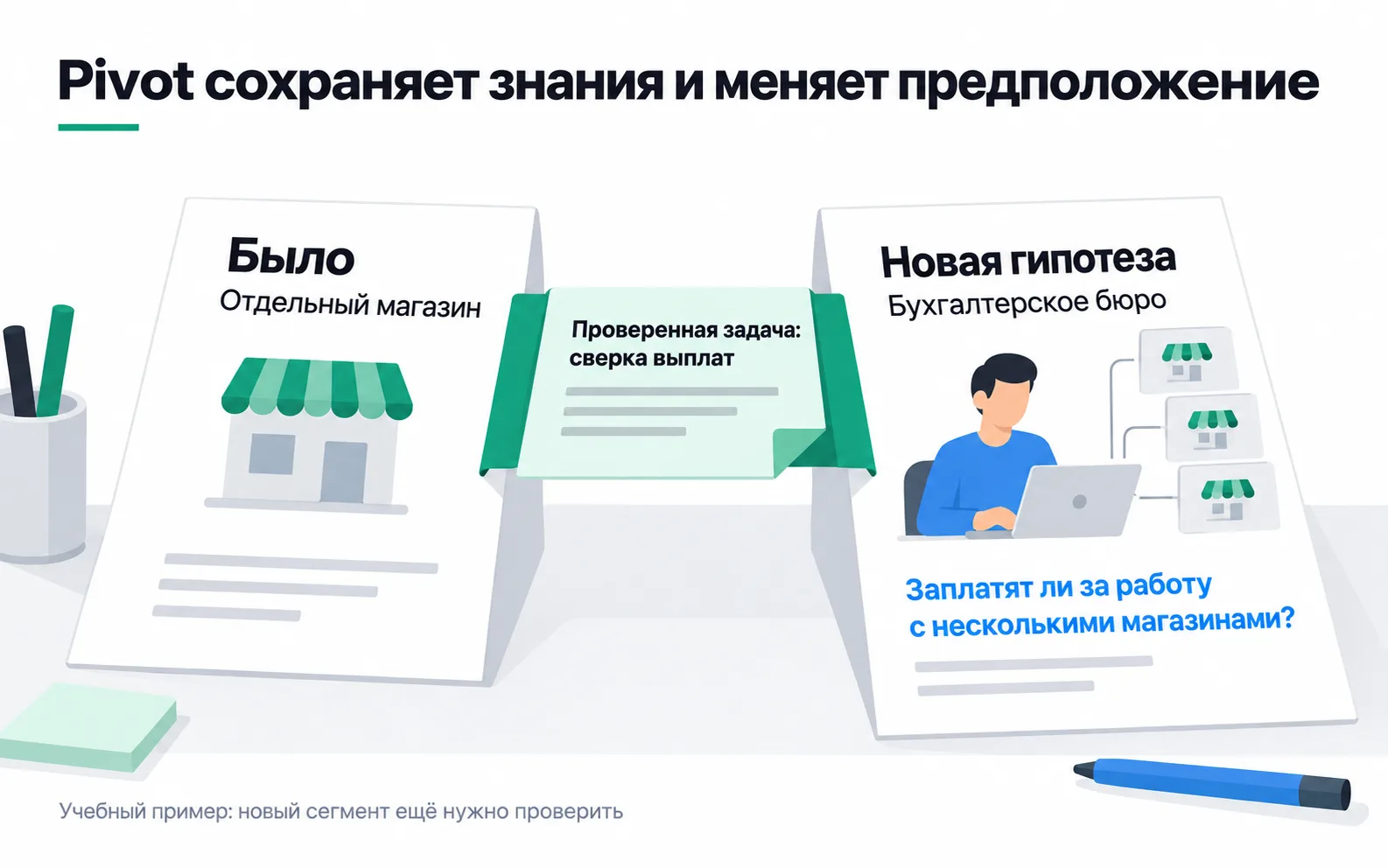
Three changes at once is a lot: if the next test fails, it will be hard to tell what let you down, the price, the model or the page itself. Here they hang together. A subscription for booking your own clients, without a catalogue, is one idea, not three. Everything else the founder left as it was: the same salons, the same city, the same hands-on help at the start.
What to keep
A pivot does not wipe out what was done. After the pilot the service still has:
- ten salons it has already worked with, seven of which want to continue;
- the knowledge of why receptionists lose clients: regulars message late in the evening and go to whoever answers;
- a booking page that clients understand without explanation;
- the link to the shared catalogue at the bottom of every salon page. The catalogue was closed but the link stayed: it now reads "Booked via" with the service's name and leads to the service's website. In the current service's funnel, that link and referrals brought in 30 of the 200 new salons in September.
The new hypothesis and the new pilot
The new main assumption: a salon will pay every month for online booking for its own clients and will manage the slots itself. The second half matters as much as the first. 70 hours of manual work for ten salons do not scale, and if salons do not close slots themselves, the subscription turns into the same manual work at a different price.
A calendar where the receptionist closes slots herself took the developer six weeks. That is no longer four months for a catalogue and apps. The pilot terms were written down in advance:
| Term | Value |
|---|---|
| What the salon gets | A calendar where the receptionist closes slots herself, and the salon's booking page |
| Price | 6,000 ₸ a month, first month free |
| Who takes part | 7 salons from the first pilot and 13 new ones, 20 in total |
| Duration | Three months |
| We continue if | At least 12 salons out of 20 pay for the second month and take more than 40 online bookings in it, and support takes under an hour per salon a month |
| We stop if | Fewer than 8 salons pay for the second month |
Fifteen salons out of 20 paid for the second month, and 13 of them took more than 40 online bookings: the threshold of 12 was passed. Supporting all twenty took about 12 hours a month. Later the service raised the price to 12,000 ₸ and replaced the free month with a two-week trial. Those are the terms it still runs on.
What the turn costs
The 120,000 ₸ of ads spent on the catalogue, waiting list included, and the four weeks of the pilot will not come back, and that is no argument for carrying on. You decide on what lies ahead: what each option costs from here and what risk is left in it. Putting more ads behind the catalogue means paying three times more for each client than she brings in. Shutting down means losing seven salons that are asking to continue. The pivot costs six weeks of a developer's time and a three-month pilot.
Before you announce the new product, settle things with the people you promised the old one. Everyone on the waiting list and the pilot's new clients got a message that the catalogue was closing and that their salon bookings still stood. Salons from the first pilot kept their pages while the calendar was being built. Quietly switch off something people relied on, and they will leave before you get the chance to offer them the new thing.
Exercise: three lines for your own turn
Take a project where the result did not match expectations: your own, a client's, or the booking service's pilot from this lesson.
And a case from the life of the service once it was running. Six months after moving to 12,000 ₸, two salon owners declined to renew: "too expensive". Your partner suggests switching to dental clinics, where the bills are bigger and 12,000 ₸ will scare nobody. Is it time to pivot?
No. Two refusals are a reason to find out why, not to change segment. Call both owners first. "Too expensive" may mean the salon gets few online bookings, that nobody is there to manage the slots, or that they found a cheaper service, and each case calls for a different decision. Then look at all paying salons: if the rest renew, you have two refusals, not a problem with the model. And dental clinics are a separate hypothesis with assumptions of their own: a different job, a different buyer, different requirements for patient data. They need their own pilot; conclusions from salons do not carry over.
Video: Lean Startup
An overview of Eric Ries's methodology, the source of both the MVP and the pivot.