An online coffee shop in Almaty has already bought advertising from bloggers. A post by an Instagram creator who covers coffee in the city cost 120,000 ₸ and in two weeks brought 29 first orders through the link or with the AROMA promo code, five more than it needed to pay off. In early March 2026, a month after the post, the blogger writes to the owner: "I liked your beans, let me be your ambassador. Six months, a Reel and three stories with the code every month, 70,000 ₸ a month plus a kilo of coffee." That is noticeably cheaper than a one-off post, and the owner is ready to sign. The numbers are illustrative.
Blogger, ambassador and evangelist
Different people speak for a brand in public, and what tells them apart is the agreement. A blogger doing a one-off integration publishes a single post under a contract, like the post with the AROMA code. An ambassador talks about a brand under a contract: regularly, for several months, for money, product or a discount. People start linking their name with the shop, so everything they do in public reflects on the brand too.
An evangelist recommends a brand on their own, with no contract and no payment. That is how regular customers bring colleagues and friends to the shop. One person can move from role to role: a customer the shop has promised coffee in exchange for posts becomes an ambassador. For the audience what matters is whether there is an agreement, and for the labelling Rules it is one of the two tests that clause 3 names. If there is one, the posts, as we read the rules, count as advertising and are labelled as advertising.
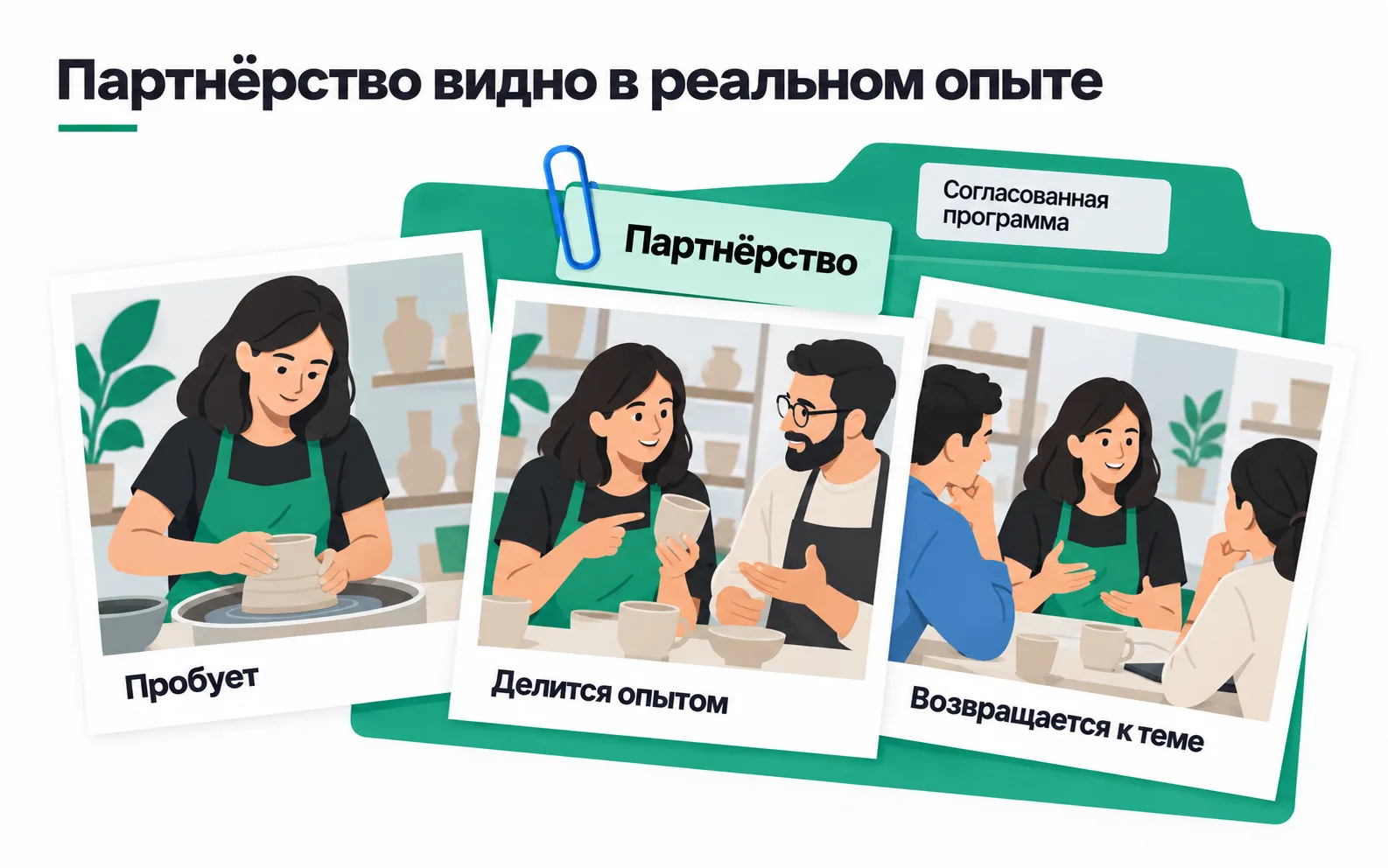
The picture shows an ambassador programme at a pottery studio: the person tries something, shares the experience and comes back to the topic. The coffee shop works the same way: the ambassador does not praise the beans over and over, but shows what they actually do with them.
Is there a basis for a long partnership
A one-off post tests the blogger's audience. A contract over several months also tests the person: all that time their name stands next to the shop's. Before signing, the owner answers four questions.
The first is whether the blogger drinks this coffee himself. After the post he ordered a second kilo and paid for it. That is a good sign: someone who only takes coffee for free will be reading from a script within a couple of months.
The second is whether the audience fits. According to the screen recording from the previous deal, 81% of his viewers are in Kazakhstan, and under his posts about beans people ask where to buy and how to grind. It is the same audience that bought after the first post, which is both a plus and a minus: whoever wanted to try the beans already has.
The third is how he handled the first contract. He sent the text and a draft before publishing, added the "ad" label and the paid partnership label, and sent the stats on time. For a long partnership that matters more than any reference.
The fourth is whether there is a conflict. The owner scrolled through the blogger's posts for the past three months: no ads for other roasteries or bean shops, but there is an ad for a coffee bar where people drink coffee on the spot. A coffee bar hardly competes with the shop for bean buyers, and the contract says so explicitly.
What goes into the contract
The owner agreed, with one change: three months first, not six. A month costs the shop 79,000 ₸: 70,000 ₸ to the blogger and a kilo of beans, which with delivery costs the shop about 9,000 ₸ (from a 15,000 ₸ order the shop keeps 6,000 ₸). If the format does not work, the shorter term saves another 237,000 ₸ that would have gone on the second three months.
| Item | What was agreed |
|---|---|
| Term | Three months, renewal decided on the results |
| Volume | One Reel and three stories a month with the link and the AROMA code |
| Content | What the blogger really does with the coffee: a new coffee, a brewing method, a trip to the roastery. Text and draft sent before publishing |
| Payment | 70,000 ₸ a month plus a kilo of beans |
| Exclusivity | No ads for other roasteries or bean shops during the contract and for a month after. Coffee bars are fine |
| Right to promote | Meta partnership ads on his posts, with term and price set separately |
| Label | Every post and story that features the shop, its coffee, the link or the code |
| Ending | Published posts stay up, the AROMA code works for another month, the shop stops the partnership ads |
Exclusivity is written out in words. Each side will read "no work with similar brands" its own way, and the argument starts as soon as the blogger is offered an ad for grinders, which the shop also sells.
For a long partnership Meta offers account-level permission: with it the shop can create partnership ads from any of the blogger's posts that tag the shop, without a separate permission for each post (partnership ad permissions). The blogger can revoke it at any time, so the term and price of that right are set separately, just as for a one-off post.
A trial period is no reason to work for free. The volume and payment for the three months are written down in as much detail as they would be for six.
Labelling and barter
What follows is our summary of the rules, not legal advice. The Rules for labelling online advertising (order No. 59-НҚ of 16 February 2024; no other editions as of 13 October 2026) require a blogger's advertising to be labelled when it is placed on a commercial or contractual basis (clause 3). Barter is not named directly; as we read it, a free kilo fits clause 3(2), where the blogger gets "exclusive terms for using the advertised goods", and the contract provides a contractual basis anyway. The label comes from a closed list (clause 5), and the word амбассадор is not on it. So an "ambassador of the shop" line in the profile bio does not replace the label: it goes on every post and story that features the shop, its coffee, the link or the code, under the same rules as for a one-off post. The US FTC reached a similar conclusion: its guide for influencers (November 2019) puts a stand-alone "ambassador" among the vague labels, and treats a free product as a connection to the brand that has to be disclosed. Discuss with an accountant before signing how to put the monthly kilo in the contract and what it means for taxes, separately for a blogger registered as a sole trader and for a private individual.
Let him speak in his own words
The contract sets the facts: which coffee, what it costs, how the code works, what must not be promised. The words stay with the blogger. If he did not like the new Kenya, he can say it is an acquired taste or skip it, but he should not praise it from a script: he talks about coffee he has actually drunk. The prohibitions are the same as in the brief for a one-off post: no promising discounts that do not exist or faster delivery than the real one, no comparing the shop with other roasteries.
A three-month series is worth watching when something happens in it. The blogger tries a new coffee, learns to brew it in a cezve, goes to the roastery and shows where the date on the bag comes from. The same praise against three different backdrops tells the viewer nothing new.
Example: three months with an ambassador
The pilot ran from March to May 2026, and the renewal rule was written down before the start. From a first order with the code the shop keeps 5,000 ₸: 6,000 ₸ of contribution minus the 1,000 ₸ trial set. A month of the ambassador costs 79,000 ₸, so it pays off from 16 first orders (79,000 / 5,000 = 15.8). The contract is renewed if a month brings at least 16 first orders through the code and the link.
| Month | First orders through the code and link | Needed to pay off | Contribution minus payment |
|---|---|---|---|
| First | 18 | 16 | +11,000 ₸ |
| Second | 13 | 16 | −14,000 ₸ |
| Third | 10 | 16 | −29,000 ₸ |
| Total | 41 | 48 | −32,000 ₸ |
Orders through the code drop every month. The simplest explanation is that the code gives a gift only with a first order, and the blogger's followers who wanted to try the beans have already tried them. Three data points cannot prove this, but they are enough for a decision: the same format on the same audience is unlikely to climb back to 16 orders in month four.
Is anything visible beyond the code? Total first orders in those months were at their usual level, 30-40 a week. The code credited the blogger with three orders a week on average (41 over 13 weeks), and a gain that small cannot be seen against that spread. The overall numbers neither confirm nor rule out that the blogger brings people who order without the code.
One more argument for an ambassador is repeat orders from his customers. Of the 29 people who came after the first post, 9 placed a second order within 60 days, or 31%. In the CRM data for last summer, a quarter of the shop's new customers placed a second order within 60 days; if winter was similar, out of 29 people you would expect about seven. The difference is two people, and no conclusion is drawn from it.
The owner does not renew on the old terms. He offers the blogger a mixed fee: a smaller fixed part plus a payment for every first order with the code, the way the analytics school agreed with a Telegram channel admin in affiliate marketing. If the blogger refuses, the shop will go back to one-off posts whenever a new coffee comes in that is worth talking about.
Exercise: an ambassador contract for your own project
Take a creator your business or your client has already done a one-off post with, or a customer who writes about you on their own.
The key number in the review is the break-even point, worked out as in the example, with the product at cost. If the one-off post brought fewer sales than that number, a long contract is unlikely to catch up: the audience is the same, and the most interested people have already bought. If your candidate is a customer who writes about you on their own, consider whether you need a contract at all: it takes away the very thing people listen to them for, and the posts will need labels. The ending and exclusivity items are easy to leave blank, but when a contract ends, these are exactly what people argue about: what happens to the published posts, and what "similar brands" means.