Under an online coffee shop's post about a new roast, a comment appears: "My order to Karaganda is on its seventh day. Is it always like this?" It's the third comment like that this week, under different posts. The manager answers each one with "Please send us a DM", and the owner asks for the comment to be hidden: the post is doing well, and a complaint under it spoils the look.
This is the shop from the lesson on brand voice: freshly roasted beans, a 15,000 ₸ order, delivery across Kazakhstan in 2-5 days. The numbers are made up.
The shop has no chat for coffee lovers; its SMM strategy decided not to start one yet. Its community is every place where customers talk to the shop and to each other: comments, DMs, WhatsApp, reviews on 2GIS. A community manager answers people, notices when a question keeps coming back, hands the recurring problem to whoever can fix it, and comes back to people with the result. How this work differs from advertising and running the account is shown on the map of SMM and community management.
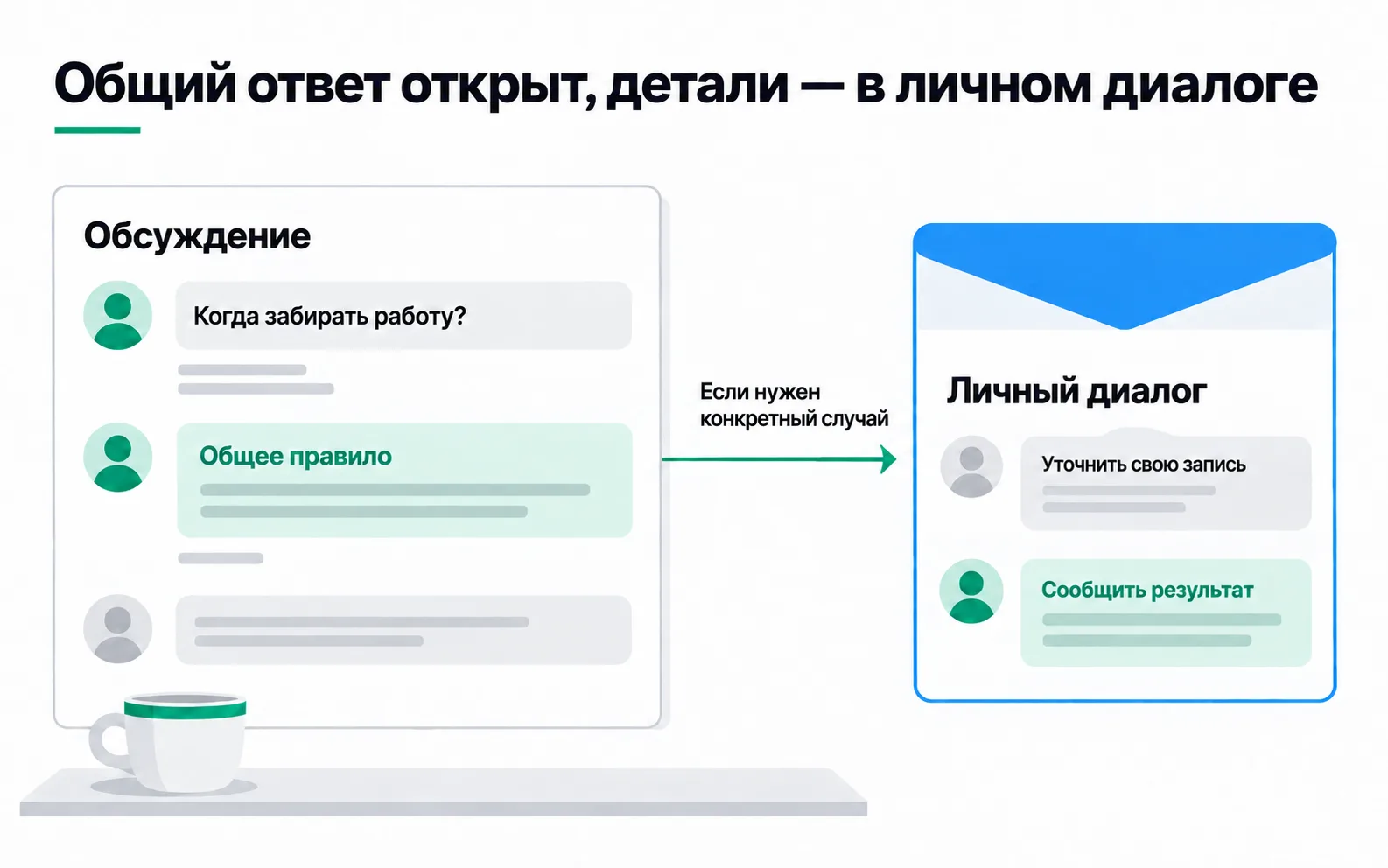
The picture shows the same sequence at a pottery studio.
A question log: where you see a complaint repeating
Since September the manager has logged every message from comments, DMs and WhatsApp as a row in a spreadsheet: date, where it came in, what it was about, city, what was answered, whether the question is closed. The shop already built its Instagram content series out of this log. Over two weeks a new topic built up in it:
| Topic | Messages in two weeks | Where | What they share |
|---|---|---|---|
| Order taking longer than 5 days | 12 | 7 in comments, 5 in DMs and WhatsApp | 9 from Karaganda and Pavlodar |
| Which grind for a cezve | 8 | Comments under Reels | First order |
| When the next roast comes | 5 | DMs | Regular customers |
Twelve complaints in two weeks, during which the shop sent out about 280 orders, isn't much. But everyone reads complaints under posts, and nine of the twelve came from two cities. The log showed where it hurts. When the owner called, the courier company explained why: the Karaganda sorting centre has a backlog, parcels sit there three extra days, and Pavlodar goes through the same hub. One of the twelve was Gulnara from Karaganda, whose parcel the shop had already been chasing at that hub.
A recurring complaint: log it, hand it over, answer it
Answering everyone with "send us a DM" means taking on the same task twelve times and never solving it. The manager can't change the courier company, but can go to the owner with the log instead of "people are complaining". Then come five steps:
- Log it. Each complaint is a row in the log with the order number. The number is asked for in DMs, never in the comments.
- Hand it to whoever decides. The owner chooses the couriers, so the task is theirs, and the log shows their name and a deadline next to the topic.
- Decide what changes. The owner sets the delivery time on the website to 5-8 days for Karaganda and Pavlodar until the backlog clears. For orders already on the way, the rule Gulnara was given still applies, with the new deadline: not delivered within 8 days means a new bag at the shop's expense.
- Tell everyone. One story, and the same text as a reply under every comment about the delay.
- Close it. When the courier company confirms the backlog is gone, the website goes back to 2-5 days and the twelve authors are told what changed.
The manager writes the reply under the comments by the shop's voice rules: the fact, what has already been done, what the customer should do.
Parcels to Karaganda and Pavlodar are currently taking 5-8 days instead of 2-5: the courier company's sorting centre in Karaganda has a backlog. We've already changed the delivery time on our website for these cities. If your order has been on its way for more than 8 days, send its number to our DMs and we'll ship a new bag at our expense.
Hiding the complaint, as the owner wanted, is worse than answering it. On Instagram a hidden comment is visible only to its author and the account owner, and the author isn't told it was hidden (how to hide comments). The author sees the complaint sitting there with no reply, while the next customer from Karaganda doesn't see it at all, orders expecting 2-5 days and writes the same thing a week later. Deleting it is the same, except the author will notice. Another good Reel on top of the complaints changes nothing either: people waiting for a parcel need a delivery date.
What to say in public and what in private messages
Under a post you answer what concerns many people: what's happening, what the shop has already done, where to write next. The order number, phone, address and payment details are sorted out in DMs or WhatsApp.
Once the issue is resolved, the manager goes back under the comment with one line: "Yerzhan, the parcel has arrived, thank you for waiting." Without it, readers see the question and "send us a DM" and never learn how it ended. The line is written only once the result is confirmed.
Screenshots of chats and orders showing a customer's name, phone or address don't go into comments or stories, even to prove the shop was right. The Law on Personal Data and Their Protection (as amended up to 14 September 2026), as a general rule, allows personal data to be disseminated in publicly available sources only with the person's consent (Art. 7(3)); comments and stories are, as we read it, such a source. This is a summary of the law, not legal advice.
Comment rules and what the platforms can do
Rules are written before the first argument and put where people will find them, for example in the profile's Highlights. The shop needed four:
- We answer on weekdays from 9:00 to 18:00; weekend messages are handled on Monday morning.
- We delete spam, ads for other people's products and insults.
- We delete other people's phone numbers, addresses and screenshots of other people's chats.
- Complaints and criticism stay up, and we answer them on the merits.
The last rule is what separates moderation from censorship: comments are removed for the author's behaviour, and content that's merely inconvenient for the shop doesn't count.
Instagram helps with spam and insults. The Hide unwanted comments filter is on by default and hides comments with common offensive words. In Hidden Words you can build your own list of words, phrases, numbers and emojis, such as the phrases spam bots use to sell followers. In Settings, under How others can interact with you, you choose who can comment and can turn comments off for all posts (hiding settings). For a single post, comments are turned off from that post's options menu (turning comments off). Hidden Words also applies to ads run from that profile, and comments on an ad can be opened and hidden in Ads Manager (comments on ads).
Customers who answer for you
Under a post about brewing in a cezve, a newcomer asks whether the Brazil tastes bitter, and Aliya answers before the manager does: "I've been buying it since the summer. Use a finer grind for a cezve, it isn't bitter." Aliya is one of the people known as brand evangelists or brand advocates. A community manager has three jobs with customers like her:
- Thank her by name and add what she doesn't know: the date of the next roast, the price, the delivery time to the asker's city.
- Correct her if the answer is wrong. If Aliya writes that regular customers get a discount and there is no discount, the manager gently clarifies under her comment: silence will be read as confirmation.
- Don't turn her into customer support and don't ask her to defend the shop in arguments about delivery. She doesn't have the facts, and an answer like that looks paid for.
If the shop starts giving Aliya coffee for posts, she becomes an ambassador, and her posts would most likely have to be labelled as advertising: Art. 19(1) and Art. 21(1) of the Law on Online Platforms and Online Advertising, as amended up to 2 March 2026, point that way.
What to count
Comment counts and ER show how many people responded, not whether their questions get solved. A community manager needs numbers from the log:
| What | How to count | Why |
|---|---|---|
| Messages per week | Rows in the log | Whether one manager is enough |
| Topics that came up three or more times | Group by topic | Tasks for whoever can fix the cause |
| Time to first reply | In working hours, from the log | Whether the shop keeps the promise in its rules |
| Closed complaints | A confirmed result exists | A reply is not yet a solution |
In the two weeks after the delivery time on the website was changed, the "longer than 5 days" topic got 3 messages instead of 12, while the grind got 7 and the next roast 6 over the same two weeks. The new delivery time probably helped, but in the same days the courier company started clearing its backlog, and these numbers can't separate which mattered more. For the shop, what counts is that delays are no longer at the top of the log.
Exercise: a month's question log
Take your own project or a client's business that gets comments, DMs or WhatsApp messages.
Frequent topics come in two kinds. A question that already has an answer, like the grind or pickup hours, is solved at the source: a line in the product description, a story in Highlights, a point in the message sent after an order. A complaint about something broken can only be solved by whoever is responsible for what broke. If that isn't you, your result is a row in the log with their name and a deadline.
A public reply needs a fact, a step taken and an action for the customer. "Everything will be sorted soon" and "We apologise for the inconvenience" contain none of the three. If the "question closed" column in your log is empty, the log is only counting replies so far.
Two weeks later the topic may come up as often as before. Then the cause was explained but not removed, and you go back to the owner a second time, now with two measurements. A topic can also vanish because people stopped logging it, so the log is kept even after the problem is solved.
Video: a community manager's work
Six minutes on ten techniques from the TexTerra agency: see which of them would help you close the questions in your log.