The owner of an online coffee shop in Almaty has an offer from an SMM agency: 12 posts, 8 Reels and stories every day for 150,000 ₸ a month. The shop has 9,000 followers on Instagram, a feed of bag photos and the odd promotion, and the owner asks you whether to sign. Until you decide how the account should make the shop money, there is nothing to compare the package with.
This is the shop from the lessons on the brand and influencer ads: freshly roasted beans delivered anywhere in Kazakhstan, an order of 15,000 ₸ that leaves the shop 6,000 ₸. The numbers in this lesson are illustrative.
The goal is in orders, not followers
The shop's goal is already written down in the marketing chain: by the end of the year a third of new customers place a second order within 60 days; over the summer a quarter did. An SMM strategy starts by turning that goal into units and tenge.
The shop gets about 150 new customers a month: before the influencer posts it had 30-40 first orders a week. A quarter of 150 is about 38 second orders, a third is 50. The gap of 12 second orders, at 6,000 ₸ each, is worth 72,000 ₸ of contribution a month. The second order is worth fighting for: the 840 customers who ordered more than once placed 5,640 orders in a year, almost seven each.
That gives the first answer to the agency. Even if Instagram closed the whole gap, within the 60-day window it would bring 72,000 ₸ a month, and the package costs 150,000 ₸. The package pays off only if the new regulars keep ordering after that, and you will see that after several months, not one.
Followers do not appear in this calculation. Money comes from orders, orders are counted in the CRM, and the CRM has no record of who follows the shop on Instagram.
Which of the three jobs the account does
The owner's word "Instagram" mixes the three jobs from the social media map: ads, the business's own account and the conversation. At the shop they look like this:
| Job | What it does at the shop | Who does it | Where the result shows |
|---|---|---|---|
| Ads | Bring new customers | Instagram ads and influencers | First orders through links tagged for ads and influencers |
| Own account | Get first-time buyers to a second order | The shop's posts, Reels and stories | Second orders through links tagged for the account |
| Conversation | Answer questions and complaints | The manager in comments and DMs | Question resolved with the first reply |
The agency is selling the second job, and the shop's goal is about exactly that one. New customers come from ads and influencers, so judging the account by follower growth means grading it on someone else's work. The account's role in the strategy reads like this: help someone who bought once brew a good cup and order again.
The conversation follows the shop's voice rules, and that job is closer to the account's than it looks. A customer whom nobody told that a Kenyan coffee is meant to taste tart is unlikely to order it twice.
There is no community in this strategy, no place where customers talk to each other. A chat for coffee lovers needs someone watching the conversation every day, and the shop can reach its second orders without one. The idea is worth revisiting when customers start asking for a place to talk about beans.
Series built from customer questions
Post topics come from the shop's conversations, not from a holiday calendar. In September the manager logged what people asked on WhatsApp and in comments: which grind to use for a cezve, 14 times; when the next roast is coming, 9; whether the Kenya is supposed to be sour, 6. Those questions became three series.
- How to brew what you bought. A 30-second Reel on grind size and ratios for a cezve, a moka pot and an espresso machine. Its job is to make the first bag taste good.
- Roast of the week. A bag with the date on the label and a flavour described in words people know. It reminds people to order when the beans run low.
- Question of the week. A customer's question and the manager's answer, with the author's permission. It clears up doubts before the order.
Each series has a question it answers and a step it expects from the reader. That is exactly what separates a series from a format: "Reels on Fridays" tells you neither what to film nor how to tell whether it worked.
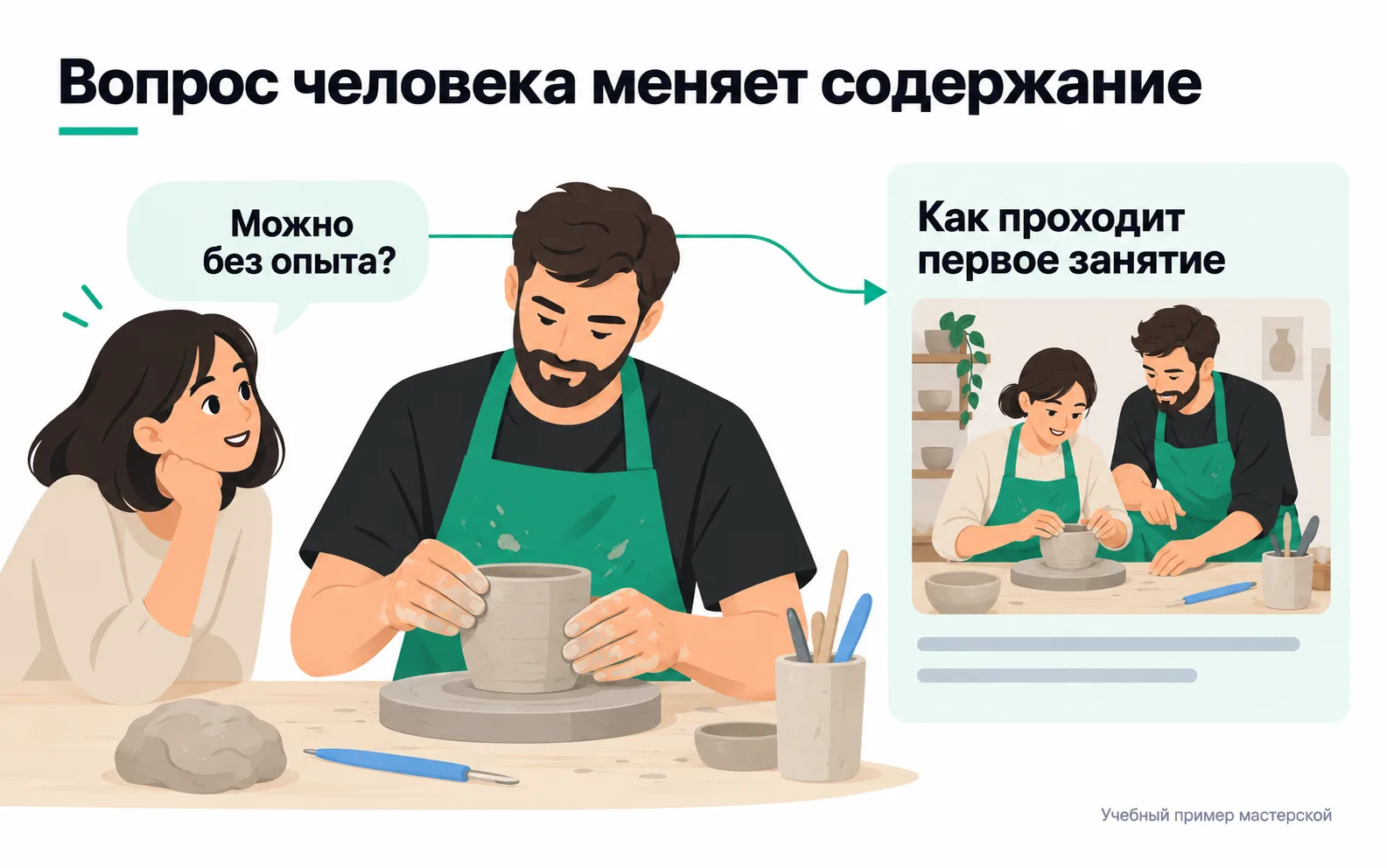
The picture shows the same move at a pottery studio: a question newcomers keep asking becomes a post.
The strategy on one page
All of it fits into one table. That is what you show the owner, and later a contractor, if it comes to that.
| Item | At the coffee shop |
|---|---|
| Business goal | By the end of the year a third of new customers place a second order within 60 days; over the summer a quarter did |
| What the goal is worth | 12 second orders a month, 72,000 ₸ of contribution a month |
| The account's role | Help someone who bought once brew a good cup and order again |
| Who it is for | First-time buyers and followers who make coffee at home |
| Series | How to brew what you bought; roast of the week; question of the week |
| The reader's step | Save the guide, tap the link in stories and order |
| Metrics | Second orders through links tagged for the account (CRM), saves on the guides (Instagram insights) |
| Who does the work | The roaster films two Reels a week, about three hours; the manager runs stories and replies |
| Review | In three months |
The shop puts the website link in stories with a link sticker and tags it according to the UTM reference table: utm_source=instagram, utm_medium=social, utm_campaign=reorder. utm_content holds the series: brew_guide, roast_week or question_week, and when a series has more than one video, the topic is added after an underscore, for example brew_guide_turka. A post outside the series, meant to show the shop to new people, gets the campaign first_order, like the influencer links. These are new values, so they go into the reference table first. Whether an order is someone's first or second shows up in the CRM.
The tags capture only part of what the account does. A customer who sees the roast of the week and opens the website directly arrives without a tag. So every month the shop also looks at the goal as a whole, the share of new customers with a second order within 60 days. Other steps from the same goal move it too, the postcard in the parcel and the WhatsApp reminder, so a rising share is not Instagram's credit alone. And if reorder orders keep growing while the share stays flat, the account is probably collecting orders that would have come anyway.
The review is in three months rather than two weeks: customers from the first month have had the full 60-day window for a second order only by the end of the third, and that is the first cohort you can count in full.
What to tell the agency
The agency's package has as many Reels as the strategy asks for, two a week. But it has no series and no tags, and the agency proposes to report on reach and ER. In three months the owner would know how many people saw the videos and still not know whether anyone ordered a second time.
The shop decides to start in-house. The roaster films the guides on a phone, and the manager posts stories with links and answers comments. If in three months there are second orders through reorder and the share has moved, the shop can hire the agency for series with a clear metric instead of "12 posts" and compare the price with 72,000 ₸. The contract then names SMM metrics tied to each series instead of ER: saves on the guides and second orders through the links.
Exercise: a one-page strategy for your project
Take your own project or a client business that already has a social media account.
A goal about followers or reach does not translate into tenge, and you will notice at the second item. Then ask yourself the question the coffee shop owner got in the marketing lesson: what does the business need those followers for? The answer is your goal.
The figure from the second item is what the account has to pay back in the first months. Spending more makes sense once the CRM shows that returning customers keep ordering. Until then the work stays within those limits, as at the shop: guides and the roast of the week instead of bag photos shot to make the feed look nice.
A series such as "useful content" or "Reels on Fridays" is a format. Rewrite it as a customer question, for example "how to brew in a cezve", and you will see what to film and what to count.
The review date cannot come before a person has had time to buy again. For coffee that is 60 days, for a course it is the start of the next cohort. A bridal shop hardly ever sells to the same person twice, and its account gets a different job: answering questions before the order and showing work people can point to.
Video: what SMM covers
A short introduction to the term. Afterwards, write one line for your own account: how it should make the business money.