In the first week of October an online coffee shop put three things on Instagram. A photo, "Roast of the week: Ethiopia", got 2,300 views in seven days; a Reel with a guide, "Grinding for a cezve", got 15,000; a meme Reel, "Monday without coffee", which the manager posted outside the series, got 21,000. The account has 9,000 followers. The owner draws two conclusions: Instagram is hiding posts from followers, and memes are what the shop should be filming.
Both conclusions assume "the algorithm" is a single lever someone has pulled against the shop. Here is what the platforms themselves say about how they choose what to show, and what follows for the shop. It is the same shop as in SMM strategy, and the numbers are illustrative.
Instagram has more than one algorithm
In May 2023 the head of Instagram, Adam Mosseri, described ranking this way: there is no single algorithm that decides what people see. Feed, Stories, Explore and Reels each have their own system, and each one predicts, for every viewer, what that person will do with a post.
| Surface | Whose posts | What Instagram predicts |
|---|---|---|
| Feed | Accounts you follow, recommendations and ads | Whether you will spend a few seconds on the post, comment, like, share, tap the profile photo |
| Stories | Accounts you follow, and ads | Whether you will tap into a story, reply to it, tap forward to the next one |
| Explore | Mostly accounts you do not follow | Likes, saves, shares |
| Reels | Mostly accounts you do not follow | Whether you will reshare, watch to the end, like, open the audio page |
Predictions rest on signals. For Feed, Instagram lists your activity (what you liked, saved, commented on), information about the post (including how many people like and save it and how quickly), information about the author, and your history of interacting with them. Post popularity, Mosseri writes, counts for much more in Explore than in Feed and Stories.
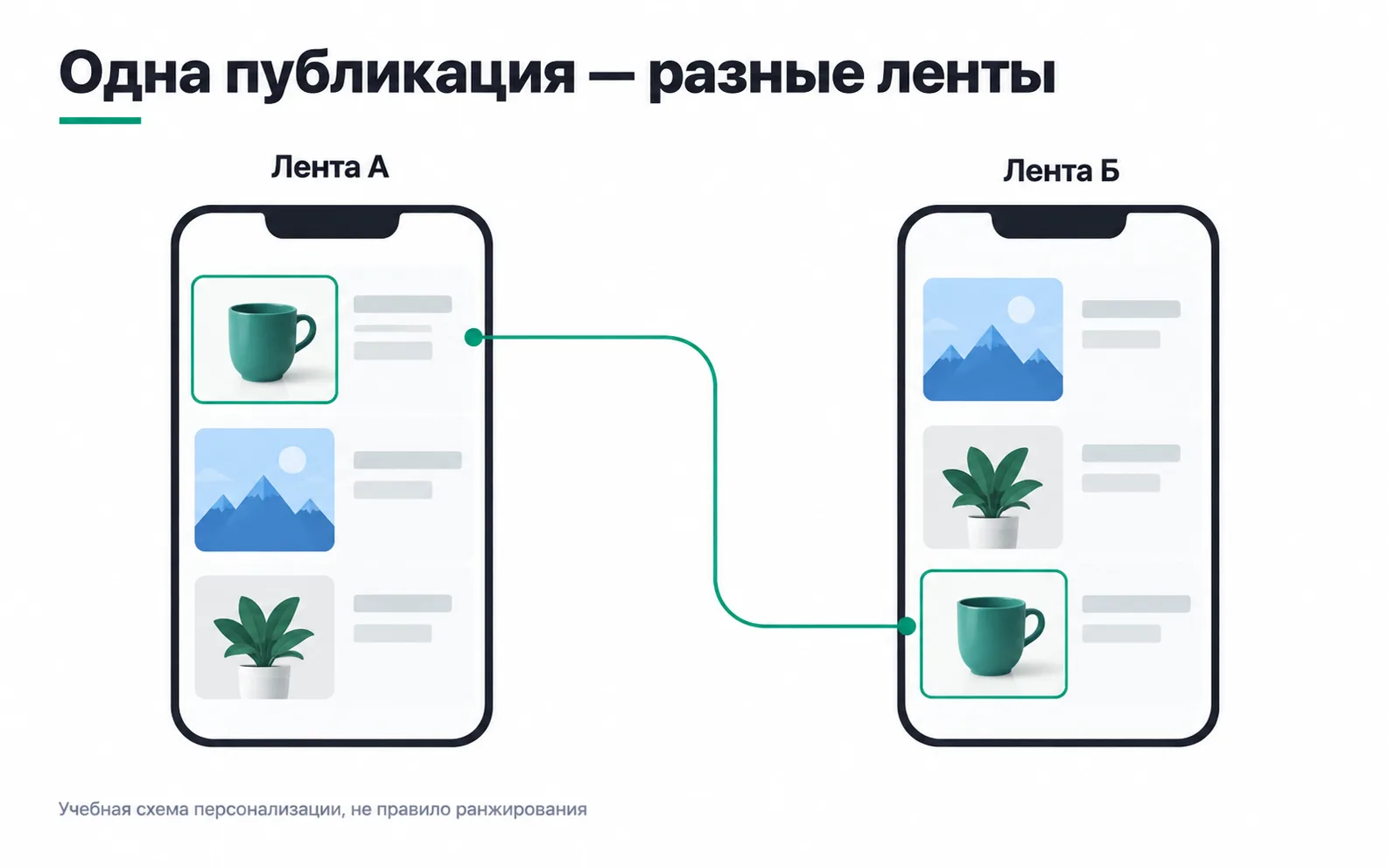
What this means for the shop's three posts
The photo went to Feed, which means mostly to followers. For each of them Instagram queued it among posts from friends, influencers and recommendations, so for one follower it came first and for another tenth. There is no sign of punishment in these numbers: with 9,000 followers the photo got 2,300 views, a follower's feed is full of other posts, and some people simply did not scroll down to the photo that week.
Instagram also shows Reels in the Reels tab, where most of what a viewer sees comes from accounts they do not follow. The Reels had 11,200 and 17,500 viewers, more than the shop has followers, so people outside the follower base watched them too. The meme collected more likes and more shares, which are exactly the actions Instagram predicts for Reels. Why the meme in particular was shown more widely, three videos cannot prove. One thing is clear: the shop's orders are not on the list of signals Instagram publishes. The system shows a video to people it expects to watch and share it; whether anyone buys beans is not part of its calculation.
If it feels as if the account has been throttled, the same Mosseri article points you to Account Status, where Instagram shows why content might not be eligible for recommendations. It is in Settings, under More info and support (checking your account status). If everything there is clear, a weak post is simply a weak post.
TikTok: watching to the end decides, not follower count
In its help article on how TikTok recommends content, TikTok names three groups of factors for the For You feed:
- user interactions: what you like, share and comment on, what you watch in full or skip;
- content information: sounds, hashtags, number of views, the country where it was posted;
- user information: device settings, language, location, time zone.
TikTok ranks the Following feed for each person too: two people who follow the same creators see their videos in a different order. Bought followers will not help: according to TikTok, follower count is not a direct factor in recommendations (its 2020 explanation), and viewers' actions, including watch time, carry the most weight.
There is one detail specific to Kazakhstan. TikTok lets you turn off feed personalisation, in which case For You becomes a feed of content popular in your region and worldwide, and videos from people you follow and friends may appear in chronological order. According to TikTok's help page, this setting exists only in the EU and Kazakhstan.
YouTube: watch history and surveys
YouTube lists the main signals behind its recommendations: watch and search history, subscriptions, likes, dislikes, "Not interested", "Don't recommend channel" and survey responses. Surveys are there so the system knows whether someone liked a video, which watch time alone cannot tell it. The home page is chosen mainly from watch history, Up next depends on the video being watched right now, and the Shorts feed is personalised as well.
YouTube also has search: a video on how to choose a grinder can be found through a query a year after it was posted, and YouTube SEO is what gets you into those results.
Telegram: there is no feed
A Telegram channel has no ranking. Every post goes to subscribers with a notification unless they have turned it off; that is how Telegram itself describes channels. On the recommendation side, Telegram describes similar channels: since November 2023, when someone joins a channel, they are offered similar public channels picked by overlap in subscribers.
So differences in views between a channel's posts are made by people. For the online school in the lesson on why people share, the announcement got 2,100 views and the checklist 3,400, although both posts went to every subscriber: readers forwarded the checklist 52 times and the announcement 6.
What follows for the shop
The platforms name groups of signals but publish neither weights nor thresholds. A sentence like "after 500 saves Instagram sends a video into recommendations" appears in none of these documents.
The surfaces do different jobs. Reels and TikTok show the shop to people who do not follow it. Feed and Stories remind followers that it exists. For the shop's goal, second orders, stories with a link are more useful than another meme: they are seen by followers, and some of those followers are customers.
The meme is worth keeping if you expect it to do what it is good at: showing the shop to new people. But letting views decide what to film next hands the choice to a system that knows nothing about orders. Instead, compare videos by their job, as in SMM metrics.
Exercise: your own posts and the save threshold
Take your own project's account or a client's.
The Feed post will most likely have fewer viewers than you have followers: it is seen mostly by followers, and not all of them scrolled that far. Instagram shows a story to followers, and it lasts a day, so its viewers are the followers who opened stories during that day. Compare them with the Feed post's viewers: if more people see the story, that is the better place for a reminder to order. A Reel that got a share of recommendations can beat the follower count several times over. When the Reel did not get more viewers than you have followers either, and the account status is clear, the video simply did not make it into recommendations, and you look for the cause in whether people watch it through and share it.
Now the question you will be asked. The manager who runs the shop's account read on someone's blog that "after 500 saves Instagram pushes a video into recommendations" and suggests asking for saves in every video. What do you tell them?
Instagram has published no such threshold. It lists saves among its predictions for Explore, puts reshares, watching to the end and likes first for Reels, and gives neither weights nor numbers. Nor can you test someone else's threshold on three videos from your own account: they are not enough to work out what one signal weighs. So whether to ask for saves depends on the video's job, not on a threshold nobody has seen.
Video: a breakdown of algorithmic feeds
Where the video disagrees with what the platforms themselves say, trust the platforms: their systems change, and the video stays the same.