An online analytics school in Almaty runs a Telegram channel, and the links in its posts are tagged according to the school's UTM scheme. In the week it was recruiting for a new stream, two posts went out. post_a was an announcement: the course for 25,000 ₸, the start date, a link to sign up. post_b was a checklist, "Before your first lesson": which laptop will do, which files to download in advance, which accounts to set up, with the full version and screenshots on the school's website. The announcement was forwarded 6 times, the checklist 52. The owner asks for "more viral posts like that one", and you need to work out what actually happened and what the school got out of it. The numbers are illustrative.
How content really spreads
Sharad Goel, Duncan Watts and their co-authors analysed a billion diffusion events on Twitter (Management Science, 2016): news stories, videos, images, petitions. The authors point out that over 99% of cascades are tiny and stop after the first step, and in their data even moderately popular events turned up about once in a thousand, while true viral hits came closer to once in a million. Even popular content got most of its reach from a single large broadcast, such as a post by an account with a big audience, rather than from a long chain of person-to-person forwards.
For the school, two conclusions follow. A chain of forwards that carries a post across the city by itself doesn't go into the plan. One step, though, is something you can count on: some subscribers will forward the checklist to one or two friends who need it tomorrow. Reach comes from the size of the channel and from paid promotion, and forwards add to it.
Why people forward: STEPPS
In his book "Contagious" (Simon & Schuster, 2013), Jonah Berger grouped the reasons people share into six principles, STEPPS. Resources for the book are on his website. The principles work best as questions about your own material:
| Principle | Question to ask about the material | Example at the school |
|---|---|---|
| Social Currency | How does the sender look to the recipient? | A graduate shares the dashboard from their final project, and it shows they can do the work |
| Triggers | What in everyday life will bring it to mind? | Tomorrow's first lesson; the Monday report that still gets compiled by hand |
| Emotion | What will the person feel? | Surprise: a report that used to take a day gets built in an hour |
| Public | Can others see that people use it? | Graduates post their dashboards on LinkedIn and tag the school |
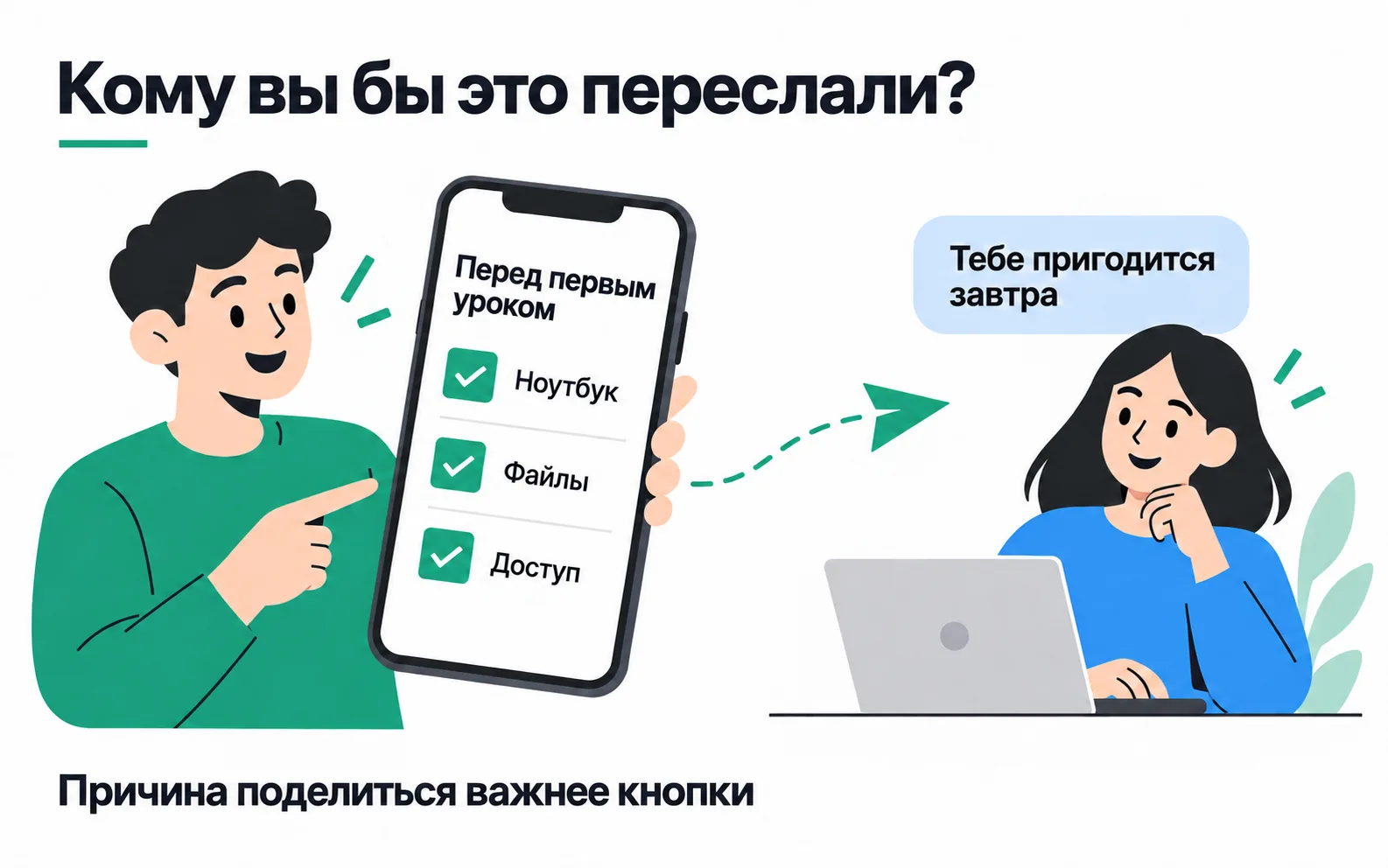
| Practical Value | What problem will the recipient solve? | The "Before your first lesson" checklist |
| Stories | What story will carry it? | A graduate's path from manual spreadsheets to a dashboard, told with their consent |
The checklist rests on two principles: practical value and a trigger. People forward it the evening before a first lesson, and the next day the recipient needs it. There's no reason to add the other four: a joke or a dramatic story in a checklist only makes it harder to read.
Emotion: what Berger and Milkman found
On emotion and sharing, Berger has a study with Katherine Milkman, "What Makes Online Content Viral?" (Journal of Marketing Research, 2012). They collected 6,956 articles from the New York Times home page between 30 August and 30 November 2008 and tracked which ones made the most-emailed list. One in five did.
Positive articles made the list more often than negative ones, but it wasn't only a matter of whether the emotions were pleasant or unpleasant. Articles that evoke awe, anger or anxiety, emotions with high arousal, were shared more, while sadness, a low-arousal emotion, reduced sharing. Practical usefulness, interest and surprise were also linked to sharing, and the effect of emotion held even after accounting for them. In lab experiments the authors then showed that the level of arousal was what drove it.
Carry this over to the school's post only as a hypothesis. That study looked at newspaper articles from 2008 sent by email; here you have Telegram and people choosing a course. A post that plays on anxiety, something like "Excel is dead and you're still compiling reports by hand", may get forwarded by exactly the people who want to argue with it, not by those planning to study. This angle is also risky. As we read it, a post in the school's open channel that invites people to the course is itself advertising: information for an indefinite range of people that builds interest in a service and helps sell it (Article 3, subparagraph 1-2 of the Law "On Advertising"). The law classes as unfair any advertising that demeans or mocks non-users of the advertised product (Article 7(1)(4)), and as we read it, a post along the lines of "and you're still compiling reports by hand" could fall under that. This is a summary of the law as amended up to 17 May 2026, not legal advice.
Awe and surprise can be stirred without an invented threat, for instance by a walkthrough where a report that used to take a day gets built in an hour, provided the school's students really work that way.
What forwarding brought: counting one week
| Metric | post_a, announcement | post_b, checklist |
|---|---|---|
| Views in Telegram | 2,100 | 3,400 |
| Forwards | 6 | 52 |
| Sessions with the post's tag in GA4 | 60 | 130 |
| CRM leads with the post's tag | 6 | 2 |
Telegram shows a channel admin statistics for its posts (how channels work), including forwards of each recent post (the statistics fields), and a post's views include views of its forwarded copies. Sessions appear in GA4 by utm_content, and leads in the CRM, where the form saves the tags, as in end-to-end analytics.
The checklist was forwarded almost nine times as often and brought more than twice the visits. Eight leads can't give you the exact difference, but they do show the posts doing different jobs: one in ten people who clicked through from the announcement submitted the form, against two of 130 from the checklist. People who click the announcement are choosing a course; those who click the checklist seem to be students already, plus their friends. If you calculate a share rate, label the denominator: the checklist has 52 forwards on 3,400 views, which is 1.5% of views, not of subscribers.
There's a second problem. A forwarded post carries the same link with utm_content=post_b, so a channel subscriber and the person they forwarded it to land in the same GA4 row, and the report can't tell you how many of the 130 sessions came through forwards. And if someone copied the link and sent it on WhatsApp, even the forward counter won't show it.
You can separate some of the forwards with a link of your own. At the end of the checklist, add a line, "Forward this to someone who's starting to learn", linking to Telegram's share window (the format of that link), and put the address of the same checklist on the website inside it, with its own tag, post_b_share. The link leads to the checklist, not to the course page: the recipient is most likely already studying, and there's no point selling them the course. Add the new value to the tag directory first, then to the link:
The checklist address inside is URL-encoded. Without that, the link breaks at the first &, and the recipient arrives with utm_source alone. People who forward the post with the ordinary button will stay in the post_b row, but visits through your line will show up separately.
From here on, measure each post by its job. The announcement brings in people choosing a course, so count its leads and payments. The checklist helps people who are already studying, so count its forwards and visits through post_b_share, not this week's leads.
What not to do for the sake of forwards
- Don't ask people to forward the post or tag friends in exchange for the checklist. People will forward it to get access, and it will reach whoever was handy, not the person with a lesson tomorrow.
- Don't invent outrage or other people's stories. A graduate's story goes into a post only with their consent, under the same rules as a review on the website, and in their own words, with no results added on their behalf.
- Don't promise a client a viral video. In Goel and Watts's data, a viral hit came up about once in a million events. What you can promise is the reach you buy, with forwards counted as a bonus on top.
Assignment: "I'll send this to _ because _"
Take one piece of your project's content that links to the site: a post, a checklist, a walkthrough.
The sentence first. If the second half came out as "because it's funny" and the product has nothing to do with the joke, there may be forwards, but the recipient will never learn what you do. If it came out as "because they'll need it tomorrow", look in the table for sessions with the _share tag: those people were brought by a reader, not by the channel.
Then the table. Lots of forwards and few visits most likely mean the material is useful without the site, and that's fine if its job is to build trust in the school. Compare leads only once each post has about ten: with fewer, a gap of two or three leads easily happens by chance, as with the school's eight. At the school's pace the announcement gets there in two weeks, the checklist in about five.
Video: viral marketing
From the PromoPult channel. Before your next post, finish the same sentence: "I'll send this to _ because _".