Aruzhan finished the course at an IELTS prep centre in Almaty, scored 7.0 and gave the centre a testimonial with consent to use it in ads: a 40-second video built from her answers to five questions, which may be cut but not rewritten. The owner, who wants "storytelling like the competitors have", has already posted about her:
Aruzhan came to us and scored 7.0 on IELTS! 🎉 Want the same? Sign up for the course!
There is no story in that post. The hero is the centre ("came to us"), there is no obstacle, and "want the same?" promises 7.0 to everyone who signs up. Below you will build a customer story from the same material, and then, on the same pattern, a product story and a story of your own case. The names and numbers are illustrative.
How a story differs from a testimonial
"Loved it, recommend" is a verdict. "Experienced teachers, convenient schedule" is a list of features. A story tells what someone wanted, what stood in the way, what they chose and what came of it. It has details you can't make up at a desk: "in June my practice test showed 5.5", "I froze on every second question". Through them a reader in the same situation recognises themselves, and everyone else scrolls on. For advertising, both outcomes are useful.
There is also evidence that stories are easier to remember. Raymond Mar and colleagues pooled 37 articles, 78 samples and more than 33,000 participants in a meta-analysis (Psychonomic Bulletin & Review, 2021): narratives were understood and recalled better than expository texts such as textbooks and manuals, by a little over half a standard deviation. But what those studies tested was comprehension and memory of texts people read to learn. The analysis says nothing about sales after an ad, and the individual studies in it vary widely. As for the claim that "stories are 22 times more memorable", usually credited to the psychologist Jerome Bruner, it circulates from article to article without a reference to any study. Keep it out of client reports.
The story skeleton: eight sentence starters
To keep a story from falling apart into a list, you build it on a skeleton. Playwright and improv teacher Kenn Adams came up with the Story Spine exercise in the late 1980s: eight sentences where only the opening words are fixed (NPR interview with the author). It reached Pixar through Rebecca Stockley: she attended one of his workshops in San Francisco and later taught improvisation to the studio's writers. Many people know the skeleton from the 22 rules of storytelling that Pixar storyboard artist Emma Coats posted on Twitter in 2011 (Stu Maschwitz's analysis): a shortened version of the skeleton is her rule number four.
Here is the skeleton filled in with Aruzhan's answers:
| Sentence starter | Aruzhan's story |
|---|---|
| Once upon a time... | there was Aruzhan, who needed 6.5 on IELTS for a master's programme |
| Every day... | she prepared for the exam, but in speaking she froze on every second question |
| But one day... | a practice test in June showed 5.5 |
| Because of that... | she signed up for the course at the centre |
| Because of that... | for three months the lessons took her pauses apart, and at home she studied for another hour a day on her own |
| Because of that... | the pauses in speaking went away |
| Until finally... | she scored 7.0 on the exam |
| And ever since then... | she has the score for her master's, and writing is still hard for her |
The lines retell her answers to the five questions. The skeleton also shows what the owner's post was missing: it had only "came" and "scored", and everything that explains the result had dropped out. The reader was left to take it on faith.
The "Because of that" lines matter most, because they carry cause and effect. If what you write there is "convenient schedule, experienced teachers", the story has turned back into a list of features.
The hero is the customer, not the brand
In "Building a StoryBrand" (HarperCollins Leadership, 2017), Donald Miller suggests framing a brand's messages as a story where the customer is the hero and the brand is the guide: it understands the hero's problem and gives them a plan. His SB7 framework has seven parts, but three are enough for a post: the hero has a problem, the guide offers a plan, and the hero acts.
In Aruzhan's story the centre is the guide: the plan and the speaking reviews. The hour a day at home was her own work, and it can't be cut. A post from the same material:
"In June my practice test showed 5.5, and the master's programme needs 6.5," says Aruzhan. In speaking she froze on every second question. For three months our lessons took her pauses apart, and at home she studied for another hour a day on her own. She scored 7.0 on the exam. Writing, she says, is still hard.
You can find out where you lose points at a free trial lesson. A manager will message you on WhatsApp.
The centre appears twice in the post: what it did in lessons and what it offers now, and both can be seen at a trial lesson. "An hour a day on her own" and the line about writing stay in, under the rules for cutting a testimonial. And the last line invites people to find their own mistakes: that is something the centre can promise everyone, and a score is not.
For an ad caption the same story is squeezed into a single line, and it still keeps the 5.5, the course with an hour a day and the 7.0. The video is judged by the people who come to a trial lesson, like any creative in the log, and angles are chosen from the creative log over several tests, once the difference rests on more than one or two attendees.
Two more stories every business has
A product story: why the date is on the bag
The online coffee shop from the lesson on what marketing is used to advertise itself with "Coffee you fall in love with from the first sip", and the roast date on the bag as its main argument came from customers themselves: the owner asked ten people who had ordered more than once why they had moved away from supermarket beans. Their answers made a story, and it can be told in the shop's voice:
We asked ten people who have ordered from us more than once why they stopped buying beans at the supermarket. Seven gave the same answer: there you don't know when the beans were roasted. Every bag of ours has the roast date on it, and we roast every week. 15,000 ₸ a kilo, delivered anywhere in Kazakhstan in 2-5 days.
Here too the hero is the customer, someone tired of guessing how fresh the beans are. And the post says seven of the ten asked, not "70% of customers": a percentage of ten phone calls would look like a study that never happened, like "75% of graduates" from a survey of 24 people.
Any business that asks customers why they chose it has a story like this. If one reason keeps coming up among five to ten people, you have found your product story. If the answers are all different, keep asking.
A case story: the week 2 test
For a freelancer, the most important story is the case study. A client uses it to judge whether you can think, and it rests on the same skeleton: goal, obstacle, choice. Here is how the IELTS centre's test from the Meta campaign reads:
The IELTS prep centre wanted leads at no more than 2,000 ₸. In five days, 9,860 ₸ brought in 11 leads at 896 ₸, less than half the planned 2,000 ₸. But only seven replied on WhatsApp and three came to the trial lesson, so each person who came cost 3,287 ₸. With eleven leads, there's no telling why the others didn't come. In the second test I'm planning around the cost per person who attends the lesson instead of the cost per lead, and the manager will record why people didn't show up.
The turning point is "But only seven replied on WhatsApp". Without that line the case would read as a success, a CPL less than half the planned 2,000 ₸, and the client would only learn about the three attendees on their own project. A paragraph like this is exactly the conclusion of a portfolio case study: it starts with a number and ends with a decision.
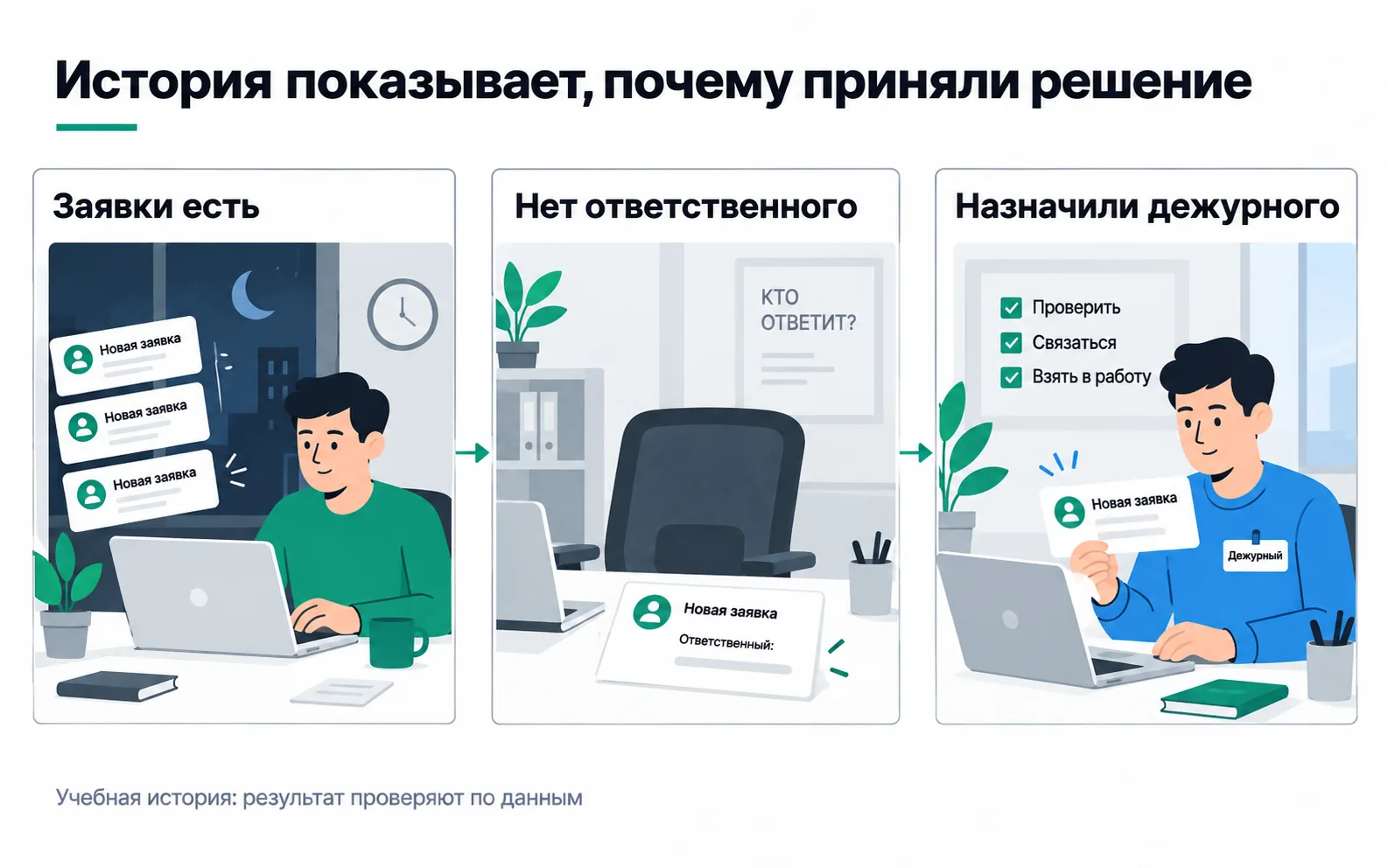
The picture shows the same pattern in a story about a decision inside a team: leads come in during the evening, some have nobody responsible for them, and the team puts someone on duty.
What a story must not contain
- Invented details and quotes. If Aruzhan never said "the centre changed my life", that line appears neither in the post nor in the video. A story assembled from several customers is labelled as such: "put together from what three of our students told us".
- Generalisations. A caption like "Our students score 7.0" turns one student's result into a promise to everyone, and that becomes a question of advertising law.
- A happy ending that didn't happen. A case study that says "sales grew" when what stands behind it is three people at a trial lesson falls apart at the client's first question.
- Other people's stories without consent. Consent comes from the person whose name and face are in the story, and what it must say and where it is kept is settled before publication.
Exercise: three stories for your own project
Take the project you ran the week 2 test for in the Start track, or a friend's business.
The "Because of that" lines get reread first. If they list the business's features instead of what the customer did, the story is still an ad in list form. Ask the customer what exactly they did and what changed as a result, and rewrite the lines in their words.
Then look at who the hero is. If "we" appears in every other sentence, keep the business only where it provided a plan or a tool. If the story has no obstacle ("came, studied, passed"), it is dull to read and impossible to check: put the "But one day" line back.
In the product story, count people: when five to ten were asked, you write "six of the ten", and a percentage has no place there. In the test story, look for the turn where the numbers pull apart. For the centre, that is 11 leads at 896 ₸ and just three people at the lesson. Finally, the ad line. If it has lost the obstacle or what the customer did themselves, it promises more than happened.
Video: stories taken apart
The video is in Russian. Run its examples through the skeleton from this lesson: does each story have an obstacle, and does the ending promise the result to everyone?