In a single morning, three people write to an online coffee shop. Gulnara in Karaganda paid for her order six days ago and the parcel still has not arrived, though the site promises 2-5 days. Under an Instagram post, a new customer leaves a comment: "Bought the Kenya, sour as a lemon. For 15,000 ₸ I expected something else." And on WhatsApp, someone who has never ordered asks which beans to get for a cezve. One manager answers all three. If he replies to all three in the same breezy way, Gulnara will get angrier, and the people reading the comments will decide this shop brushes complaints off.
This is the shop from the lesson on blogger advertising: freshly roasted beans delivered all over Kazakhstan. The names and numbers are illustrative.
Tone of voice is the set of rules a brand follows when it writes and speaks. It has two parts. The voice is the character, and it never changes: how the shop addresses people, which words it uses to describe coffee, what it never jokes about. The tone changes with the situation: short and to the point with Gulnara, warmer and more detailed with the newcomer. Mailchimp's editorial guide explains it the same way: you have one voice, and your tone changes, including with the emotional state of the person you are writing to.
In a brand platform the voice takes up one line. Here that line grows into a working document with examples, so that a new manager answers a customer the way the owner would.
The picture shows the same difference for a mentor at an online school.
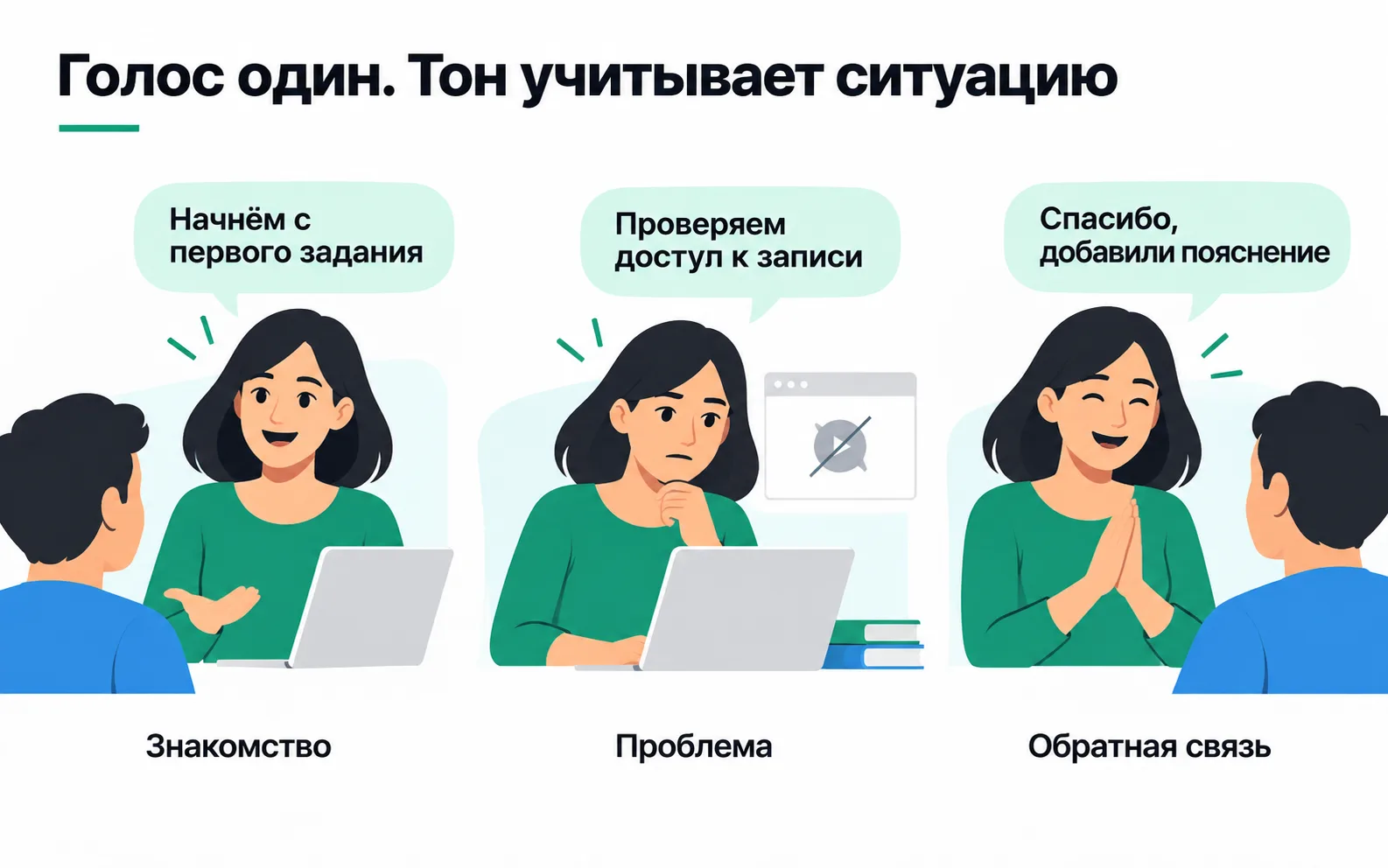
The shop's voice: rules with examples
Adjectives such as "friendly, expert, modern" mean something different to everyone, and they will not tell a manager what to write to Gulnara. What works is rules, each with a "we write" and a "we don't write" example. The shop has six:
| Rule | We write | We don't write |
|---|---|---|
| Speak in facts: date, delivery time, price | "Roasted on Monday, delivered in 2-5 days" | "The freshest coffee with fast delivery" |
| Answer the question first | "For a cezve, go for the Brazil: chocolatey, no sourness" | "Thanks for getting in touch! We have a wide choice of beans..." |
| Only write about what has already been done | "We've written to the courier company, they promise an answer by 15:00" | "All sorted!" before it is |
| Describe taste through things people know | "Sour like a green apple" | "Bright acidity with notes of bergamot" |
| No comparisons with others | "The roast date is on every bag" | "Unlike supermarket coffee" |
| Formal "you" and the person's name, one emoji at most, never in a reply to a complaint | "Good afternoon, Gulnara" | "Dear customer!", "Oops 😅" |
The voice is the same in ads. The ad the shop used to replace the cappuccino picture follows these rules: "Beans for home, roast date on the bag. 15,000 ₸ a kilo, delivered in 2-5 days." It has facts, a price and a delivery time, and not a single "best".
Comparing yourself with others in an ad is off limits anyway: the law "On advertising" as amended up to 17 May 2026 directly classes any comparison with other sellers' goods, even one without value judgements, as unfair advertising (Article 7(1)(1)). This is a summary of the rule, not legal advice.
A separate rule covers language. If a customer writes in Kazakh, the reply is in Kazakh. The templates for those replies are written by someone who speaks Kazakh, not by a browser translator: machine translation in a reply to a complaint reads as a brush-off. A customer from Shymkent asks when his order will arrive and gets an answer:
"Hello! When will my order arrive?"
"Hello, Nurlan! Your order has reached Shymkent, and the courier will deliver it tomorrow by 18:00."
Both messages are in Kazakh in the original.
Tone: three situations
The parcel is late
The manager's first reply to Gulnara was:
"Oops! Delivery let us down a bit 😅 It'll all be there soon!"
There are three mistakes in it. A joke in reply to a late parcel sounds like "we don't care". "Delivery let us down" shifts the blame, although Gulnara paid the shop, not the courier. And "soon" is not a time: once "soon" has passed, she will write again, angrier.
After editing:
"Good afternoon, Gulnara. Since Monday the parcel has been at the courier company's sorting centre in Karaganda. We've written to them, they promise an answer by 15:00, and we'll forward it to you straight away. If it has not arrived by Friday, we will send a new bag at our expense."
The tone is serious, with no exclamation marks or emoji, and the voice is the same: facts, a time, the next step. The manager can write the last sentence only because the owner decided in advance what to do when a parcel takes longer than a week. Without that decision, promising a new bag would be exactly the "all sorted" the shop's voice does not allow.
A complaint in the comments
A reply under a post is read by the author and by everyone scrolling through the comments. The template "Thank you for your feedback! We're so sorry you didn't like it 🙏" tells them nobody read the complaint. A reply in the shop's voice:
"Aizhan, thanks for writing. The Kenya really is sour, like a green apple, and our description only mentioned it in passing; we'll fix that. If you brew in a cezve, try a finer grind. If it still doesn't suit you, message us on WhatsApp and we'll swap it for the Brazil."
The tone is warm, but the shop does not apologise for something it did not do: sourness is a property of the beans. It owns its part, the passing mention, gives advice and offers a way out, and the swap, like the new bag for Gulnara, is a rule the owner approved in advance. People reading the comments see that the complaint got a real answer.
A new customer's question
To the newcomer who asked about the cezve, the manager used to send a link to the catalogue. Now he replies like this:
"Good afternoon! For a cezve, go for the Brazil: chocolatey, no sourness. 15,000 ₸ a kilo, delivered in 2-5 days depending on the city. Tell us where you are and we'll give you the exact time."
Here there is room for more warmth and detail: the person is choosing and in no hurry. But even here the answer to the question comes first, then the price and delivery time, and a story about how much the shop loves coffee is not needed at all.
How to collect and test the rules
The rules are not invented from scratch; they are pulled out of real conversations.
- Export the last 30-50 replies to customers: from WhatsApp, comments and reviews. Remove names and phone numbers.
- Mark the replies after which the question was closed first time, and the ones after which the customer asked again or got angry.
- Look at what the good ones have in common and write down 5-7 rules, each with a "we write" and a "we don't write" example.
- Save the frequent replies in WhatsApp Business as Quick Replies, shortcuts for messages you send again and again (WhatsApp Business features). Leave room in each template for the name and the details: an unedited template reads as a brush-off.
Testing the rules takes half an hour. Give two people the same five customer messages and ask them to reply from the document without talking to each other. If one promised a new bag and the other suggested waiting, the rule about promises is unclear. Sharpen it with an example and run the test again.
A one- or two-page document with a table of rules and a dozen examples is more useful than a thick brand book: it is the one a manager opens while answering a customer right now.
Exercise: voice rules for your own project
Take a business that chats with its customers: your own, a client's or a friend's.
Reread your rules and strike out any that would fit every business: "polite", "always available", "we care about our customers". A rule works if you can argue about a single sentence with it. Your rewritten reply to an outage needs the fact, the time of the next update and what you have already done, and compensation only if the owner approved it in advance. In the reply to a public complaint, check whether you owned your part and avoided arguing with the author: future customers will read that reply. Where your colleague's replies differ from yours on a point the rules cover, sharpen that rule with an example. Where they differ on a point the rules do not cover, you have found your next rule.