Since September an online analytics school in Almaty has had a checklist for new students on its website: which laptop you need, where the files for the first lesson are, how to open the report in Data Studio (formerly Looker Studio). The Telegram post about it got 3,400 views. Yet in the first week of the October stream the curators again got 41 questions about getting ready, against 48 in September with no checklist at all. GA4 shows 38 views of the checklist page for that week, with 60 new students. The owner draws a conclusion: "Nobody reads checklists. Let's write ten more, one for every tool on the course."
Ten new checklists will end up where the first one did: on a website nobody goes to for them. Before writing them, answer three questions: does the reader need the material, can the reader find it, and how was it meant to reach them. Low views may mean poor delivery rather than lack of interest. The school's numbers in this lesson are illustrative.
Why useful material goes unread
| Question | How to answer it | What the school found |
|---|---|---|
| Is the material needed | Count repeat questions, requests and search queries on the topic | 41 questions in a week: it's needed |
| Can the reader find it | Walk the reader's path and note where they come across the link | The link is only in the channel post. It isn't on the course page, in the post-payment email or in the stream chat |
| How was it meant to reach them | Find the plan: who shows the link, where and when | The places were listed on the card, but none had anyone responsible, and only the post ever happened |
You start with the first question because everything else depends on it. If only two people per stream asked about preparation, the checklist would be unnecessary, and ten new ones even more so. But 41 questions say people need the answer; they just look for it in the chat, not on the website.
The second question settles it. The channel post went out two weeks before the start, so anyone who paid later or isn't subscribed to the channel never saw it. The post-payment email stayed as it was: "Welcome, here's the link to the chat." And one curator was sending students a PDF from the spring with an old link to the folder: the copy had a life of its own, even though the website had long been fixed.
38 views against 41 questions is demand without delivery. If the page had 300 views alongside the same 41 questions, the conclusion would be different: people find the checklist but don't find the answer in it, and the text is what needs fixing.
The picture shows the same gap: the material is ready and checked, and the reader is still asking where the instructions are.
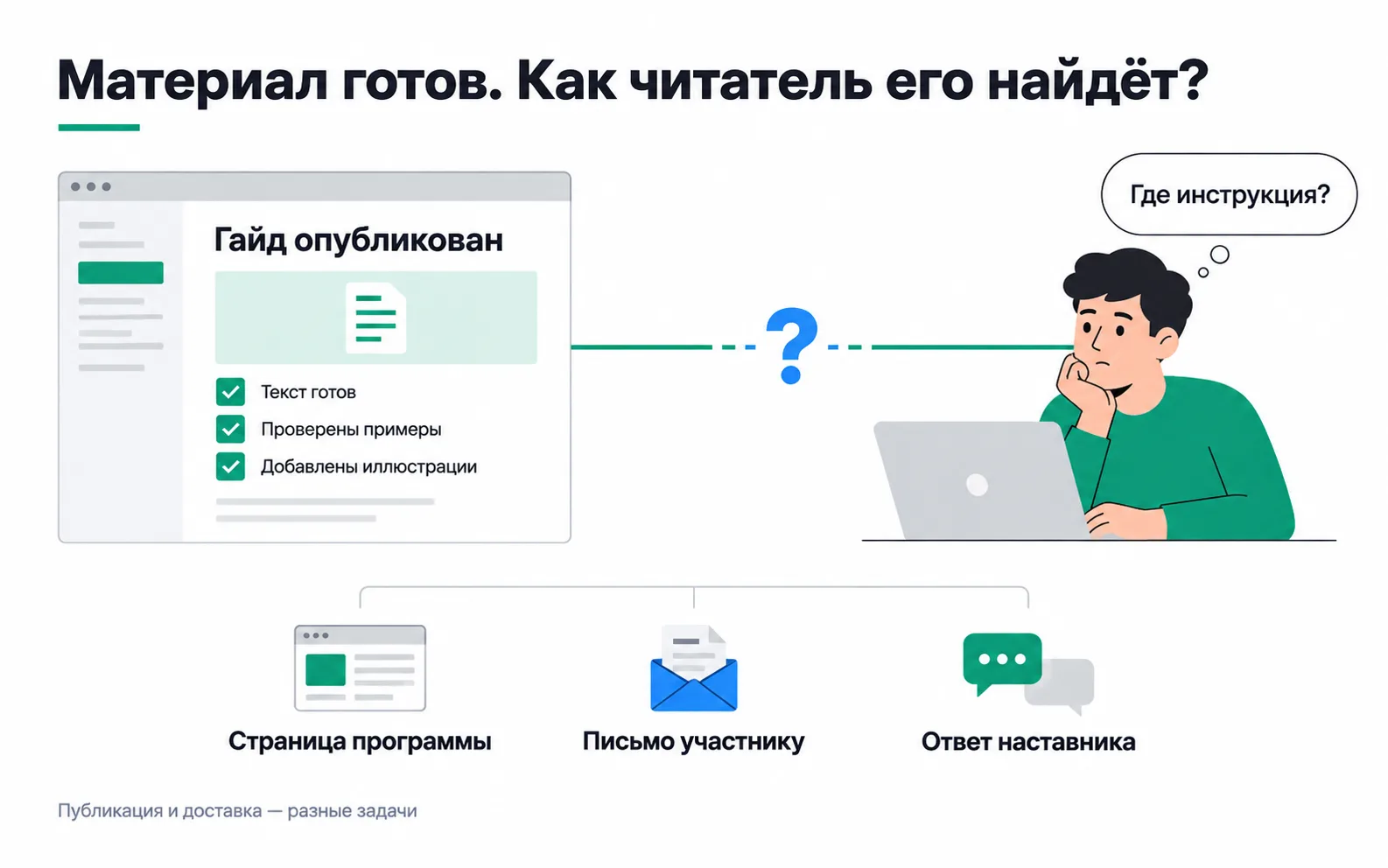
The route: where the link should be
The link goes where the question comes up, at the moment it comes up. For the school's checklist there are five such places:
| Where the question comes up | What goes there | Who is responsible |
|---|---|---|
| Someone choosing a course on the course page | A "What you'll need" block: three lines and a link to the checklist | The marketer |
| A student has paid and receives an email | The first line of the email: "Before your first lesson, get your laptop and files ready" and the link | The marketer |
| A student joins the stream chat | A pinned message with the link | The senior curator |
| A student writes to a curator | A reply template with a link to the right section, no copied text | The curators |
| Recruitment week in the Telegram channel | Post post_b with the link, following the same rules as a post made for forwarding | The marketer |
The link text names the task. "Materials" could mean anything, while "What to prepare for your first lesson" reads as the answer to the student's question. The curators' reply templates follow the same voice rules as the rest of the school's messages: the answer to the question first, then the link to the section.
The links in the email and in the pinned chat message get their own tags so GA4 shows how many students reached the checklist from there. New values go into the tagging reference first and into the link second: for the email, for example, utm_source=email, utm_medium=email, utm_campaign=onboarding, utm_content=first_lesson, and the chat link gets its own utm_content, such as chat_pin. Tags only go on links that bring people to the site from outside: from an email, a messenger, a post. The link from the course page to the checklist does without them.
The checklist isn't sent to everyone. Graduates of the spring stream don't need it, and an email that's no use to someone teaches them to skip the school's emails.
The process: from brief to update
The school lost one stage out of six. The checklist was written, checked and published, the marketer considered the job done, and nobody ever opened the post-payment email template. To keep stages from getting lost, each one has a result you can check and a person responsible for it:
| Stage | What should come out of it | Who is responsible |
|---|---|---|
| Brief | Who the material is for, what job it does and where the link will be | The marketer and the senior curator |
| Draft | Every step in order, with text for each screenshot | The senior curator |
| Check | Someone who didn't write the checklist has followed it on a clean laptop without help | A curator from another group |
| Publication | A permanent address and the date of the last edit on the page | The marketer |
| Delivery | The link is in all five places from the table above | The marketer and the curators |
| Update | The reason for the edit is logged with the date and the places where the link sits | The senior curator |
The "where the link will be" item is already in the brief. If it isn't filled in before the draft, nobody plans the delivery, and the material's journey ends on the day it is published. An edit log needs three columns: what changed, when, and which places it affects. Then, when the file folder changes, it is immediately clear that besides the website the curators' reply template and the pinned message in the chat need fixing too.
The content calendar: the date isn't the only column
The school's content calendar is a table of Telegram posts for the month: date, topic, author. A calendar like that shows when things go out but says nothing about who will read the material a month later, or where. The school added two columns: "who it's for" and "where else the link will be". A one-off news item needs a single line, "channel". The checklist's route line is long, and until every item on it is done, the material doesn't count as released.
Old material gets a new life through short versions that link to the source: a channel post, a block on the course page, a line in an email. A full copy of the text in each place is really several pieces of material, and each will have to be edited separately.
The marketer answered the owner with a plan for the month. First, get the existing checklist into all five places. Then count the questions in the November stream. Only after that decide whether a second checklist is needed and for which tool: the curators' question log will tell you that, not the list of tools on the course.
How to tell the route is fixed
The threshold is written down in advance, before the November stream starts on 2 November. If its first week brings 24 or fewer questions about getting ready, the route works: the checklist has removed at least half of September's questions, as the payback estimate assumed, and a gap that size is hard to put down to chance. 25-34 can't be read from one number: the tags show which places people reach the checklist from, and the missing ones get finished. If there are still 35 or more even though the link is everywhere, the problem is the checklist itself. Then a newcomer is sat down at a clean laptop with the checklist, and you watch where they get stuck without prompting them.
Be careful with conclusions from a single stream. September's 48 questions and October's 41 are barely different: at these numbers a gap of seven questions easily happens by chance. A drop to 24 or below is hard to put down to chance, but even then you look at whether anything else changed: if the programme changes in November or a new curator joins, some of the difference may be theirs. The second number to count is the students who came to the first lesson without files, and the tags show how many reached the checklist from the email and from the chat.
Exercise: the route of one piece
Take a piece of material from your project that is already published but that people keep asking about: instructions, a checklist, the answer to a common question.
Questions and views together tell you what to fix. Two or three questions in two weeks means few people need the material, and neither new material nor delivery will do much. Many questions and few views means fix the route, as the school did. Plenty of both means readers find the material but not the answer, and then you rewrite the text.
The table of places shows whether the material has a delivery plan: if it has a single line, "website", there is none. And if the team proposes releasing ten more pieces, ask where the link to each one will be. "On the website" means ten pieces with the same fate as the first.
Video: strategy and distribution
How to tie the goals of content to its distribution.