In mid-October the marketer at an online analytics school in Almaty is preparing enrolment for the November cohort and asks ChatGPT to write an announcement for the school's Telegram channel. Thirty seconds later the text is ready, upbeat and confident: "Starts 1 November! Grow your sales by 50% within a month. Homework is checked by a curator. We'll help you find a job. Only 10 places left!" The cohort starts on 2 November, the school promises no job placement, and the course syllabus says nothing about sales. The owner likes it: "Great, post it."
AI writes fast, but the school answers for whatever goes out on its channel. Between the draft and the post there are six steps: brief, generation, fact-check, rights, labelling and sign-off. The same steps apply to articles, ad images and videos with a voice-over; each format just has its own traps. The school's numbers in this lesson are made up.
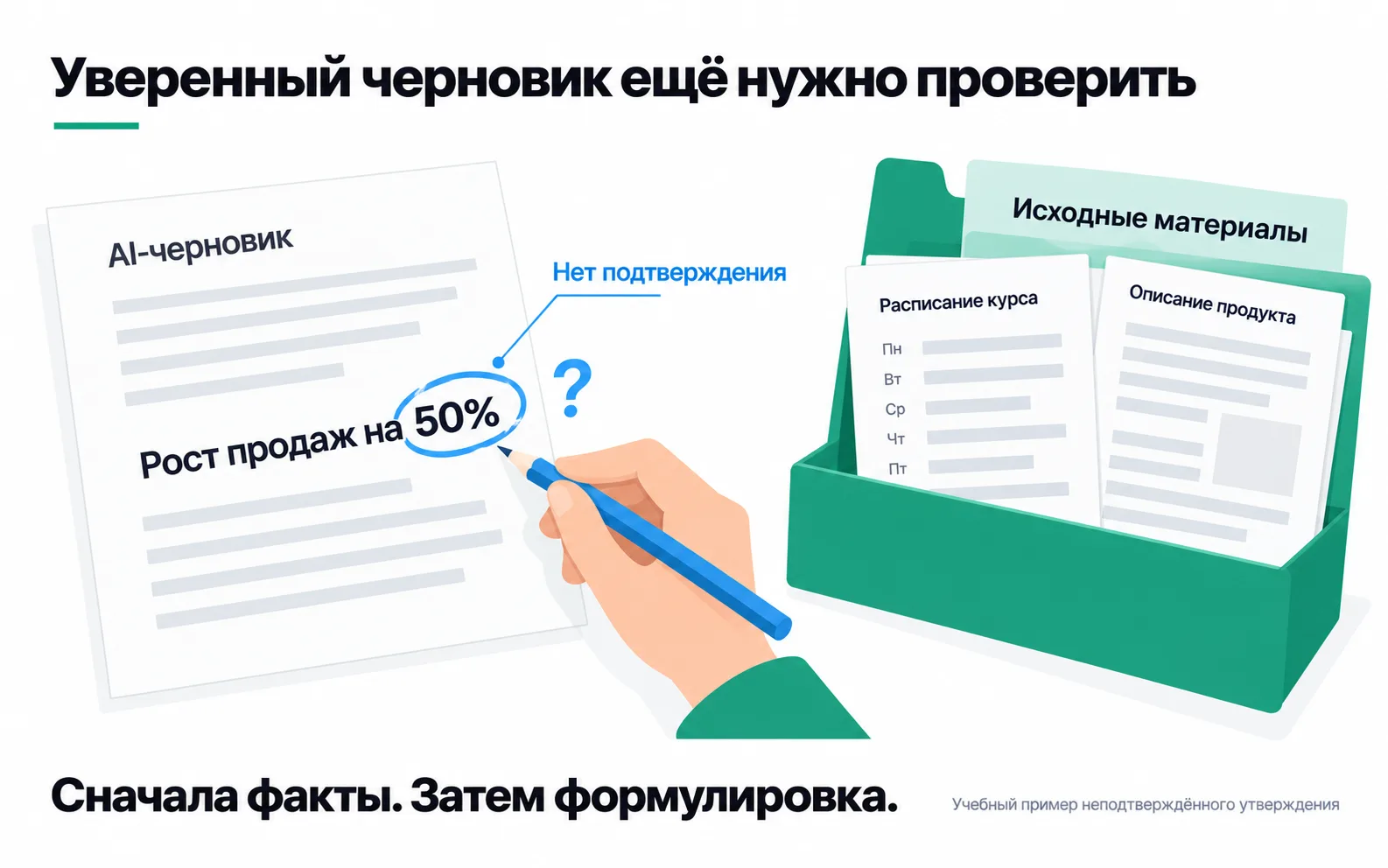
The picture shows the first check: every claim in the draft is looked up in the source materials.
Six steps that don't depend on the tool
Tool names, plans and terms change faster than lessons get written. So this isn't about a tool's buttons but about a way of working that survives any tool:
| Step | What you do | Who owns it at the school | What it leaves behind |
|---|---|---|---|
| Brief | Collect the task, the facts with sources, and what is off limits | Marketer | Brief |
| Generation | Get a draft and variants | Marketer | Draft |
| Fact-check | Find a source for every claim | Marketer, with the senior curator for the syllabus | List of claims with decisions |
| Rights | Work out whose text, image, face and voice it is | Marketer | Tool terms and people's consent |
| Labelling | Decide whether an AI label is needed and where it goes | Marketer | Label on the post |
| Sign-off | Approve the final version | Owner | Dated version |
A polished text with the wrong date is more dangerous than a clumsy one, because it looks finished and gets posted. So style is fixed after the facts, never before.
Brief: what the model must know before the first word
The model has never seen the school's schedule and doesn't know what the school doesn't do. Anything missing from the request it fills in itself, and plausibly: "starts 1 November" sounds every bit as real as "2 November". The brief closes those gaps up front. It has six parts:
- the task and the reader: a Telegram announcement for people who work with spreadsheets and are thinking of moving into analytics;
- the facts and where they come from: the course page, the schedule, the syllabus;
- what must not be promised: graduates' results in numbers, job placement, discounts;
- the school's voice: the tone of voice rules with examples;
- the format: where the text runs, how long it is, how it ends;
- what to do with gaps: ask instead of inventing.
Put together, it reads like this:
Write an announcement of the November cohort for the school's Telegram channel, up to 600 characters. The reader works with spreadsheets and is thinking of moving into analytics. Use only these facts: the course costs 25,000 ₸; starts 2 November, enrolment closes 30 October; 60 places in the cohort; homework is checked by a curator; during the course the student builds a report in Data Studio (formerly Looker Studio). Don't promise sales growth, salary or job placement. If a sentence needs facts you don't have, don't invent anything; list your questions after the text.
What must stay out of the brief is student data. A CRM export with names and phone numbers isn't needed for an announcement, and it ends up on someone else's server. Under OpenAI's terms for personal accounts outside Europe, in the version effective 1 January 2026, OpenAI may use your content to improve its services, and opting out of model training is a separate step (OpenAI terms of use). Business plans have their own terms.
Draft: what to hand to the model
Give the model work where the facts already exist and only the form is missing: five versions of the opening line, a 125-character cut of the announcement for an ad, a step-by-step retelling of the student guide, a first-pass translation for a native speaker to fix. Don't hand it what it doesn't have: dates, prices, students' results and reviews. It doesn't know them, so it will make them up.
Budget the checking time from the start: the draft appeared in thirty seconds, while checking it against the schedule and the syllabus took the marketer 40 minutes.
Fact-check: every claim to a source
The marketer listed five claims from the draft and opened a source for each. He corrected the start date against the schedule. The school has no data on graduates' sales and no job placement in the syllabus, so both lines went. The syllabus confirms that a curator checks homework, with 20 students per curator, so that line stayed. "Only 10 places left" he checked against payments: fewer than half are taken, so the line either goes or carries the count by payments on the day of posting.
Anyone would catch the 50%. The date is worse. "1 November" looks like a line from the schedule, and a person who turns up for class on 1 November will write to a curator asking where it is. Dates, prices and counts are checked against the source line by line, even when they look right. "Only 10 places left" without a count behind it is made-up scarcity.
Rights and labels
What follows is our reading of the laws as amended up to 17 May 2026 ("On Advertising"), 25 August 2026 ("On Artificial Intelligence"), 14 September 2026 ("On Personal Data and Their Protection") and 20 August 2026 (the Civil Code); this is not legal advice.
Start with promises. The Law "On Advertising" treats false claims about expected results as unreliable advertising (Art. 7(2)(6)), and a channel post inviting people onto a course fits the law's definition of advertising (Art. 3, subparagraphs 1-2). So the draft's 50% is a risk to more than reputation.
Tools hand the rights to the result over to the user, each with its own caveats, collected in the tools table below. Whether the result is protected by copyright is decided by the Law "On Artificial Intelligence": a work created with AI is protected only if a human made a creative contribution to it (Art. 23(1)). An announcement copied from a chat unedited may end up unprotected, and stopping a competitor from copying it word for word would be hard. An announcement the marketer built from the school's own facts, reworked and cut down is better protected.
People are a stricter matter. The Law "On Personal Data and Their Protection" lists an image of a person's face among personal data identifiers (Art. 6) and allows personal data to be placed in publicly available sources only with the person's consent (Art. 7(3)). The Civil Code also forbids using a person's image without their consent (Art. 145(1)). Voice isn't on the Article 6 list, but it's safer to treat it the same way. So a teacher's face or voice appears in generated material only under written consent that names this kind of processing explicitly. It's drafted the same way as consent for student reviews and videos, with a separate clause on generation.
The Law "On Artificial Intelligence" has been in force since 18 January 2026. It defines synthetic results as images, video, audio and text created or altered by AI that imitate a person's appearance, voice or behaviour, or events that never happened (Art. 1(4)). They may be distributed only with machine-readable marking and a visual or other warning that the user can perceive; techniques that make it hard to perceive are not allowed (Art. 21(2)). The procedure for machine-readable marking is set by the authorised body (Art. 22(3)).
The school's announcement falls outside this definition: it depicts no person and describes no invented event. A generated photo of a "student", or the teacher's voice saying things he never said, falls inside it. The law makes the owners and holders of AI systems responsible for informing people (Art. 21(3)), and says nothing directly about a school posting an image from someone else's tool. Until there is guidance, the safer path is to label it yourself.
The platforms have their own rules; as of October 2026 they are as follows. The school's announcement needs no label anywhere, and the last column shows whether a video in which the teacher's voice has been re-voiced by AI needs one:
| Platform | What must be labelled | How to label | Video with an AI voice |
|---|---|---|---|
| Photorealistic video and realistic audio created or altered with AI. Images don't have to be labelled, but Instagram labels them itself if it detects AI signals (AI labels on Instagram) | The "Add AI label" toggle when posting | Needed | |
| Meta ads | Disclosure is mandatory only for ads about social issues, elections or politics (AI-created media in ads) | In Ads Manager, in the ad creative setup | Meta doesn't require it; the warning required by Kazakhstan's law stays in the video itself |
| TikTok | All realistic AI-generated content. TikTok may label files carrying Content Credentials (C2PA) on its own, and that label can't be removed (AI-generated content on TikTok) | The AI-generated content setting before posting | Needed |
| YouTube | Realistic content: a real person saying or doing something they didn't, altered footage of a real event, an invented realistic scene (disclosing altered content) | The AI use field in YouTube Studio during upload | By our reading, needed |
Sign-off: one signature and a log
One person approves the final version; at the school that's the owner. They see the list of claims with sources along with the text, so it's clear the date was checked against the schedule rather than "looks fine". If the text goes out in Kazakh, a native speaker reads the translation first.
The publication log has one row per post: date, platform, version, who checked the facts, whether an AI label was needed, and where the consents are kept.
Tools as of October 2026
Tool names and terms change, so open the page behind the link before you start.
| Tool | Used for | What matters in the terms |
|---|---|---|
| ChatGPT (OpenAI) | Text, images | You own the output, and OpenAI assigns its rights "if any"; other users may get similar output (OpenAI terms of use) |
| Claude (Anthropic) | Text | Anthropic assigns its rights in outputs "if any" and advises against relying on them without checking (Anthropic consumer terms) |
| Gemini (Google) | Text, images, 10-second clips with sound on a Google AI subscription | Google won't claim ownership of generated content and forbids passing it off as made by a human (Google terms of service, version effective 30 July 2026); images, video and audio from Gemini carry SynthID and C2PA metadata (Gemini watermarks) |
| Midjourney | Images | You own what you create, but a company with more than $1 million a year in revenue needs a Pro or Mega plan; by default your work is visible to everyone (Midjourney terms) |
| Image generation in Ads Manager (Meta) | Ad image variants | The ad may get an "AI info" label (generating image variations) |
| ElevenLabs | Voice | A professional clone can be made only from your own voice, after verification; an instant clone requires confirming you have the rights and consent (professional clone, instant clone) |
Exercise: take one draft apart
Take a text that AI wrote for your project or a client's: a post, an ad, a product description. If you don't have one, ask a model to write an announcement from the product name alone, with no facts, and take that apart.
If you have more "remove" rows than "keep" rows, it's the brief that needs rewriting: add the facts and the limits to it and generate again.
The trickiest rows look genuine: a date one day early, "from 25,000 ₸" instead of "25,000 ₸". Only the source catches them. And if the "who signs off" field says "the team", put in a named person, or there will be no one to work through the mistake with later.
Video: AI in a marketer's work
The video is in Russian and covers how a marketer can speed up content work with AI.