An online analytics school in Almaty runs an ad called video_teacher: a 30-second video in which the teacher talks, in his own words, about himself and how he teaches. The school's dashboard shows it brought in 20 and 22 leads in two consecutive weeks, and 3 and 2 of those people paid for the course the same week. For the November cohort the owner wants a Kazakh version: "Let AI re-voice it in his own voice and sync the lips. They say it takes five minutes." The teacher doesn't speak Kazakh. The school's numbers are made up.
The generation itself may well take minutes. But the result is a video in which a real person says words he never said, in a language he doesn't know. Before a video like that can run, it needs his consent, a check by a native speaker, a match across every track, and an AI label.
Three ways to make a Kazakh version
Dubbing in the teacher's voice isn't the only option, and not always the best one:
| Method | What it takes | What you risk |
|---|---|---|
| Kazakh captions on the Russian video | Translation and proofreading by a native speaker | Viewers hear Russian and only read Kazakh |
| A voice-over artist off screen, the teacher on screen | A native-speaker voice artist, translation, editing | The voice doesn't match the face, but nobody speaks for the teacher |
| AI dubbing in the teacher's voice | Written consent to voice synthesis, a native speaker's check, an AI label | A real person "says" something he didn't, and viewers hear any translation error in his voice |
The choice depends on the job. If the Kazakh version is a first trial, captions are enough: they take a day and can be checked by eye. Dubbing makes sense once the trial shows that Kazakh-speaking viewers submit the form and the video will run for months.
The school went straight to dubbing because the owner insisted. The captions get made anyway: if the teacher doesn't sign the consent or the native speaker rejects the dub, the Russian video with Kazakh captions goes into the ad instead.
Consent to the voice
What follows is our reading of the laws; this is not legal advice.
The teacher agreed to appear in an ad in Russian. Synthesising his voice in another language is a new use, and the earlier consent covers it only if it names voice synthesis and another language. The Law "On Personal Data and Their Protection" lists a face image among personal data identifiers (Art. 6). Voice isn't on that list, but it's safer to treat it the same way. Art. 8(4) sets out what consent must state, and it is the school that has to prove consent was given (Art. 25(2)(5)), so the consent is signed and kept with the video's source file.
For dubbing, the consent should spell out:
- which video is being translated, and into which language;
- that AI synthesises the voice and adjusts the lip movement;
- where the video will run, and for how long;
- who approves the translation: the teacher reads a back-translation into Russian and signs it;
- whether the recording and the voice model leave the country: if so, the consent names cross-border transfer (Art. 7(6) and Art. 8(4)(5));
- the details Art. 8(4) requires: the operator, the term, the list of data;
- how to withdraw consent, and what then happens to the voice model.
Voice tools have their own rules, and they can be stricter than the law. In ElevenLabs a professional clone can only be made from your own voice, after verifying that it is yours: even with their consent, you can't clone someone else's voice. So if the school uses this service, the teacher makes the clone himself, in his own account. Another tool will have other terms, and they are read before recording.
Picture, voice and captions say the same thing
The video carries three conditions that must not get mixed up: the course starts on 2 November, enrolment closes on 30 October, and the course costs 25,000 ₸. In the Kazakh version they live in three tracks: the picture (the end card), the voice (the dub) and the captions. Each is made by a different tool or person, so each can go wrong on its own.
The trickiest error comes down the chain. The automatic transcript of the Russian video wrote "until the thirteenth of October" instead of "the thirtieth": the words sound alike. Translate from that transcript, and the error reaches both the captions and the dub, and the two tracks will agree on something false. So the translation is done from the approved script. W3C WAI warns that automatic captions are often wrong and don't match the spoken audio, and need significant editing.
The picture shows the same check on a café video.
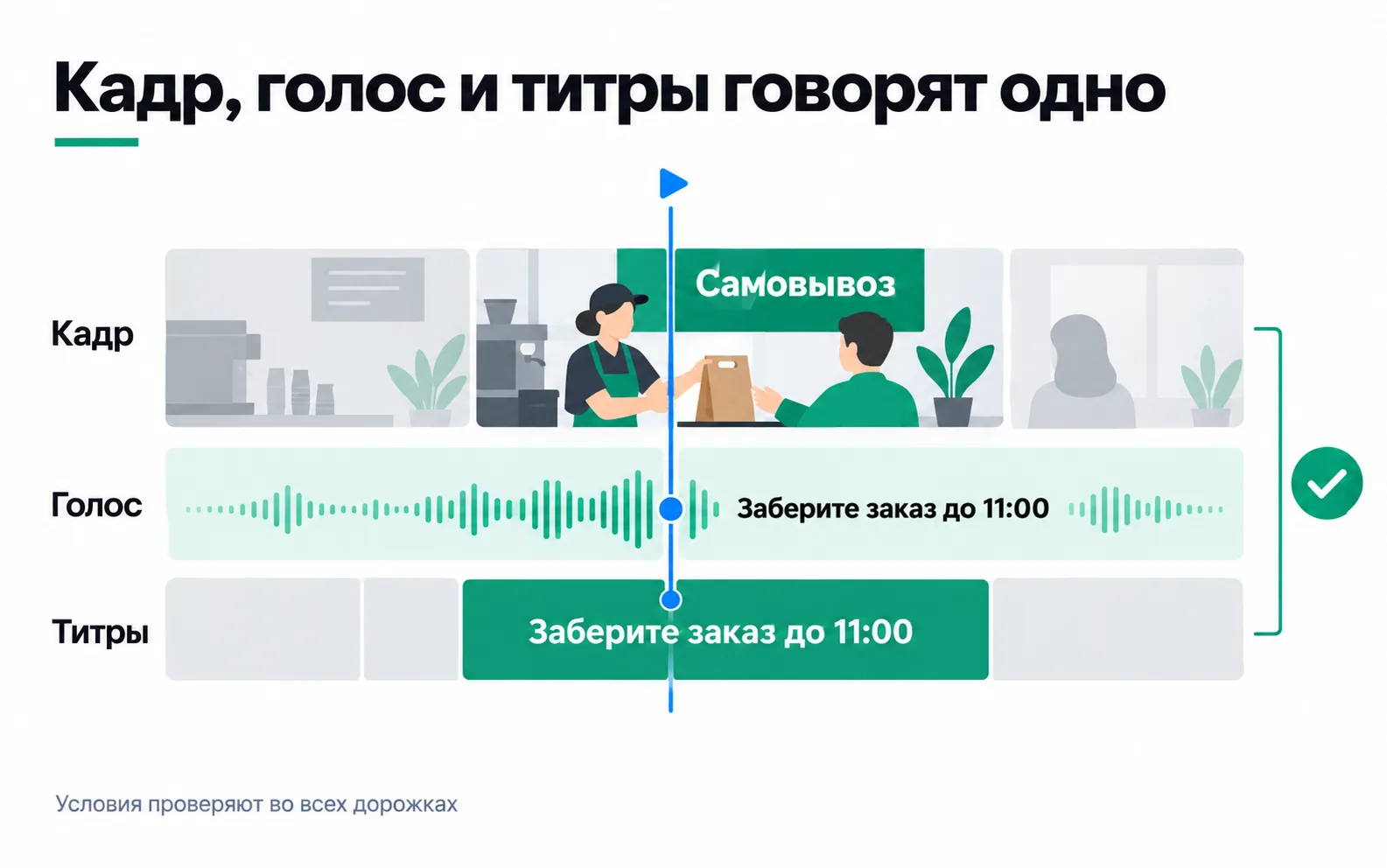
A native speaker who knows the approved text checks all three tracks. They look at the end card, listen to the dub and read the captions, noting every date, price and negation. "Until 30 October" and "from 30 October" differ by one word and mean opposite things.
Generated footage
Sometimes you want to add shots that were never filmed: a city at night, a laptop with a chart. The tools for this change before your eyes. In October 2026 OpenAI says Sora has been discontinued, while the Gemini app makes 10-second clips with sound, and there Gemini Omni is replacing Veo. Images, video and audio from Gemini carry SynthID and C2PA metadata.
The rule is the same as for images: generate mood, not evidence. The city and the laptop are fine. "A class with a full room" or "students applauding" are not: that event never happened, which by our reading of the law makes it a synthetic result, and for viewers a false promise too.
AI labels on the platforms
Kazakhstan's Law "On Artificial Intelligence" treats a dub in the teacher's voice as a synthetic result: audio and video altered by AI that imitate a person's voice and behaviour (Art. 1(4)). A video like that may be distributed only with machine-readable marking and a visual or other warning that the user can perceive; techniques that make it hard to perceive are not allowed (Art. 21(2)). The school adds the visible one itself: the line "Teacher's voice generated with AI" in the first seconds of the video and in the ad text. The machine-readable one depends on the tool: some services add a watermark or Content Credentials on their own, others don't. The procedure for that marking is set by the authorised body (Art. 22(3)), and it's worth searching adilet for it before launch.
As of October 2026, the platforms require the following:
- Meta ads. Self-disclosure is mandatory only for ads about social issues, elections or politics (AI-created media in ads). For a course ad, Meta's help page doesn't require self-disclosure, but the visible warning we add because of Kazakhstan's law stays in the video itself.
- Instagram. If the school also posts the video as an ordinary Reel, it will have to be labelled: Meta itself gives a Reel with realistic AI-generated voice-over as an example of what must be labelled. Turn on the "Add AI label" toggle when posting.
- TikTok. Realistic AI-generated audio and video must be labelled, and using the likeness of an adult private individual without their permission is prohibited. With the teacher's written consent, the video passes that rule.
- YouTube. YouTube doesn't require disclosure when creators clone their own voice for voice-overs or dubs. Here the lips have been adjusted and the video is posted by the school, not the teacher himself, so by our reading it is a case of a real person saying something they didn't, which has to be disclosed: answer "Yes" in the AI use field in YouTube Studio.
The final file
The finished export is watched twice: without sound, to check the captions and the end card, and without the picture, to check the voice. Exports have errors of their own: an old version of the captions, a clipped last frame, a missing AI line.
The ad is named video_teacher_kz. The new name goes into the tag reference list first, and from there into the utm_content of every lead. That way leads from the Kazakh version don't mix with the Russian one in the CRM, and by the start of the cohort the school compares two rows: leads, the share the manager reached, and payments. A difference of one or two payments is down to chance, so the versions aren't chosen on it.
Exercise: find the mismatches in the Kazakh version
The video editor sends the first cut of the Kazakh version. The voice is right: starts 2 November, enrolment until 30 October. The captions were made from the automatic transcript and say enrolment closes "on 13 October". The end card says "25,000 ₸ a month". There's no AI line either at the start of the video or in the ad text. The teacher's consent is the one he signed in spring for the Russian video. Make a list of fixes and put them in order.
Then take any video from your own project that contains a date, a price or a condition and check it the same way: list the conditions from the script and find each one in every track.
Consent comes first, because without it nothing else matters: the video doesn't go anywhere until the teacher has signed consent to voice synthesis. The captions come next. The "13 October" error came from the automatic transcript, so they are translated again from the approved script. Fixing one number isn't enough: the same transcript may hide other errors. Then the end card: "a month" turns a one-off payment into a monthly one, and someone who arrives with that expectation will open the conversation with the manager by arguing about the price.
Labels come last, but they are not optional: the line "Teacher's voice generated with AI" in the first seconds of the video and in the ad text. After the fixes, the native speaker watches the whole export again without sound and listens to it without the picture.
The voice in this cut was correct, but one correct track tells you nothing about the others, which is why all three are checked.