Aruzhan finished her course at an IELTS prep centre in Almaty and scored 7.0 on the exam. That evening she posted an Instagram story: a screenshot of her result, a tag of the centre and the caption "Couldn't have done it without the speaking feedback". The owner forwards the screenshot to the media buyer: "Let's put it in an ad. Caption: 7.0 for our students."
It's a good reason for an ad, but that version has three mistakes in it. The story belongs to Aruzhan, and she never agreed to an ad. If the screenshot shows her full name or her face, that is, in our reading, personal data. And the caption turns one result into a promise for everyone, even though the score depends on the student and the centre doesn't promise it. Let's go through how to turn a story like this into an ad creative without breaking the law or anyone's trust. The centre's numbers in this lesson are illustrative.
Who makes it and what the brand needs
UGC (user-generated content) is photos, videos, reviews and stories made by customers rather than the brand's staff. In advertising the term also covers videos that a creator is paid to shoot in the style of a customer clip. They are all shot the same way, on a phone with no studio lighting, but the rules differ:
| Who made it | Paid? | Where it appears | What the brand needs |
|---|---|---|---|
| A customer on their own initiative: Aruzhan's story | No | On the customer's account | Consent for every new use |
| A customer at the brand's request: a review built on the manager's questions | No, sometimes a gift | On the brand's website and account | Consent, and a note about any gift next to the review |
| A UGC creator for a fee: a customer-style video for the brand's ads | Yes | In the brand's ads | A contract with rights to the video, and the creator doesn't pose as a customer |
| A blogger with their own audience | Yes | On the blogger's account | Ad labelling, as with ads placed with bloggers |
Two questions draw the line: was the author a customer, and did they get anything for the post. A UGC creator can film what a trial lesson is like if they actually attended one. But "I prepared here and got 7.0" from someone who never studied at the centre is a made-up review, however natural it sounds. A staff member playing a random student is the same thing.
Ask for a story, not praise
"Please record a review" gets you "Everything was great, highly recommend". That tells a future student nothing. The centre's manager asks Aruzhan five questions:
- What goal did you come with, and by when?
- How were you preparing before the centre?
- What did you do on the course, and what did you do on your own?
- What came of it, in numbers if there are any?
- What was hardest, and what is still hard?
The answers make a 40-second video: "In June a practice test gave me 5.5, and my master's programme needs 6.5. I went to the centre for three months and studied on my own for an hour a day on top of that. In speaking I froze on every other question, and the feedback sessions fixed that. I got 7.0. Writing is still hard for me."
You can shorten a review, but you can't change what it says. "Studied on my own for an hour a day" can't be cut: without it the viewer will assume the course alone produced the 7.0. "Writing is still hard" could go for length, since what she says about the centre stays the same without it. Better to keep it anyway: a review with a caveat sounds like a real person talking. Adding anything Aruzhan didn't say is out of the question, even if "it goes without saying".
Nobody is offered money for a review, and a good review is never made a condition. If the centre does give a graduate a free mock exam for the video, say so next to the review. The US FTC calls this kind of tie to a brand a material connection and asks for it to be disclosed in the video itself, not only in the description (FTC disclosures guide for influencers). The rule is American, but the question is the same anywhere: does the viewer know the author got something? And a customer who regularly receives gifts for posts is, as we understand it, already advertising the brand, and their posts get labelled as ads, as with the coffee shop's customers.
Consent: what to write down and where to keep it
What follows is our reading of the laws, and it is not legal advice. The general rule is the same as for the online school's graduate reviews: personal data may be distributed in publicly available sources with the person's consent (Art. 7(3) of the Law on Personal Data and Their Protection as amended up to 14 September 2026), and in our reading the centre's public website and Instagram are such sources. The centre has to prove the consent (Art. 25(2)(5)).
The story adds something the school's example didn't have: Aruzhan posted her result herself but gave the centre no consent. In that case everyone who collected, distributed or otherwise processed her data has to be able to show it was lawful (Art. 7(3-1)). The law allows further distribution with a reference to the source (Art. 7(5)), but we wouldn't build an ad on that: the burden of proof is on the centre. On top of that, Art. 145(1) of the Civil Code (as amended up to 20 August 2026) prohibits using a person's image without their consent.
So the centre gets written consent from Aruzhan and keeps it together with the original video. Art. 8(4) lists what consent has to contain. For ads, the lines that matter may be missing from a website consent: where and for how long the video runs, whether it can be shortened and whether the data goes abroad:
| Item | Aruzhan's consent |
|---|---|
| Who uses the data | The centre: its name and business ID number |
| Whose data | Aruzhan: surname, first name and patronymic (if it appears on her ID) |
| What exactly | The 40-second review video with her face and voice, her first name, her exam result |
| Where | The centre's website, the centre's Instagram, ads on Meta and TikTok |
| Period | 12 months |
| Publication in publicly available sources | Allowed (Art. 8(4)(6)) |
| Transfer to third parties and abroad | In our reading, yes: the video is uploaded to Meta and TikTok ad accounts (Art. 8(4)(4-5); see also Art. 7(6) and Art. 16(1)) |
| Edits | May be shortened and subtitled; the words may not be changed and the line about studying on her own may not be cut |
Consent can be withdrawn. The centre then has 15 working days to stop processing the data, unless the law requires keeping it, or to send a reasoned refusal (Art. 8(7)). In practice that means pulling the ad and removing the video from the website and Instagram. That's why the creative log records where each review is currently running.
Consent for the website is not consent for ads. If the paper says "the centre's website", you get new consent for ads. The picture shows the path from a student to an ad: the experience, permission to publish, the story on the website, and a question mark over the billboard.
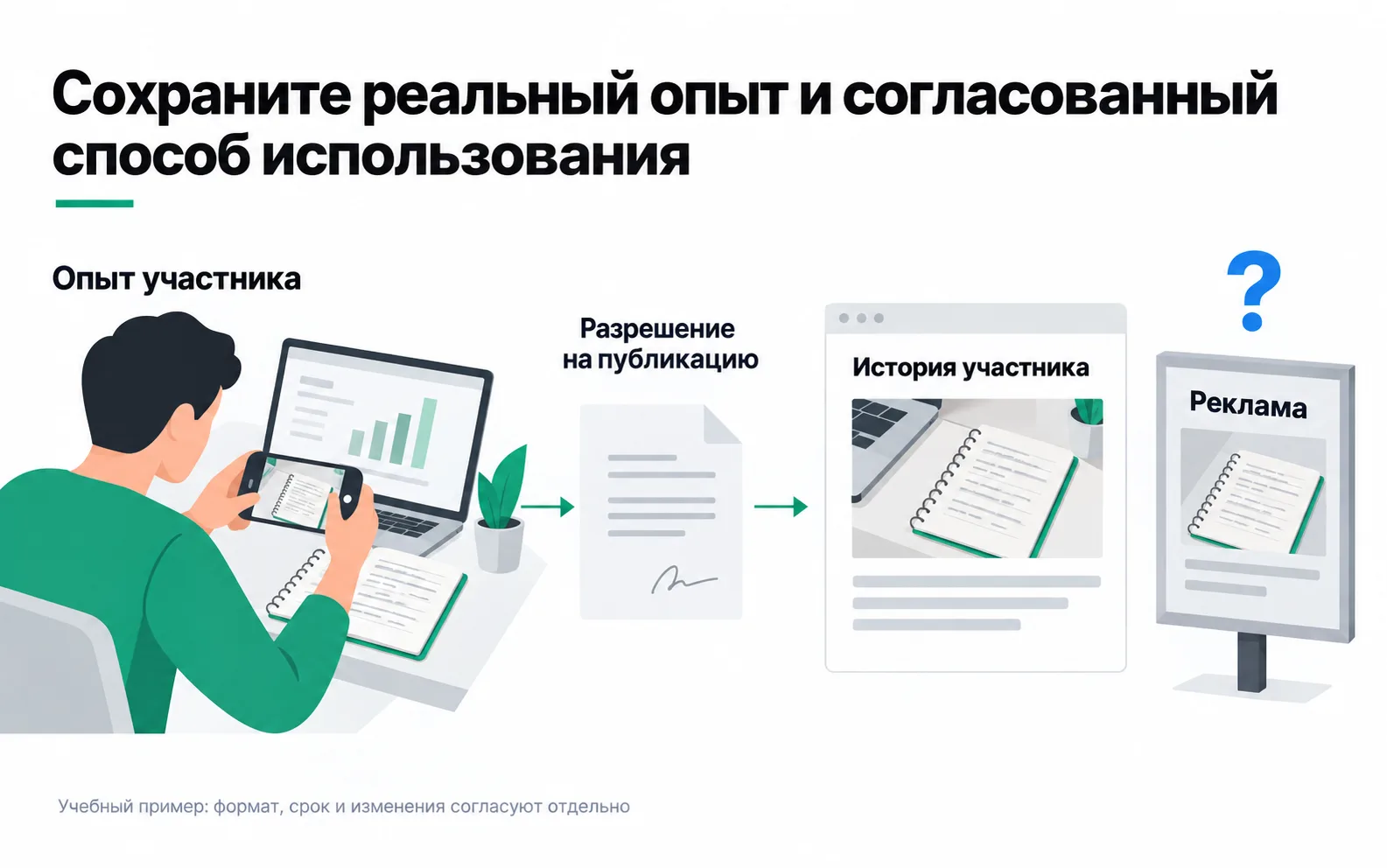
How a review gets into an ad
On Meta there are two routes.
A partnership ad from Aruzhan's account. She turns on the Get partnership ad code toggle in the settings of her post and sends the code to the centre. The centre runs an ad with her account in the header and can change the ad copy without touching the original post. A code can be used by no more than two advertisers at a time (partnership ad permissions), and the creator can withdraw permission at any moment (stopping partnership ads). But partnership ads are only available to Instagram professional accounts (partnership ad eligibility). With a personal account this route is closed.
The original video as an ad from the centre. Aruzhan sends the file, and the centre runs it as a regular ad, with her name in the caption and a consent that names advertising. This route is simpler: her account isn't needed, and the video can be cut for Reels and TikTok.
TikTok has a similar tool, Spark Ads: an ad built on a regular post, including someone else's, if the author has given permission. The authorisation code's duration is set to fit the campaign (about Spark Ads).
The ad caption retells the story instead of generalising it: "Aruzhan, 7.0 on IELTS. Started at 5.5, three months at the centre and an hour a day on her own." The caption "7.0 for our students", in our reading, presents one student's result as the course's expected result, and the Law on Advertising as amended up to 17 May 2026 classes untrue information about expected results as misleading advertising (Art. 7(2)(6)). The advertiser is responsible for an ad's content (Art. 20(1)), so that's the centre, unless it proves the violation was committed by the ad's producer or distributor. Someone else's words in the video don't change that.
A paid video follows the same rule on results. If a UGC creator posts the video on their own account under a contract with the centre, it is, in our reading, sponsored content, and the requirements are the same as for ads placed with bloggers: the review is genuine, and the people on camera agreed in advance. Such a post is labelled as an ad in text, for example "реклама" (advertising) or the Russian for "partner material", and in a video before it starts (Art. 21(1) of the Law on Online Platforms and Online Advertising as amended up to 2 March 2026, points 4 and 5 of the Online Ad Labelling Rules, order No. 59 of 16.02.2024). The platform labels the centre's targeted ads itself (point 7 of the Rules).
What UGC costs and how to test it
Aruzhan's review cost the centre an hour of the manager's time and an evening of editing. For comparison, the owner got a quote from a UGC creator: 40,000 ₸ for a "what a trial lesson is like" video with the right to run it in ads for three months. The creator attends a trial lesson and films her own experience.
Let's see what 40,000 ₸ means on the centre's ad budget of 2,000 ₸ a day. It is 20 days of ads. Under the scaling plan a person who reaches the trial lesson can cost the centre up to 8,000 ₸. So the shoot pays off only if the video brings 5 more people to a lesson (40,000 / 8,000) than it takes to justify the ad spend itself. Over the three months of rights at 2,000 ₸ a day the ads will spend about 180,000 ₸: that is justified by 23 people coming (180,000 / 8,000 = 22.5), while with the video you need 28 (220,000 / 8,000 = 27.5). A five-day test can't be compared with that. On a small budget the shoot is counted together with the ads: the cost of a person who came includes both the impressions and the video.
In a test, a review is one more angle, the fourth after the problem, the result and the process, and it is judged like the other angles in the creative log. The ad is named testimonial_1, without the student's name: UTM tags must not contain personal data.
Exercise: one review from story to ad
Take your own project or a client's where customers have already left reviews: on 2GIS, Google Maps, Instagram or in chats.
The shortened review is read next to the full one. If the cut lost the line about what the person did on their own, or how long it took them to get the result, it goes back in: without it the review promises more than happened.
Now the caption. Say the customer wrote "The speaking feedback helped me stop freezing on pauses", and the team suggests the caption "With us, people score 7.0". That is a new claim that isn't in the review, and consent to publish the review doesn't back it up. The caption has to stay within what was said: "The speaking feedback helped me stop freezing on pauses". If there is a result in numbers, add it in the person's own words and with their caveats.
Finally, the consent. If it doesn't name advertising, a period or the right to shorten, add them before the video goes into the ad account.
Video: an introduction to UGC
What UGC means in advertising and how creators work with it.