An IELTS prep centre in Almaty rewrote its ads, the first screen of its site, its Instagram bio and its 2GIS listing around one idea: a prep plan built back from your exam date, and a speaking review that shows where you lose marks. Two months later a two-star review appears on 2GIS: "I came to the trial lesson for the speaking review, but there were six of us and they spent forty minutes telling us about the course. Nobody asked when my exam was." The ad promised one thing, the lesson delivered another, and everyone who looks the centre up on 2GIS will read about it.
A brand is made of what people get every time they deal with you; the ads only name the promise. The centre decided what to promise when it wrote its positioning statement. Now everyone who talks to customers has to keep that promise: the media buyer, the manager on WhatsApp, the teacher at the trial lesson. The centre, its reviews, its chats and the numbers are illustrative.
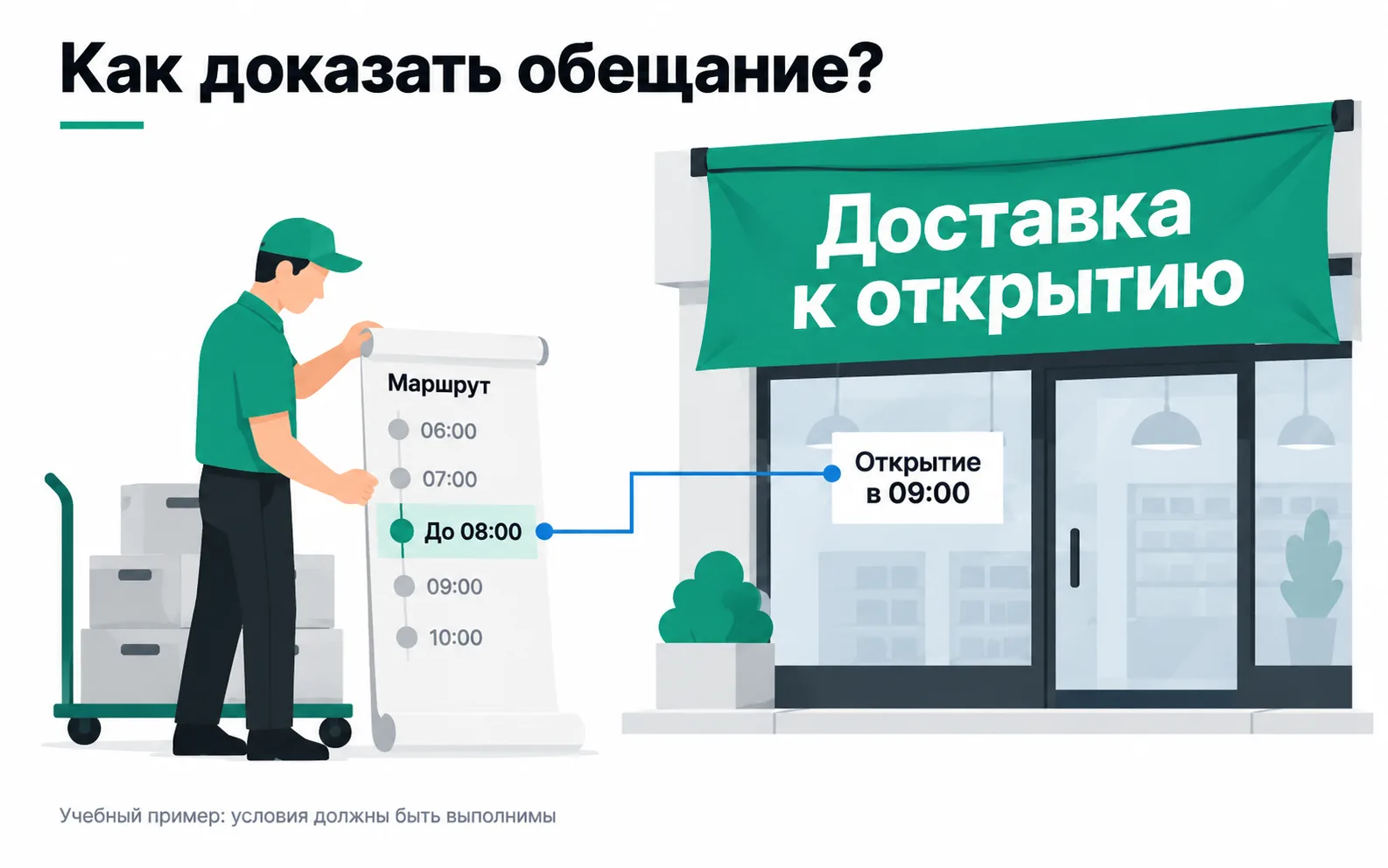
The picture shows the same idea for a café supplier: the "Delivery before opening" sign rests on a route where the courier makes it by 08:00, an hour before the doors open.
A one-page brand platform
A brand platform is a working document that tells any employee what the centre promises and what they personally do to keep it. A new manager reads it on day one, and a new teacher reads it before their first trial lesson. That is why it fits on one page and is made of decisions.
The centre's platform came to eight rows:
| Section | At the centre |
|---|---|
| Who it is for | Applying to a university abroad, taking IELTS Academic, exam in the next three to four months |
| What they compare us with | Self-study with books and videos, a private tutor, another centre |
| Promise | A prep plan built from your exam date and a speaking review that shows where you lose marks |
| What you can see before paying | A free trial lesson with a level test and a speaking review, a sample plan on the site |
| Rules for the team | The manager's first message asks for the exam date and the score needed. No more than four people per teacher at a trial lesson and at least 15 minutes of review. The plan is handed out in the first week of the course and checked with the student once a month |
| What we don't promise | A score, conversational English, General Training prep (for now) |
| How we talk | Polite form of address, dates and numbers, no "best" and no "guarantee" |
| How we track it | Reviews, complaints, answers in the CRM field "why did you choose us", searches for the centre's name. Monthly, owned by the marketer |
The first four rows come straight from choosing the segment, the positioning and the value proposition. What's new is the rules for the team: until a rule is written down, one manager asks for the exam date and another opens with the price.
The "what we don't promise" row stops the promise from creeping: without it, six months from now the media buyer brings back the offer for schoolchildren, and the centre is back among the general English schools. One row is enough for tone in the platform; the brand voice rules with sample replies are better kept in a separate document.
The mission, the values and a forty-page brand book can wait: a manager on a Saturday evening won't open them, but will read eight rows. You can tell whether the platform works from a new teacher's first trial lesson: afterwards the student can say how many weeks they have until the exam and where they lose marks.
Where the promise meets the customer
A touchpoint is any place where a person runs into the centre: an ad, the site, a chat, a lesson, someone else's review. To find where the promise breaks, walk the path as a customer: message the centre on WhatsApp on Saturday evening from a number the manager doesn't know, book a trial lesson or send a friend, and read the last twenty reviews on 2GIS and the comments on Instagram.
The centre's marketer walked the path and put what they saw in a table:
| Touchpoint | What the person should see or get | What we found | What we changed |
|---|---|---|---|
| Ads and Instagram | A plan to the exam date, a speaking review | Highlights still show last year's "Summer English for schoolchildren" offer | Removed the offer, added a sample plan to Highlights |
| Website | A plan for your exam date, a trial lesson, the price | Matches | - |
| A reply within the hour, the first question about the exam date | At weekends an administrator handles the leads, replies by the evening and opens with the price | A shared template, an out-of-hours auto-reply with a real time | |
| Trial lesson | A level test and 15 minutes of speaking review | When six people turn up, the review is replaced by a talk about the course | No more than four per teacher, the rest get another day |
| Lessons on the course | A plan from the exam date | The plan is handed out in the first week and never looked at again | Ten minutes a month to check against the plan |
| Reviews on 2GIS and Instagram | The centre replies to the point | Half the reviews have no reply, the rest say "Thanks for your review!" | A reply within two working days: what happened and what changed |
The trial lesson is the most expensive row in this table. Under the centre's plan a lead costs up to 2,000 ₸ and one in four leads comes to the lesson, so each person who shows up is up to 8,000 ₸ of advertising, and six of them are up to 48,000 ₸. By the plan, two of them would have paid for the course. None did. Six people are too few to name the reason, but the centre knows one from the 2GIS review.
The four-person rule costs money too. The centre runs two trial lessons a week with eight places each, and unless a second teacher joins each lesson, sixteen places a week become eight.
The first WhatsApp message
The administrator's template opened with the price and the group times. After the rewrite it reads:
Hello! When is your exam, and what score do you need? The prep plan depends on it. At the free trial lesson we'll test your level and review your speaking: 15 minutes of you answering, 15 minutes going through the answers. The course runs for three months, 45,000 ₸ a month.
The price is still there, but the conversation now starts with the question the centre needs to keep its main promise. So that nobody keeps a template of their own, it is saved in WhatsApp Business as a quick reply, and out of hours an away message gives a real time (WhatsApp Business features): "We'll reply today by 20:00" beats "within the hour", which nobody delivers on a Saturday.
Replying to a review
2GIS recommends that businesses post an official reply under a review, because readers go through the whole exchange between the business and the author before they make up their minds (working with reviews on 2GIS). This is how the centre replied to the trial lesson review:
You're right: six people came to the trial lesson that day, and there was no time left for the speaking review. We now take no more than four people per teacher at a trial lesson. If you like, we'll review your speaking for free on a day that suits you, just message us on WhatsApp.
There's no "we apologise for any inconvenience" and no arguing with the author, but there is the rule, and everyone choosing a centre on 2GIS will read it.
Name and identity: briefing a designer
The name, logo, colours and fonts help people recognise the centre the second and third time: in their feed, in their chat list, in 2GIS search results. They can't keep the promise, but they can get in its way. The designer draws; the marketer writes the brief.
The name
A centre that is already running isn't renamed for a new platform: people already search for it under the old name. A name comes up for a new business or a new programme, and the first check is against the platform. Say the owner wants to put a score into the name of the programme for applicants, like the competitor with its "7.0 Guarantee". A score in the name is a promise of a score, which the centre has ruled out, so the idea falls straight away. If a name doesn't clash with the platform, check that the Instagram handle and the domain are free and that there are no similar names in the same 2GIS category, and ask a patent attorney about the trademark before you order a logo.
The identity brief
The whole platform goes into the brief: the designer needs to know the promise, not just the colours the owner likes. Then comes the list of places the identity will live, from smallest to largest: the avatar on Instagram and WhatsApp, the logo in the 2GIS listing, feed creatives and vertical ones for Stories, the site's first screen, the prep plan form, the sign over the door. From that list the designer delivers the logo in horizontal, square and one-colour versions, colours with codes for screen and print, licensed fonts, and templates for creatives and the plan.
The centre's most important layout is the plan form. Students get it in the first week of the course, and within ten seconds it should show when the exam is, how many weeks are left and what to do in each. It is the promise on paper, so in the brief it comes before the logo, and instead of "stylish, modern, premium" the brief says what the student should take from it. Two more requirements:
- No text in the mark. For ads, 2GIS asks for the graphic mark only: the ad shows the name next to it, and text inside a logo can't be read on a phone (uploading a logo to 2GIS).
- Kazakh and Russian from the start. Under Article 21 of the Law "On Languages in the Republic of Kazakhstan" (as amended up to 12 July 2026), a non-state organisation's sign and flyers are in Kazakh, with Russian added where needed. In a bilingual layout Kazakh goes on the left or on top and Russian on the right or below, in letters of the same size. A new sign has to be notified to the akimat at least five working days ahead, with a sketch attached. This is a summary of the law, not legal advice.
Sign the work off on a phone: put the avatar into a real WhatsApp chat and an Instagram feed, and print the plan form on a black-and-white office printer.
How to tell whether the promise is kept
Three months after the centre rewrote its ads, site and 2GIS listing, the marketer pulls together four sources.
- Complaints. The complaint list is built from the platform, since every rule is a possible complaint: "didn't ask the exam date", "no speaking review", "slow to reply", "plan not checked", "other". The field sits in the CRM next to the reason for losing the lead and is a drop-down list too.
- Reviews on 2GIS and Instagram. Each new review is tagged: does it mention the promise (the plan, the date, the speaking review), and is it positive or negative.
- "Why did you choose us". The CRM field the centre added when it checked its positioning. At the first lesson the manager asks it with no options offered and writes down the paying student's own words. If it's the plan and the review, the promise got through. If it's "close to home" and "a friend recommended you", the platform so far lives only in the ads.
- Searches for the name. In the Search Console Performance report, the query filter doesn't know that the Latin and Cyrillic spellings are one name: add each spelling, or combine them in one regular expression (filtering the report). The built-in branded queries filter isn't available to small sites, and queries hidden for privacy drop out of filtered totals (branded and hidden queries). The report shows the last 16 months, so export the months before the change right away.
Here is what the centre got:
| Source | What we count | Three months before | Three months after |
|---|---|---|---|
| Reviews on 2GIS | New reviews / of them about the plan, the date or the review | 9 / 2 | 14 / 8, of them 2 negative, both about the trial lesson |
| "Why did you choose us" | Answers / naming the plan or the review | No field yet | 27 / 17 |
| Complaints in the CRM | Total over three months | Not recorded | 7: slow to reply 3 (all at weekends), no speaking review 2, other 2 |
| Searches for the name | Impressions a month, average | 210 | 280 |
The numbers are small, and two of the rows have nothing to compare with, so the table supports only a few conclusions. The promise reaches at least some students: 17 of the 27 who paid named the plan or the review in their own words, without a prompt from the manager. Complaints clustered where the marketer found breaks when walking the customer path: weekend replies and the trial lesson. Two complaints can't show whether the four-person rule works; the next few months will.
Impressions for the name grew by a third, but in the same months the centre added retargeting and TikTok ads. Searches for a name can grow with the brand, with ad reach and with the university application season, and this data mixes all three, so search is the weakest signal in the table. Brand awareness as an asset is measured separately from traffic.
Once a month the marketer goes through the table with the owner, the senior teacher and the manager. The senior teacher fixes the trial lesson, the manager fixes the templates, and the marketer shows where they part ways with the promise.
Exercise: a platform and a customer path for your project
Take the project you chose a segment and wrote a positioning statement for.
You'll end up with a one-page platform, a touchpoint table and two fixes with named owners.
If the platform ran to three pages, with a mission and values but no rules for the team, read it as the manager would on a Saturday evening and keep what helps them answer a lead.
If everything matched in the touchpoint table, you most likely walked the path as the owner: the manager recognised your number, or you wrote during business hours. Do it again from someone else's phone at the weekend. And if the marketer is down as the owner of every fix, put in the people who run the service and the chat: without their names the fix will stay an item on a list.
Five answers in the "why did you choose us" field are read as wording; nobody calculates shares from them. And if Search Console shows zeros for your name, either there are so few such queries that Google hides them, or people look for the name on 2GIS and Instagram, and then you rely on reviews and the CRM fields.