A month after the Meta test, the owner of the IELTS prep centre comes up with a new idea: "Our students live on TikTok, and a competitor posts videos there every day. Launch there too, on the same 2,000 ₸ a day." The media buyer hits two obstacles before even getting to the videos. Judging by TikTok's country list, a business in Kazakhstan can't open an ad account on its own. And an ad group's daily budget has to be above $20, more than four times 2,000 ₸. The centre's numbers are illustrative.
The account: most likely through a representative
TikTok publishes a list of countries whose users can create an ad account in Business Center themselves, without going through a TikTok representative. Kazakhstan is not on it (countries for self-serve account creation, updated November 2025). It is not in the payment methods table for Europe, the Middle East and Africa either (EMEA payment methods). The practical conclusion: you will most likely have to open the account through a TikTok representative or a partner agency. TikTok doesn't say so directly, so when you register, look at whether Kazakhstan is on the country list.
If an agency opens the account, agree on three things with it before paying:
- Currency and time zone. They are set when the account is created and can't be changed later (ad account information). The time zone should match the CRM and Meta, or the daily numbers won't line up.
- Country of registration. It decides which countries and cities you can target (available locations). Ask them to show you that Kazakhstan and Almaty are on the list.
- Access. The pixel and audiences take months to build up. Agree that the client keeps access to them if they change agencies.
Objective and optimization location
Objectives in TikTok Ads Manager fall into three groups: Awareness (Reach), Consideration (Traffic, Video views, Community interaction, Branded Mission) and Conversion (App promotion, Lead generation, Sales) (how to choose an objective). The centre needs Lead generation. With Traffic the campaign will scoop up cheap clicks, the same trap as on Meta. App promotion is for installs, like the grocery delivery service in the lesson on in-app events.
In the ad group you choose the optimization location: Website, Instant Form, TikTok Direct Messages or Instant Messaging Apps (optimization location). The centre picked Website: it already has the form, the pixel and a lead list, and TikTok leads will land in the same place as Meta's. An Instant Form opens inside TikTok, but its leads are stored in TikTok Ads Manager for only 90 days (accessing Instant Form leads), and you have to pull them into the CRM separately.
To optimize for website leads you need the TikTok pixel (lead campaign with a website form). It goes in through GTM on the same trigger that fires the centre's Lead for Meta: TikTok's form event is also called Lead, as in the lesson on Meta and TikTok pixels. A server copy through the TikTok Events API comes later, with its own rules for event_id and the phone number.
Smart+ or a regular campaign
Smart+ is a campaign where TikTok picks the audience, creative combinations and budget itself, while you set the goal, videos, country and language (about Smart+ campaigns); the upgraded version lets you automate only some settings, but according to TikTok not everyone has it yet (upgrades to Smart+). For Smart+ lead campaigns TikTok recommends a daily budget of at least 10 times the average cost per result, which means 20,000 ₸ at a 2,000 ₸ target (Smart+ lead generation best practices), and for regular campaigns 10 to 50 times the cost per result or, while there is no cost yet, from $100 for shallow events and from $200 for deep ones such as a purchase (budget best practices). The owner agrees to 10,000 ₸ a day, but only for a week, and with that money neither Smart+ nor a regular campaign reaches the recommendations, so the centre takes the one where every setting is in plain view.
Budget, bidding and learning
An ad group's daily budget must be above $20, and a campaign budget, if you set one, above $50 (about daily budgets). At the official exchange rate for 13 October 2026, 451.31 ₸ to the dollar, that is over 9,026 ₸ a day. 10,000 ₸ a day (about $22 in a dollar account) comes to 70,000 ₸ for the week, the same as the centre spent on Meta over four weeks of scaling. The week's goal is modest: find out whether TikTok brings people to the trial lesson.
There are two bid strategies (bidding strategies). Maximum Results tries to get as many conversions as possible within the budget. Target cost per result keeps the cost of a lead close to the amount you set. The centre chose the first: to set a cost you need to know what a lead costs on TikTok, and nobody knows that yet.
For the first few days the campaign is learning and the numbers jump around. TikTok says volatility starts to decline after about 25 results or 7 days, and advises against pausing the campaign or changing the budget or the number of creatives without good reason during that time (learning phase). At 2,000 ₸ per lead, 25 leads cost 50,000 ₸, five days at 10,000 ₸. Within a week the campaign will collect 25 leads if each costs no more than 2,800 ₸.
The attribution window is set in the ad group, under Bidding and Optimization: 1, 7, 14 or 28 days for clicks, and off, 1 or 7 days for views. It can't be changed once the ad group is published (attribution windows for ad groups). The centre chose 7-day click and 1-day view, as on Meta, so that both ad accounts count by the same attribution rules.
Videos: vertical video, not an Instagram banner
The banner from the Meta test looks out of place in a TikTok feed. TikTok recommends shooting vertically at 9:16, at 720p or higher, with sound or music, keeping what matters inside the safe zone that the app's buttons don't cover, adding captions or on-screen text and hooking the viewer in the first 6 seconds. One ad group should carry 3 to 5 different creatives (creative best practices). Music for ads comes from TikTok's Commercial Music Library: businesses can't use the general sound library in ads (Commercial Music Library).
The centre's offer is the same as on Meta: a free trial lesson and level test, a three-month course, and a manager who messages you on WhatsApp. What changes is the angle, as with performance creatives:
tt_speaking_mistake- a teacher takes 20 seconds to break down a common speaking mistake and invites viewers to the trial lesson;tt_price_plan- the price and next step video: a manager on camera explains where to see the price and what happens after you submit the form;tt_lesson_day- a slice of a real lesson, shot on a phone.
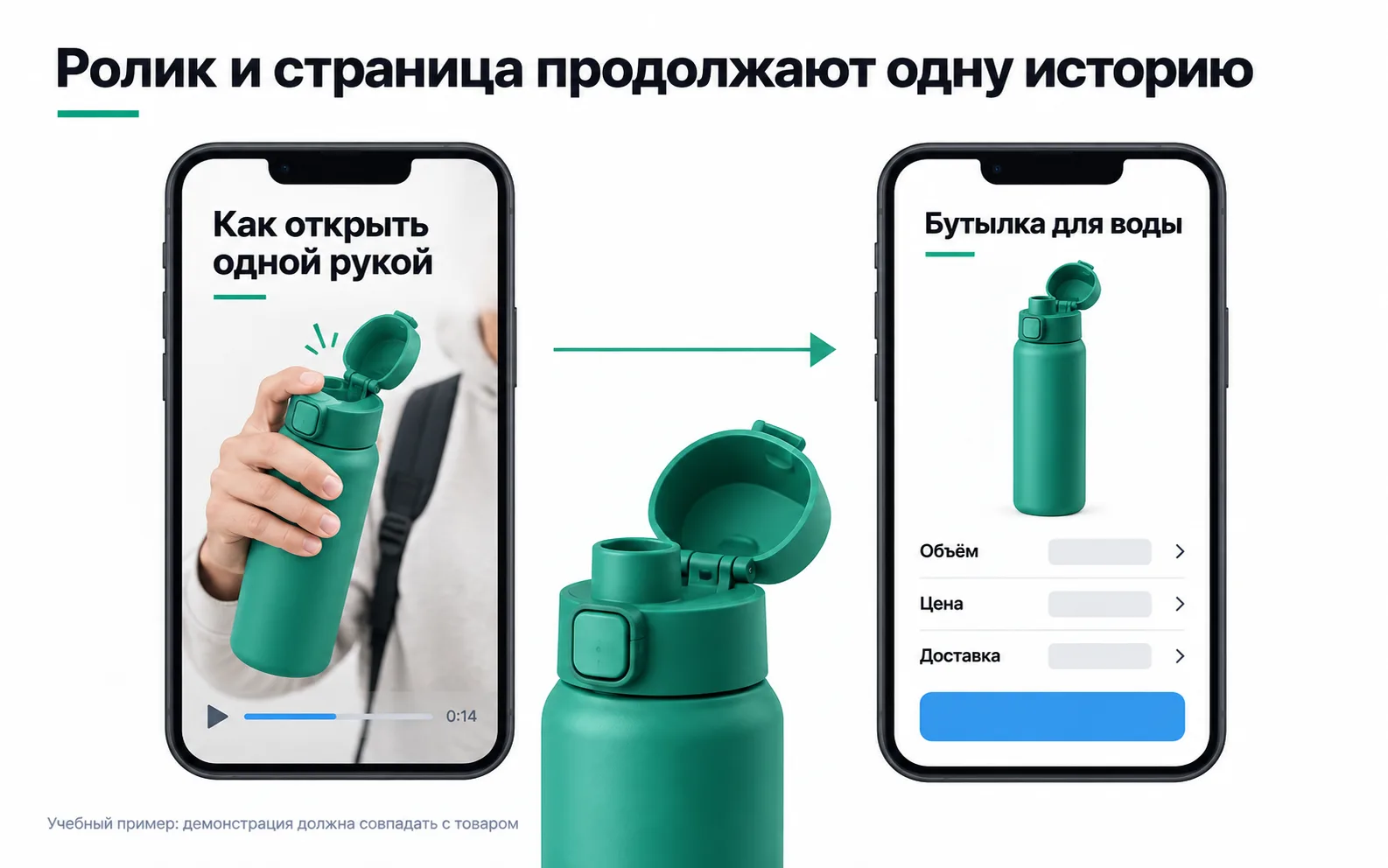
Whatever the video promised, the person should find on the page after the click. If the video shows a lesson, the page needs the schedule and a trial booking, not a general story about the centre. The picture shows the same rule with a product.
Tags: your own string instead of the automatic one
TikTok adds tags to the ad link by itself: source TikTok, medium Paid, the campaign ID and name (URL parameters in TikTok Ads Manager). That doesn't match the tagging scheme, where the source is tiktok, the medium paid_social and the campaign comes from the naming sheet. So turn off the Auto-attach toggle in the ad's link settings and paste your own string:
TikTok replaces __CID_NAME__ with the creative name and __AID_NAME__ with the ad group name, and in upgraded Smart+ the ad name comes from __ADID_V2_NAME__ (TikTok macros). The campaign is typed by hand: ielts_trial has to be named the same in every channel, whatever the campaign is called in the ad account. tiktok is listed as a social source in GA4's source list, so with paid_social these visits land in Paid Social, next to Meta.
The first week: cheap leads, few make it to the lesson
Here is how the seven days turned out.
| Video | Spend | Clicks | Leads in TikTok | Leads in the centre's list | Replied on WhatsApp | Came to the trial lesson |
|---|---|---|---|---|---|---|
tt_speaking_mistake | 38,000 ₸ | 1,300 | 26 | 24 | 9 | 1 |
tt_price_plan | 19,000 ₸ | 520 | 9 | 9 | 6 | 2 |
tt_lesson_day | 12,300 ₸ | 380 | 6 | 5 | 2 | 1 |
| Total | 69,300 ₸ | 2,200 | 41 | 38 | 17 | 4 |
The gap comes first: TikTok counted 41 Lead events, while the centre's list has 38 leads with TikTok tags. The three extra may be repeat submissions, colleagues testing, or leads TikTok credited on view: such people show up in the list without TikTok tags. Split them using the CTA Conversions and VTA Conversions columns (attribution metrics). Track down repeats the same way as an extra Lead on Meta.
By the list, a lead cost 1,824 ₸, under the 2,000 ₸ target, and the campaign reached 25 results within the week. But only 17 of the 38 people replied on WhatsApp, fewer than half, and four came to the trial lesson. Each of them cost 17,325 ₸ against a target of 8,000 ₸. The same money spent over four weeks on Meta brought 11 people to the lesson.
These numbers can't tell you whether TikTok is worse. If the channels were equal, a split of 4 to 11 or more lopsided in Meta's favour would happen about 6 times in 100: on the edge of chance, not proof. On top of that, the comparison is between different weeks, not two channels in one experiment, and TikTok spent 10,000 ₸ a day against 2,000-3,000 ₸ on Meta, while the scaling steps show that added leads get more expensive as spend grows. Video by video, the picture resembles the Meta test: the cheapest lead comes from the speaking mistake video, while more people came to the lesson after the price and next step video. But that difference rests on one or two people.
The centre can't measure TikTok's lift rigorously. TikTok runs conversion lift studies as a managed service, together with a TikTok representative, for accounts that spend at least a set minimum (about conversion lift studies). TikTok can also optimize for a deeper step, such as people who came to the lesson, if you send those events back (lead quality optimization), but four people a week is far too few to learn from.
The centre's decision: no budget increase, and one change at a time. The second week runs on the same 10,000 ₸ a day with the same three videos, and the form gets a new question, "When is your exam?", so the manager can see whom to message first. The videos change at the next step, once it's clear what the question did.
Exercise: a plan for your first week on TikTok
Start with the arithmetic. If your target is 3,000 ₸ per lead, 25 leads cost 75,000 ₸, about 10,700 ₸ a day for a week. If the client will only pay the ad group minimum, around 9,100 ₸ a day, the week brings about 21 leads, 5 to 10 per video. Numbers like that can't separate the videos: the difference rests on one or two people.
If there are no leads at all after three days, don't touch the settings: submit the form yourself and look for Lead in Test Events. A broken pixel is quicker to find than guessing about targeting. If leads are cheap but people don't reply, as at the centre, put what the video says next to the manager's first message. And check how many minutes pass before the manager writes to the person: in the Meta test that is where the review of unresponsive leads starts.
Video: a tour of the ads manager
An English-language video on where everything is in TikTok Ads Manager. Objectives, bidding and Smart+ have changed since it was recorded, so take the settings from the sections above.