The admin of a Telegram channel for marketers offers an online analytics school a sponsored post for 50,000 ₸. The school has already worked out, by comparing clicks, impressions and the post in the same units, that the post pays off from four course payments, which means roughly 17 leads. Now the owner has two questions: are the channel's views real, and would it be better value to buy impressions through Telegram's official ads instead? The figures in this lesson are made up.
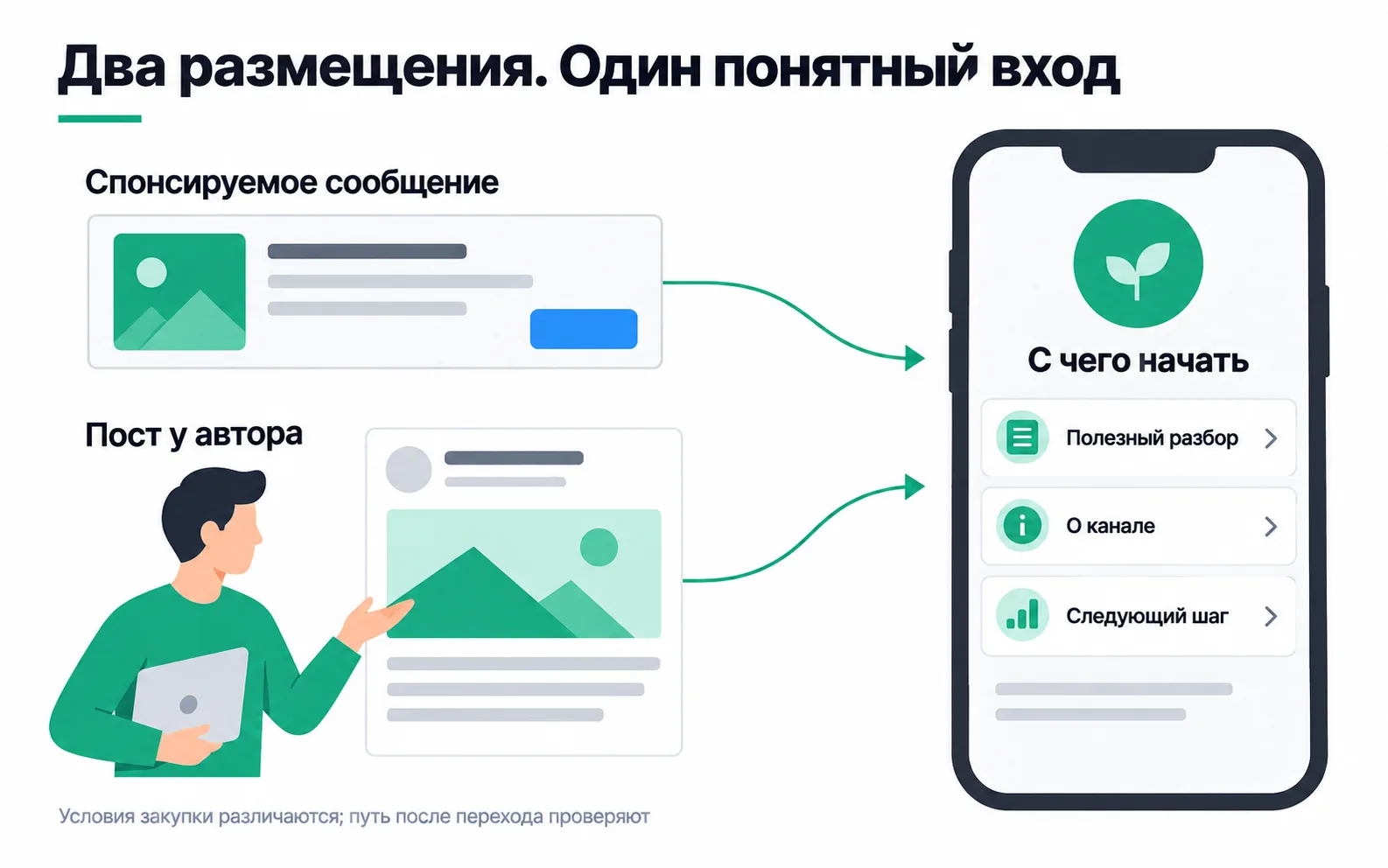
Two ways to buy reach on Telegram
Telegram Ads is the official platform: impressions in public channels go to whichever bid wins the auction (platform terms, clause 3.1). A paid post is a post in someone else's channel at the admin's price: you pay before it goes out and find out what it brought in afterwards.
| Telegram Ads | Paid post | |
|---|---|---|
| Who you buy from | Telegram, in the ads.telegram.org ad account | The admin, over chat |
| Price | Your bid per 1,000 impressions in an auction | A fee per post, set by the admin |
| Payment | The Gram cryptocurrency, or through a reseller | However you agree with the admin |
| Where the link goes | Only to a channel or bot (in the self-serve account) | Wherever you agree: a website, a channel, a bot |
| What you see afterwards | Impressions, channel joins, bot starts | The view counter under the post and whatever channel statistics the admin shows you |
Telegram Ads: what the self-serve ad account can do
The self-serve Telegram Ads account shows ads in public channels with 1,000 or more subscribers, and you list the channels yourself as links like t.me/channel. An ad is up to 160 characters with no line breaks or lists, and its link can only go to a channel or a bot. The promoted channel needs a profile picture, a description and a post from the last two weeks, and the ad's language has to match both the channels it runs in and the channel or bot it links to (ad guidelines). So Russian-language and Kazakh-language channels need separate ads.
You set a CPM, the price per thousand impressions, of at least 0.1 Gram, plus a budget for the ad. You pay in the Gram cryptocurrency (platform home page). Since 15 June 2026 Toncoin has been called Gram: same coin, new name and ticker. The account guide still uses the old name.
How a company buys crypto and books the expense is a question for your accountant and lawyer: in Kazakhstan, unbacked digital assets can only be bought and sold through licensed platforms, and they are not recognised as a means of payment (Article 12-1 of the Law "On Digital Assets").
Four more things worth knowing before you top up:
- An ad's budget can only go up. To lower it, you stop and delete the ad, and the remainder returns to the account balance.
- Money on the balance can't be withdrawn or refunded (clause 4.3 of the terms), so top up by the amount of the test.
- The channel list can't be changed once the ad is created. For a new selection, you copy the ad with the Create a similar ad button.
- Telegram Premium users don't see ads (privacy policy, section 5.6).
The ad's statistics show impressions and how many times people joined the channel or started the bot after seeing it. What they did next, the ad account doesn't know.
What's on offer beyond a channel list
In Telegram's privacy policy for Kazakhstan (the text is in Kazakh), the section on extended ad capabilities in some countries (5.6.1) lists country and city based on the phone prefix or IP, the topics of channels a person subscribes to, encrypted identifiers made from phone numbers, and a pixel on the website. It doesn't say which advertisers get access to them. If a reseller promises these settings, payment in tenge or a link to your website, get the terms in writing and ask to see them in the account before you pay: ads.telegram.org has no list of resellers.
Paid posts: how to choose a channel
Before paying, ask the admin five questions:
- When the post goes out and in what format. The format is written as numbers like 1/24: for one hour the post stays the latest in the channel with nothing posted on top of it, and it isn't deleted for a day. Check what the numbers mean for this admin.
- Whether you need a pin and what it costs.
- Whether they'll show you a month of channel statistics as a screen recording. A screenshot is easy to edit; a recording is harder.
- What earlier sponsored posts achieved. Past advertisers are visible in the feed, and you can message a couple of them.
- Whether you can use a tagged link and a promo code.
Telegram opens channel statistics to admins of channels above a certain size: subscriber growth, average views and shares per post, the share of subscribers with notifications on, the sources of views and new subscribers, and languages. There are no countries, so the statistics won't back up a claim like "all of Kazakhstan reads us".
The subscriber count won't tell you how many people will see the post. Work out the median views of the last 10-15 ordinary posts, with no ads or pins. The channel that approached the school has 18,000 subscribers, and the median post gets 5,000 views, under a third. A thousand views cost 50,000 / 5,000 × 1,000 = 10,000 ₸. Another channel asks 30,000 ₸ with 2,000 views, which is 15,000 ₸ per thousand: the post is cheaper, but each view costs more. You compare the cost per thousand views across channels, but you decide by how many leads the post has to bring in to break even.
What the view counter shows
Telegram itself calls the view counter under a post approximate. It includes views of forwarded copies, and after about four days Telegram forgets that someone has seen a post and counts them again. 5,000 views are not 5,000 people. Nor does the counter know who clicked the link: post statistics have views, shares and reactions, and only your tags on the website will show clicks.
How to spot inflated views
No single sign proves inflated views, so look at several together:
- Almost every post gets the same number of views, whatever it's about. With real readers, a discount announcement and a long breakdown draw different numbers.
- The subscriber graph shows a jump of several thousand in one day, and the sources of new subscribers show no ad or mention to explain it.
- Thousands of views come with a handful of shares and reactions.
- The admin won't share a screen recording of the statistics, or pushes you to pay for a whole series of posts.
If doubts remain, buy one post and decide on the next ones by its results.
How to tag the link and count leads
Tag the website link in a paid post using the UTM scheme, the row for a paid post in someone else's channel: source telegram, medium paid, the same campaign as in other channels, and the channel name in Latin letters in utm_content.
In GA4 these visits land in the Paid Other channel group, which is expected. Each channel gets its own link: if two channels share one link, you can no longer split the leads between them.
Besides the link, give a promo code in the post, again one per channel. The school used the code DIGEST, which adds a recording of a past webinar to the course. A discount would cut into the 15,000 ₸ the school keeps per sale, and the break-even maths would have to be redone.
The promo code also covers you against the in-app browser. Links from Telegram can open right inside the app, depending on each user's settings. If someone looked at the course page inside Telegram and submitted the form that evening from Safari, the tags won't reach the lead: the form takes them from the page address or from a first-visit cookie, and to the website Safari is a different browser that doesn't have the cookie from Telegram. Look at the in-app browser yourself before the post goes out: open the link from Telegram on your phone, submit the form as a test and find the lead in the CRM with its tags.
If the paid post leads to your own channel rather than the website, create a separate named invite link for each channel you buy in. Telegram counts how many people joined through each one.
An ad from the self-serve Telegram Ads account can't link to a website, so the school sends people to its own bot. The bot link gets a start parameter of up to 64 characters made of Latin letters, digits, _ and - (deep linking):
The bot receives /start tg_ads, stores the tag and replies with a button to the website. Before launch, add a row to your UTM scheme: "Telegram Ads via bot: telegram / paid / course_start / tg_ads". The bot can message these people later because they started it themselves, but consent to promotional messages is asked separately. It's safer to treat a Telegram ID together with the tag as personal data, which as a rule is collected with the person's consent (Article 7(1) of the Law "On Personal Data and Their Protection"). If the ad points to the school's channel instead, the trail ends at the joins: leads from new subscribers arrive with the same telegram / social tag as everyone else's.
Example: did the 50,000 ₸ post pay off?
The post went out on a Tuesday, and the school tallied the results before the course started. The Plan column holds the channel's average views and the minimum at which the post breaks even:
| Metric | Plan | Actual |
|---|---|---|
| Post views | about 5,000 | 5,600 |
GA4 sessions with utm_content=marketing_digest | - | 140 |
| Leads with tags | - | 11 |
| Leads with only the promo code | - | 3 |
| Total leads | about 17 | 14 |
| Cost per lead | up to 2,941 ₸ | 3,571 ₸ |
| Payments | 4 | 3 |
| Contribution after ad spend | from +10,000 ₸ | −5,000 ₸ |
The post got as many views as the channel's averages promised. Three of 14 leads paid, 21%, against 15 of 65 across the school's whole report, 23%. At the school's 23%, 14 leads would give 3.2 payments, which is the same three. One payment more or less would make it 29% or 14%, so 14 leads can't tell you whether this channel sells better or worse. What fell short was the number of leads: 14 instead of 17. One post can't tell you why either: the timing, the copy or the audience could all have played a part.
The promo code earned its keep. Three people submitted the form without tags, and one of them paid for the course. Without the code those leads would have gone into the "no tags" row, and the post would have looked like 11 leads and 2 payments, or minus 20,000 ₸.
With the same three payments, the post would have paid off had it cost no more than 45,000 ₸ (3 × 15,000). That figure gives you something to negotiate with, or you can buy a second post in the same channel and decide on two.
Ad labelling in Kazakhstan
What follows summarises the law as amended up to 17 May 2026 (the Law "On Advertising") and 2 March 2026 (the Law "On Online Platforms and Online Advertising"), and isn't legal advice. Check the current text on adilet.zan.kz before placing an ad.
The Law "On Advertising" requires ads to be recognisable as ads at the moment they are shown (Article 6(1)). The Law "On Online Platforms and Online Advertising" counts messengers among online platforms (Article 1(10)) and requires online ads to be identifiable and labelled (Article 19(1)). Sponsored content names the sponsor, and reviews in it must be genuine and verifiable (Article 21). The Rules for Labelling Online Advertising require influencers, meaning authors who publish for an indefinite audience for business purposes, to put a label from a closed list on paid or contracted ads: реклама, на правах рекламы, жарнама and others (clauses 3-5). Targeted ads are labelled by the platform itself (clause 7).
Clause 6(1) of the same Rules exempts online ads "placed on an instant messaging service" from labelling. The law defines such a service as software "for exchanging instant messages or transmitting them to a specifically defined person (defined persons)" (Article 1(7)), while a post in a public channel is addressed to all its subscribers. The Rules don't say outright whether the exemption covers posts in Telegram channels, and we found no official clarification. Even if the exemption applies, it lifts labelling under the Rules, but the requirements to be recognisable (Article 6(1) of the Law "On Advertising") and to name the sponsor (Article 21(1) of the online platforms law) appear, going by the text of the laws, to remain. So an advertising label in the first line and the advertiser's name in the text are a sensible minimum for any paid post. In a disputed case, a lawyer decides what to do.
For the content and language of an ad, the Law "On Advertising" holds the advertiser liable first, unless the producer or distributor is proven to be at fault (Article 20(1)). That means the school, even if the admin wrote the post. The advertiser keeps advertising materials for a year (Article 16): save the post text, a screenshot and your chat with the admin. On Telegram Ads, too, complying with the law is the advertiser's job (clause 3.3 of the terms).
The law bans advertising alcohol, tobacco and vapes (Article 13), and ads for medicines and medical services fall under healthcare legislation (Article 13 refers to it). Financial, insurance and investment services have their own bans: for example, you can't guarantee income or hide material terms (Article 14). If the advertiser's business is licensed, the ad states the licence number and the body that issued it (Article 6(4)). Telegram Ads won't accept some of these topics at all (section 5 of the ad guidelines).
The law requires Kazakh everywhere except periodicals, news agencies and internet resources, with Russian and other languages added at the advertiser's discretion (Article 6(2)). The same paragraph requires compliance with the Law "On Languages in the Republic of Kazakhstan", whose Article 21 (as amended up to 12 July 2026) puts advertising in the state language "unless otherwise provided by legislative acts". The law doesn't say outright whether a post in a Telegram channel counts as an internet resource, or whether that exception is enough, so discuss a Russian-only paid post with a lawyer.
If a channel serves a Russian audience and the admin asks for an erid, that's a Russian requirement for ads aimed at people in Russia: an identifier from an advertising data operator (Article 18.1 of Federal Law No. 38-FZ). Take that to a lawyer too.
Exercise: a paid-post plan for your own project
Take your own project, or a business you know that suits Telegram.
Check your maths against the school's: 50,000 / 15,000 = 3.3, so four payments, and at 4.3 leads per payment (65 for 15) about 17 leads. If the owner doesn't know how much they keep per sale and you're working from revenue, say so in the plan: that calculation lets you pay more for a post than the business can afford. And if the test lead arrives without tags, fix the form before you pay: leads from a post that has already gone out can't be tagged after the fact.
Video: setting up a campaign
A 50-second clip, in Russian, posted in May 2025 by a studio that promotes clients through Telegram Ads. The ad account may have changed since then, so check the terms against the guide on ads.telegram.org.