The owner of an online coffee shop comes in with a plan: "Let's connect the WhatsApp API, load every phone number from the CRM and send out the news about the Colombian lot." The CRM has phone numbers for all 2,400 customers, since the courier can't deliver without one. But not everyone agreed to WhatsApp messages: of the 300 regulars, 210 did. And for now the shop's entire WhatsApp is the WhatsApp Business app on one manager's phone, with quick replies for common questions. It is the same shop as in the lesson on trigger flows; the shop's numbers are made up, while the WhatsApp prices come from Meta's rate card.
The WhatsApp Business app or the platform
WhatsApp has two products for businesses, and they work differently:
| WhatsApp Business app | WhatsApp Business Platform | |
|---|---|---|
| How to get it | Download it to a phone | Through a provider, or directly through Meta's Cloud API |
| Who writes | A manager by hand: quick replies, labels, a greeting and an away message | Several managers on one number, a bot and automatic messages from the CRM |
| First message to a customer | The manager writes as in any chat | Only with an approved template |
| Where the conversation lives | On the phone and linked devices | Messages and statuses arrive by webhook in the CRM or a chat service |
| Price | The app is free | Meta charges per delivered message, and the provider adds its own fee |
The app's features are listed on the WhatsApp Business page. The same page says that with a Meta Verified subscription you can link up to 10 devices and agents to the account, so a second manager is not yet a reason to move to the platform.
For now the app is enough for the shop. Without a control group, about 100 new customers a month could get a reminder, three to five messages per working day. Half will get no reminder in the planned test, leaving a volume the manager can handle between answering questions. The platform becomes necessary when the shop wants the "Your order is with the courier" update to go out of the CRM automatically for each of its roughly 600 orders a month, with the conversation saved on the customer's record.
What a message costs on the platform
Since 1 July 2025, Meta has charged for every delivered message, with the price depending on the category and on the recipient's country. A business writes first with a template, and templates are marketing, utility or authentication. A free-text reply can only go out in the customer service window: 24 hours after the customer's last message, with every new message from them restarting the clock. Meta puts these replies in the service category.
Since 1 October 2026, Kazakhstan has had its own line on the rate card. Prices for Kazakh numbers, in US dollars per delivered message:
| Category | Example | Price |
|---|---|---|
| Marketing | A new lot, a reorder reminder, an abandoned cart | 0.0604 |
| Utility | An update on an order the person placed | 0.018 |
| Authentication | A one-time code | 0.018 |
| Reply in the service window (service) | The manager answers a question | 0.018, first 1,000 a month per number free |
Before 1 October 2026, replies in the window and utility templates inside the window were free; now they are charged. If someone messages from a click-to-WhatsApp ad and the business replies within the service window, a free window of up to 7 days opens, and Meta doesn't charge for messages in it. The tenge is not among the 16 billing currencies, so you will be paying in dollars or another currency from the list.
Meta decides a template's category. Add "and we have a new lot" to an order update and the template becomes marketing, and Meta can change the category of an already approved template on its own (how Meta categorises templates). A reorder reminder is marketing too: Meta's own examples of marketing templates even include "You left items in your cart".
For a full month without a control group, assuming all 100 newcomers chose WhatsApp, the platform bill would look like this:
| Message | Category | Per month | Amount, $ |
|---|---|---|---|
| "Your order is with the courier" | Utility | 600 | 10.80 |
| "Your beans are running low" | Marketing | 100 | 6.04 |
| New lot for regulars | Marketing | 210 | 12.68 |
| Manager's replies in the window | Service | 900 | 0, within the free thousand |
| Total | 1,810 | about 29.5 |
That is about 30 dollars a month plus the provider's fee at its own rates. It gets expensive when marketing goes to everyone: a new-lot message to all 2,400 numbers would cost 145 dollars a send. WhatsApp's rules limit that campaign to people who opted in.
Who you may message first
The WhatsApp Business Policy, as updated on 23 September 2026, covers both the app and the platform. You may message someone if they gave you their number themselves and confirmed they want to receive messages from you. Any request to stop, on or off WhatsApp, must be honoured. The policy recommends asking for consent to the kinds of messages you will actually send, and requires that people are not surprised by messages they don't expect.
A phone number given for the courier doesn't qualify. The shop collects consent in two ways: an unticked checkbox on the order form, "Message me on WhatsApp about new beans and remind me when the bag is running low", and in chat, where the manager asks and tags the customer with the date.
In our reading, the law On Advertising (as amended up to 17 May 2026) has no general rule on consent to advertising messages; what it has are mostly bans for particular products, for example on betting ads sent to phones (Art. 13, para. 1-4, subpara. 4). It is safer to treat a phone number as personal data. On our reading of the law On Personal Data and Their Protection (as amended up to 14 September 2026), if the earlier consent named only delivery, advertising needs a separate one (Art. 14), and the data operator, here the shop, has to prove that consent was given (Art. 25, para. 2, subpara. 5). So the date and wording of consent go into the CRM, and consent for each channel is stored separately. This is not legal advice.
Telegram: the channel and the bot
The online analytics school has a Telegram channel and a bot, example_school_bot, which the ads from the lesson on Telegram Ads lead to. The marketer wants the bot to send every channel subscriber an invitation to the new cohort. That won't work.
A channel post goes to all subscribers, but the channel can't message a subscriber personally. A bot can send messages, only it can't start a conversation: the person has to message the bot or add it to a group first. A bot can write to the people who started it. The paid broadcasts in the bot FAQ only raise the sending speed above about 30 messages a second. Switching them on requires at least 100,000 monthly active users and a balance of 100,000 Stars; the recipients are still its own users, the people who started the bot. Telegram's documentation offers no way to message someone who never opened the bot.
So the school works the other way round. The channel post has a button to the bot with a start parameter that tells the bot where the person came from. The bot answers the question and asks, with a separate button, whether to send news about cohorts. Starting the bot is not consent to advertising, and anyone who didn't tap that button stays out of the cohort mailing.
The bot hands the conversation to a person
The same bot books free consultations. Sometimes a person needs more than the bot can do, such as moving a booking.
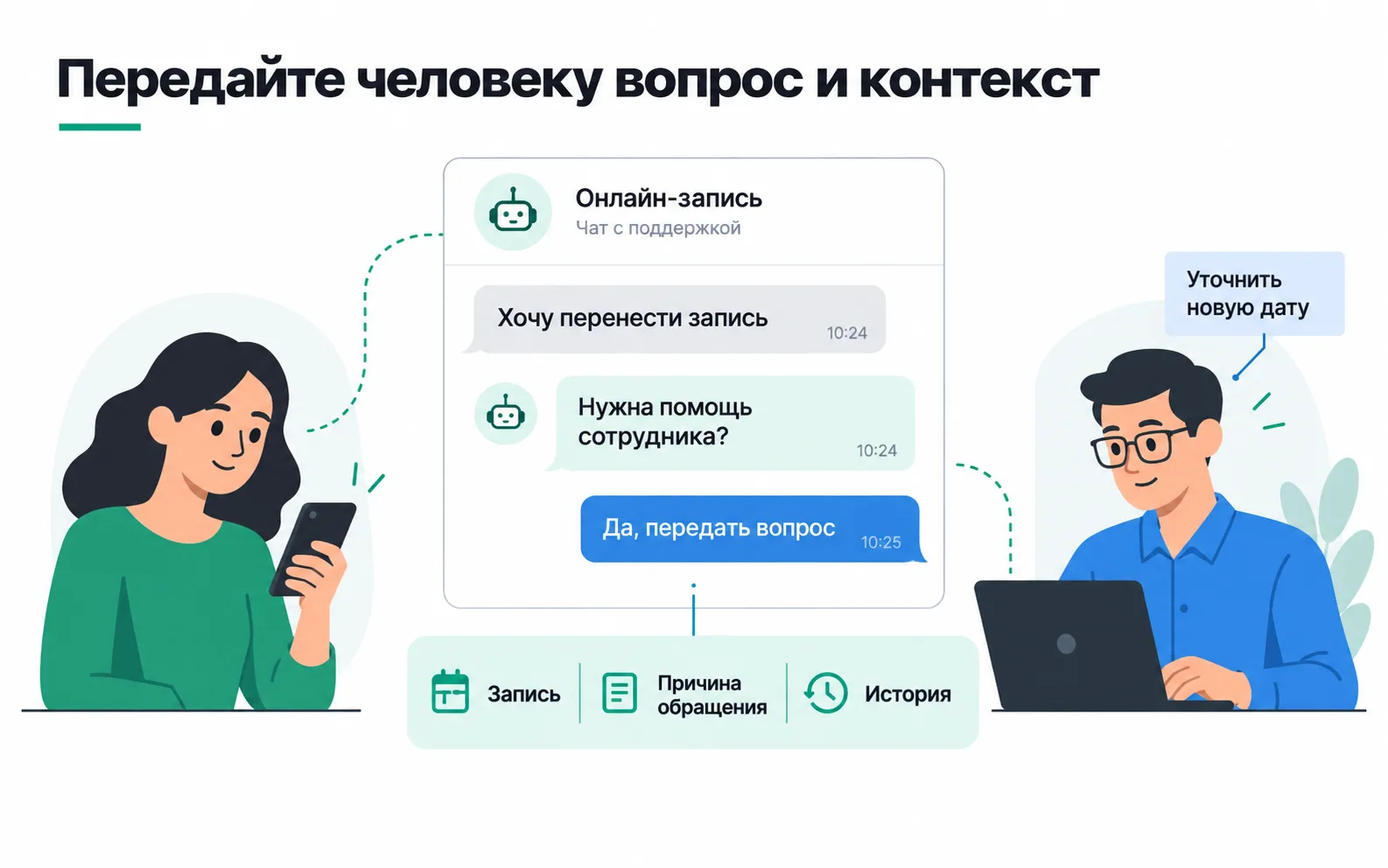
The bot finds the person's booking but can't change the date itself. So it doesn't reply "Rescheduled". It offers to bring in a staff member and says when they will answer, by the real working hours: "We've passed this to the administrator, who will reply by 19:00." The administrator gets the booking, the reason and the whole chat, and doesn't ask the person to start over. In the CRM the request has an owner and a status, and it counts as closed once the customer has confirmed the new date.
For WhatsApp this is a policy requirement: if automation answers messages, people must have a clear route to a human, for example a transfer to a staff member in the same chat. The school's Telegram bot works the same way; otherwise someone whose question the bot couldn't solve simply leaves.
How to count orders from chat
At the coffee shop the manager does the selling in chat. Someone asks which beans to get for a cezve, the manager answers with a quick reply, adds a few words of his own and sends a link. To understand later what the chat brought in, you need three things.
- Tags on links from the shop's dictionary, for example
utm_source=whatsapp,utm_medium=social,utm_campaign=reorder,utm_content=colombia_lot. Visits through untagged links can end up in GA4 as direct traffic, as in the lesson on brand. - A source on the order. If someone orders right in the chat, the manager creates the order in the CRM with the source "WhatsApp" and the reason: a reminder, a new lot, a question.
- Statuses treated as signals, not results. The platform sends "sent", "delivered" and "read" by webhook. "Read" means the message appeared in an open chat; the CRM records the order. How many orders a campaign added is shown by a control group, as in trigger flows.
Time to first reply is counted in working hours and separately from the automatic greeting: the greeting arrives in a second, but it doesn't answer the question.
Exercise: a messenger map for your client
Take a business that talks to its customers on WhatsApp or Telegram.
If the database has thousands of phone numbers and only dozens of consents, that is the main finding of the audit: there is almost nobody to message yet, and the work starts with collecting consent on the order form and in chat. A bill of a few dozen dollars a month is no reason to stay on the app. What decides it is the amount of manual work and whether the conversations need to be in the CRM.
If a staff member joined a day later and asked "so what's the problem?" all over again, the bot isn't passing on context, and the handoff needs fixing, not the bot's wording. And untagged links plus orders without a source mean the chat is doing its job but doesn't show up in reports.
The map fits in one table: the channel, who writes, who may be messaged first, what a month costs and where it is recorded that a chat led to an order.