After a week of TikTok ads, the owner of an IELTS prep centre in Almaty comes back to his idea: "Our competitor posts videos on TikTok every day. Let's do the same, and start a Telegram channel and a YouTube channel too." At the centre one teacher films the videos, and she has five hours a week for it. A manager answers on WhatsApp. Five hours do not stretch across four platforms, so a choice has to be made. The centre's numbers in this lesson are illustrative.
How many people each platform has
The first thing the owner will ask is where the most people are. Dated figures for Kazakhstan are in DataReportal's Digital 2026: Kazakhstan, with data as of October and the end of 2025. For social networks the report gives ad reach: how many accounts the platforms' own advertising tools say an ad can reach.
| Platform | Ad reach in Kazakhstan, end of 2025 | Source of the figure |
|---|---|---|
| TikTok | 16.9 million aged 18 and over | TikTok's advertising resources |
| 13.1 million | Meta's advertising tools | |
| 2.5 million | Meta's advertising tools | |
| 1.9 million registered members | LinkedIn's advertising resources | |
| Threads | 1.85 million | Meta's advertising tools |
For comparison, Kazakhstan has 20.9 million people and 19.5 million internet users. TikTok's ad reach includes more adults than the country has, and DataReportal itself flags that 122.8% of the population aged 18+ as possibly implausible while publishing it as reported. Ad reach counts accounts, not people. Meta's help page on estimated audience size says its estimates are not the number of active users and are not designed to match census figures: one person can have several profiles.
YouTube, Telegram and VK are not in the report, and we have no other dated figure for Kazakhstan. Penetration percentages without a source or a date, the kind that travel from one slide deck to the next, stay out of the plan.
The table tells you little: Instagram and TikTok are big enough in Kazakhstan that the centre's customers are almost certainly on both. Choosing between them comes down to the job, the format and the team's hours. The size of your own segment, say people aged 18-25 in Almaty, you check in the ad account while setting up the audience, with the same caveat about accounts.
What a platform asks of the team
Each platform shows posts to new people in its own way, and each asks for its own kind of work from the team:
| Platform | What it takes from the team |
|---|---|
| Vertical videos; stories and DM replies for those who already follow | |
| TikTok | Vertical videos that people watch to the end |
| YouTube | Long walkthroughs aimed at search queries, or the same vertical videos as Shorts |
| Telegram | Several posts a week and a budget to promote the channel |
Someone has to bring a Telegram channel its subscribers, for example ads and paid posts in other channels, and those need a budget of their own. A channel is convenient for people who are already with you and harder to grow from zero.
Threads is small, 1.85 million by ad reach, and it is built first of all for text posts. For a centre that sells by showing a lesson, it would not be the first choice.
Where the centre's customer decides
The customer the centre builds its launch around is an applicant going abroad, taking Academic, with the exam 3-4 months away, as in the centre's segmentation. The manager can find out where that person chooses a course: if the manager asks "Where did you see us?" in the WhatsApp conversation and records the answer in the CRM, in a month the centre will have its own picture instead of industry guesses.
What the centre already knows:
- The centre has already run a Reel with feedback on a speaking mistake as a Reels ad, and over two weeks it brought two people to a trial lesson for 9,400 ₸.
- A week of TikTok ads brought four people to a trial lesson for 69,300 ₸. From the results of that week you cannot say TikTok is worse than Meta: the difference is on the edge of chance, and the weeks and budgets differ.
- The same vertical video works for Reels, TikTok and Shorts. The music rules differ, and editing it for TikTok and Shorts takes the teacher about an hour a week.
These are advertising results: they say something about the format, not about what a free account will bring. Instagram stays the main platform because the account and its followers already exist.
What a platform costs in hours and tenge
Now split the teacher's five hours:
| Platform | What to post | Hours a week |
|---|---|---|
| One Reel with speaking feedback and three stories | 4 | |
| TikTok and YouTube Shorts | The same video, edited for each platform with music under its rules | 1 |
| Telegram channel | Three posts: a task walkthrough, word of the week, a trial lesson announcement | 3 |
| YouTube, long videos | A 15-minute walkthrough of a mock exam | 6 |
Instagram plus moving the same video to TikTok and Shorts takes exactly five hours. The Telegram channel and long videos do not fit.
The owner could hire an assistant to run the channel for 80,000 ₸ a month. Under the scaling plan the centre spends up to 24,000 ₸ to acquire one student, so the channel would have to produce at least 3.3 payments a month (80,000 / 24,000). One in four people who submit the form comes to a trial lesson, and one in three of those pays, so that is one payment per 12 leads. 3.3 payments means about 40 leads a month from a channel that does not exist yet and has zero subscribers. You cannot count on that in the first months, so the channel is put off until the centre has a second person for content.
The bar will only rise from here. In early November the cohort analysis will show that a student brings the centre less than planned, and if the owner still spends half on advertising, the limit drops to 20,000 ₸. The channel would then need 4 payments a month, that is 48 leads.
The centre's decision for eight weeks:
- Instagram stays the main platform: one video and three stories a week.
- The same video goes out on TikTok and Shorts. The test costs an hour a week and needs no new work.
- The profile link on Instagram and YouTube is tagged according to the UTM reference table:
utm_source=instagramorutm_source=youtube,utm_medium=social,utm_campaign=ielts_trial, as in the centre's ads. That way clicks split by platform. On TikTok a website link in the profile needs 1,000 followers or a Verified Business Account (adding a website link to your profile), so a new account will not have one. People who message on WhatsApp straight away get asked by the manager: "Where did you see us?" - After eight weeks the centre looks at how many people from each platform came to a trial lesson. One or two attendees from TikTok and Shorts is not an answer yet, and the test is extended. None at all, and the hour goes back to Instagram.
Exercise: four questions for your platform
The picture shows the four questions a choice starts with. They are drawn for a pottery studio, but they fit any business.
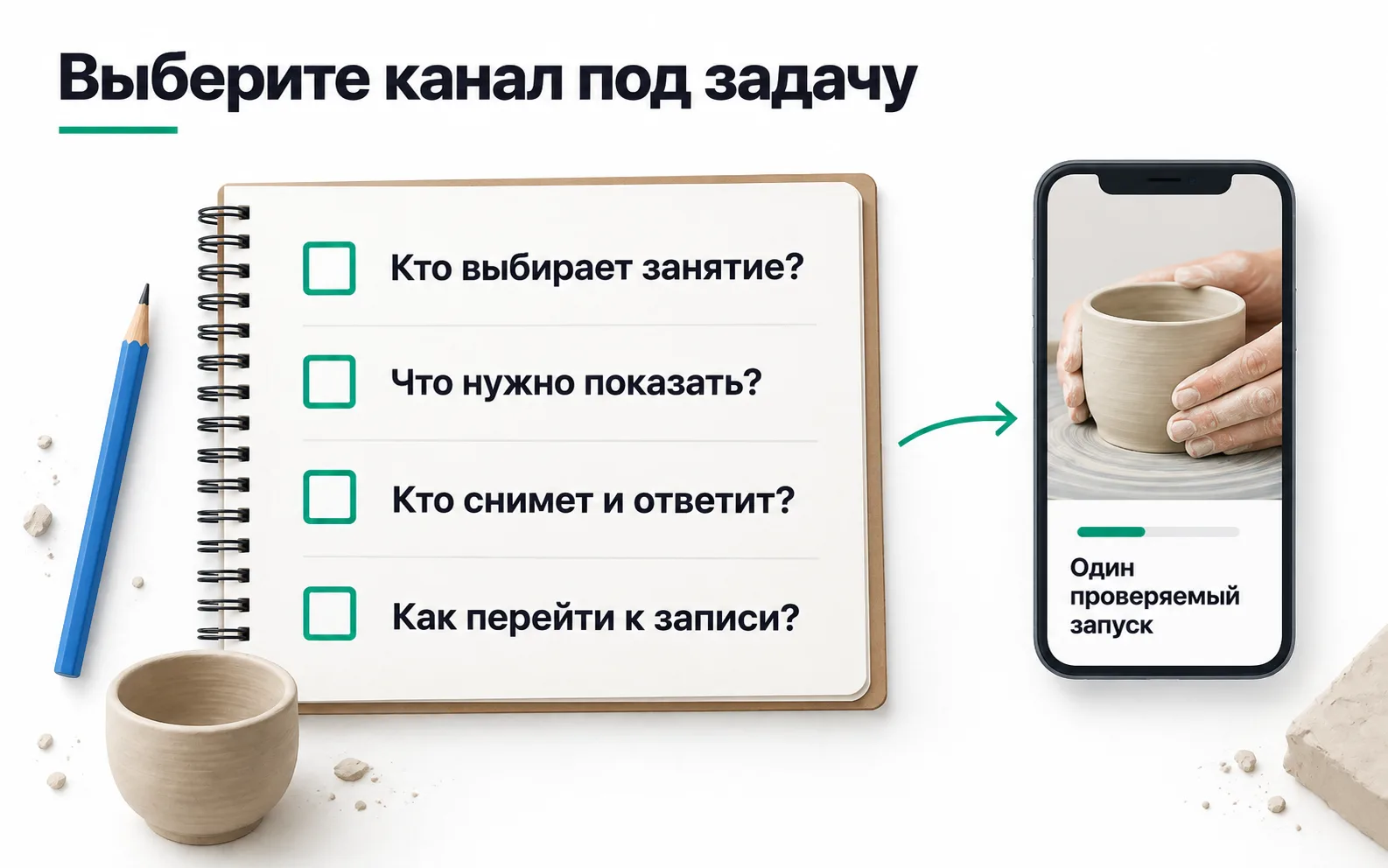
Take your own project or a client business and two platforms you are choosing between.
"Everyone on Instagram" as the answer to the first question means you have not chosen a platform yet, you have taken the biggest one. Go back to your customers and ask where they found you: five to ten answers will tell you more about your buyers than a platform's total reach.
No hours for a second platform means the second platform is the same video in another place, as TikTok is for the centre; it needs no new series.
The calculation in the last item has a sobering effect. The centre's channel would have had to produce 40 leads a month from zero. A platform that needs more leads than you currently get from all channels combined is put off until you have the people and the budget.
Video: choosing a social network for your business
Check any audience figures from a video against a dated source, such as the DataReportal report.