Saturday, 19:40. A customer posts a story with a photo of a bag of Brazil from an online coffee shop: the label says "Roasted 14.07", and the parcel arrived yesterday. The caption reads "Fresh roast, you say?", with the shop tagged. By 20:30 there are 38 comments under the shop's latest Reel: "what date is on mine?", "so that's why it tasted bitter", "unfollowing". An ad is running in the feed, "Beans for home, roast date on every bag", and a video about freshness is scheduled for Sunday morning. The owner is at a family celebration, and one manager is minding the account, even though the rules say weekend messages are handled on Monday.
This is the shop from the lesson on community management: freshly roasted beans delivered across Kazakhstan, a 15,000 ₸ order. The numbers and events are made up.
A complaint or a crisis
A complaint about a late parcel is routine work: one person, a clear cause, a reply by the rules. Saturday's story is different, and here is how you can tell:
- the main promise is hit: the shop sells fresh roasts with the date on the bag, its brand rests on that date, and the photo says the date can't be trusted;
- the story is moving without you: the story gets reposted, and questions appear under your posts and in DMs from people who never wrote before;
- nobody knows how many people are affected: one bag or the whole batch;
- the ads and scheduled posts repeat the same promise, so the shop keeps making it while it's being challenged.
If customers' health, money or data are at risk, the person responsible for that decides first, and marketing gets their decision to everyone.
W. Timothy Coombs, a crisis communication researcher, names two aggravating factors. In his overview for the Institute for Public Relations, people judge the same incident more harshly if the company has had a similar crisis before or already has a poor reputation (Crisis Management and Communications, 2007). The shop has no history like that, so neither factor applies.
The first hour: stop what makes it worse
Coombs advises trying to give the first response within an hour: while the company is silent, others tell the story for it. But in the same paper he writes that speed means nothing if what you say is wrong. So the first hour isn't spent only on the text:
- Decide who decides and who writes. The owner decides, even by phone. The manager writes, and every reply goes out from them with the same text.
- Pause the ad about the roast date. People comment under ads too, and next to the words "roast date on every bag" those comments hit harder than under a post.
- Move the freshness video. On Sunday morning it would land in the middle of the investigation.
- Delete nothing and don't argue in the comments.
- Collect the facts: the customer's order number, the batch, the roasting log, how many bags with that label went out and to whom.
- Give the first reply.
The first three steps take minutes if everyone knows in advance who has access to the ad account and the post schedule. On a Saturday evening that's the owner, so the manager calls them first.
The first reply: what we know, what to do, when we'll be back
At 20:30 the manager messaged the customer in DMs, thanked her and asked for the order number. The same text went out in a story and under the Reel:
We've seen the photo of the bag dated 14.07. We're checking it against our roasting log right now and finding out how many bags went out with this label. If you have a Brazil dated 14.07, send your order number to our DMs: we'll replace the bag either way. Our next update will be here tomorrow before 12:00.
The reply has four parts: what the shop sees, what it's checking, what the customer should do now and when the next message comes. For Coombs, any response starts with instructions for everyone who may be affected (instructing information), as in a product recall, and only then turns to reputation. Here the instruction fits in one line: send the order number and get a replacement.
What the reply leaves out matters just as much. There's no cause: nobody knows it yet, and a guess like "probably a printer glitch" would turn into fact in other people's reposts. There's no "our coffee is always fresh": on Saturday evening the shop doesn't know that about this batch. There's no "everything is under control".
The picture shows the same technique at a pottery studio that cancelled a class.
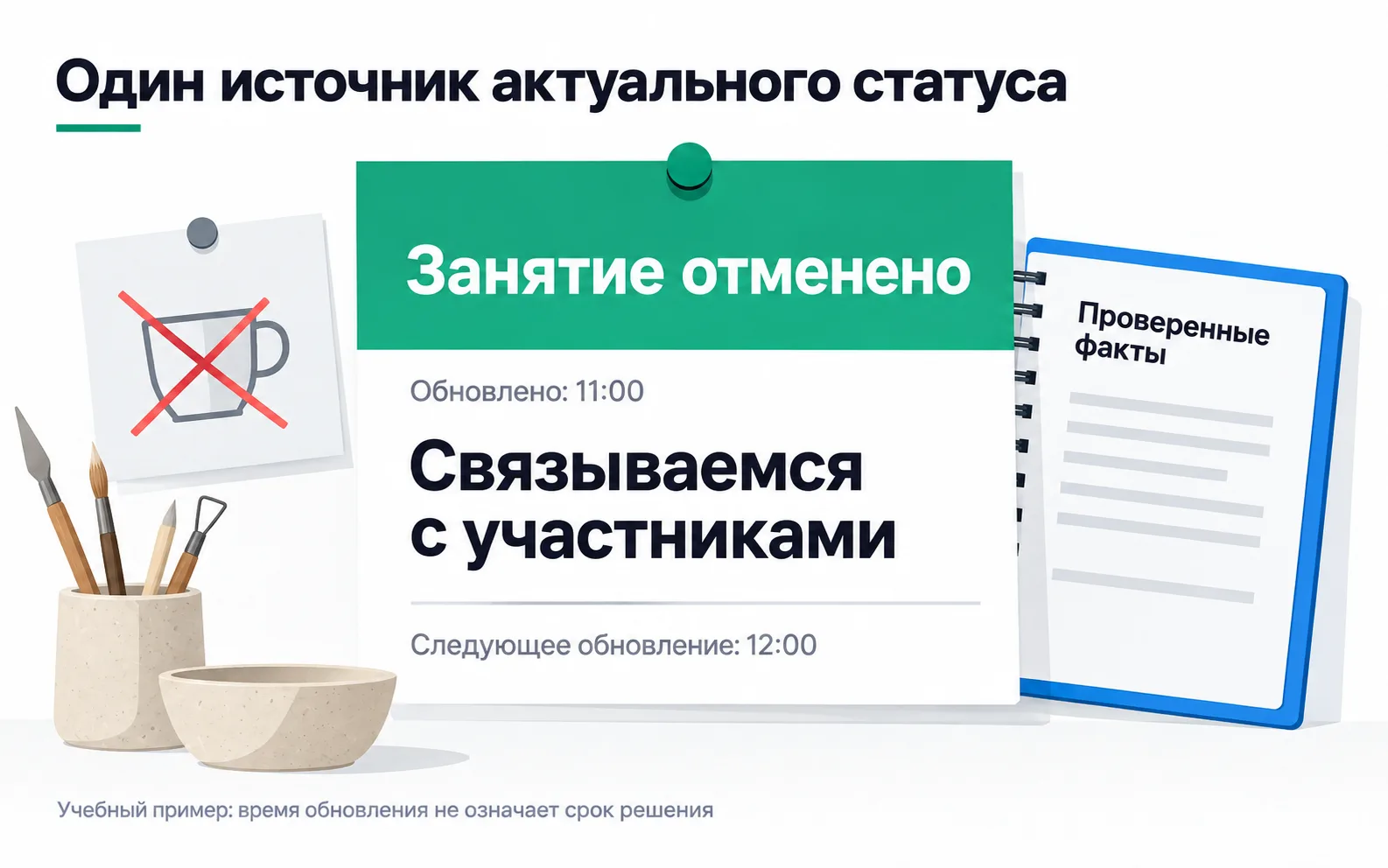
The reply depends on what you find
At 10:30 on Sunday the roaster opened the log. This batch of Brazil was roasted on Monday, but on Tuesday the labels were printed from an old file that still carried the date of the July batch. The batch number on the label matches the entry in the log. Between Tuesday and Friday, 46 bags went out with that label, and three more are on the shelf.
Coombs's Situational Crisis Communication Theory (SCCT) sorts crises into three groups by how much people blame the company, and recommends a different response for each. The base is the same for all: instructions for those affected, sympathy and an account of what is being fixed. Beyond that, it depends:
| What could turn out | Coombs's group | What to add to the base |
|---|---|---|
| The photo shows someone else's bag or an old order | Company as victim: a rumour | A rebuttal with proof, such as the log entry and batch number |
| The equipment that prints dates broke | Accident: a technical error | An explanation of what happened and that it wasn't intentional |
| The label was printed from an old file, or the beans really are old | Preventable crisis: human error or misconduct | An apology and compensation |
The shop is in the third row, human error. Coombs allows denial and attacking the accuser only for rumours and for accusations that the company operates inappropriately. Here the label really is wrong, so "the customer mixed things up" won't do, even though the beans are fresh.
At 11:40 the second message went out:
We've found the cause. This batch of Brazil was roasted on Monday, but on Tuesday its labels were printed from an old file with the date 14.07. The mistake is ours: nobody checked the label date against the roasting log. Forty-six bags went out with this label. Today we'll message every one of those customers on WhatsApp: you can exchange the bag or get your money back, and we'll add a set of drip bags to your next order. From Monday, two people check the date on every label, the packer and the roaster.
The owner chose the compensation: the manager doesn't make decisions like that in the comments. The shop has given away the drip bag set before, with bloggers' promo codes, and it costs 1,000 ₸.
The Law on Consumer Protection (as amended up to 20 August 2026) lists the date of manufacture among the mandatory information about a product (Art. 25(1)(12)). If the roast date serves as the date of manufacture, a wrong date is, as we read it, an error in mandatory information. What claims that gives the buyer depends on the consequences of the error (Art. 10(2)), and the shop offered an exchange or refund to all 46 buyers on its own. A screenshot of the customer's order with her name and address isn't posted even as proof: personal data follow the same rule as in comments and stories. This is a summary of the law, not legal advice.
Moderation while the wave lasts
The rules are the same as on any other day: insults, spam and other people's data are removed, complaints stay up, and every "what date is on mine?" gets a one-line reply linking to the status story.
Comments under the Reel stay on: turning them off makes Instagram hide all existing comments along with the shop's replies (turning comments off). If the wave is in a Telegram channel's discussion group, slow mode in the group permissions slows the flood: each member can post once per chosen interval (about slow mode).
How to close the story
By Sunday evening the manager had messaged all 46 customers who got a bag with the wrong label:
| What | People |
|---|---|
| Messaged on WhatsApp | 46 |
| Replied | 40 |
| Chose an exchange | 6 |
| Asked for a refund | 2 |
| Kept the bag and are waiting for the set with their next order | 32 |
| Haven't replied yet | 6 |
The story is closed when all 46 rows are closed, not when the comments go quiet. The six who haven't replied get another message on Monday, and until then they stay open in the log. The final message goes out where the status updates were: what was done, how many people got an answer, what changed in packing. The manager writes to the customer who started it all personally, and whether to share the outcome on her account is up to her. The roast-date ad is relaunched on Monday, once the double check is working.
A week later the owner, the manager and the roaster rebuild the timeline: 19:40 the story, 20:30 the first reply, 10:30 the log, 11:40 the second message, Sunday evening the messages to 46 customers. They look for the point where the mistake slipped through. The label file had no link to the roasting log, and nobody was there to compare them. The fix is written down with a name and a deadline: the label template takes the date straight from the roasting log.
Exercise: a first-evening plan for your project
Take your own project or a client's business. A story like Saturday's went up today at 20:00: what do you do?
The main promise shows in the ads: whatever the business repeats in every ad is where a complaint turns into a crisis. For a coffee shop it's the roast date, for a dental clinic it might be "painless", for food delivery it's the time.
The weakest line in such a plan is the weekend. If only a contractor who doesn't answer on Saturdays has access to the ad account, there's nobody to pause the ad. That gets sorted before a crisis: a second person gets access, or there's an on-call arrangement.
The first-reply template leaves the cause blank. It's added in the second message, once confirmed, and that's when you pick the response from Coombs's table. The manager gets advance permission for small compensation, such as an exchange or a gift with the next order. Anything bigger is the owner's call, but the manager comes to that call with the number of customers affected.
If the data for checking is only reachable on weekdays, the first reply names that time. "We'll check the log on Monday before 12:00" beats silence until Monday.
Video: answering negative comments
The Skillbox webinar runs almost 1 hour 40 minutes, and the most useful part starts at 49:10: how fast to react, seven rules for handling negative comments and worked examples.