A pottery studio in Almaty sells handmade mugs through Instagram. There's no website: photos in the feed, "price in DMs", payment by transfer to a card. On Friday evening a Reel with a green mug collects 60 messages saying "I want one" and "how much?", and there are eight of those mugs in the batch. By Saturday one mug has been promised to two people, one customer has sent a screenshot of a transfer while the money never arrived, and twelve people got no reply at all. The studio and the numbers are made up.
Social commerce is selling that starts on social media and gets all the way to payment there: a person sees the product in the feed, agrees the details in a chat and pays without visiting a website. For the studio, this is the main sales channel rather than a stopgap until a website appears. It can be set up so that one mug never goes to two people and the owner knows where buyers come from.
Where to sell without a website in Kazakhstan
| Where | What it does | What to keep in mind |
|---|---|---|
| Instagram: posts, Reels, DMs | Shows the product and lets you agree the sale in a chat | Instagram shops aren't available in Kazakhstan |
| WhatsApp Business | A catalogue with photos and prices, quick replies, chat labels, away messages | Payment is taken separately |
| Shop on Kaspi.kz | The buyer finds, pays for and receives the item inside Kaspi | Requires Kaspi Pay and a payment history; a commission on each sale |
Instagram. Meta opens shops on Facebook and Instagram, where posts carry product tags, by a list of countries, and Kazakhstan isn't on it. As of 13 October 2026 the help page lists the full feature set for the United States only, an open beta for 20 countries from Canada to Thailand, and limited features for Ukraine and Indonesia (supported countries for shops). On top of that, a shop needs a checkout URL on your own website, and without one it won't become visible (how to set up a shop). So selling on Instagram in Kazakhstan means a profile, posts and conversations.
WhatsApp Business. The app has a catalogue: on the Tools tab, under Catalog, you add an item with photos, a name, price, description and product code (how to create a catalog), and you can share a link to the whole catalogue or a single item on WhatsApp, Facebook and Instagram. There are quick replies for messages you send over and over, labels to organise and filter chats, a greeting for new customers and an away message outside business hours (WhatsApp Business features).
Kaspi. Any organisation connected to Kaspi Pay that has received payments into its Kaspi Pay account on at least 20 days in the last two months can sell in the Kaspi.kz Shop (who can sell, updated 27 May 2025). The commission depends on the category and is charged only on completed sales: if the buyer cancels, it's returned (commission, updated 6 January 2026). In Kaspi's 2026 tariff table, the row for tableware, then mugs, glasses and tumblers, then mugs, saucers and sets shows a commission of 10.9% excluding VAT, or 12.5% including VAT.
Price, stock and terms go in the post
"Price in DMs" makes everyone who likes a mug write in and wait for an answer. Sixty of those in one evening are too many even for two people, and twelve people were left without a reply. A post caption with the price and terms answers everyone at once:
"Green Tea" mug, 350 ml, 9,000 ₸. There are 8 in this batch, and the glaze settles a little differently on each. Pick it up at the studio or get it delivered in Almaty for 1,500 ₸. To reserve, message us on WhatsApp via the first link in our profile; we hold a reservation for 2 hours after sending payment details.
The "8 in this batch" count is updated after every sale in the post caption, in stories and in the WhatsApp catalogue. Once everything is sold, the post says so, and new messages go onto the waiting list.
The order log: one row per mug
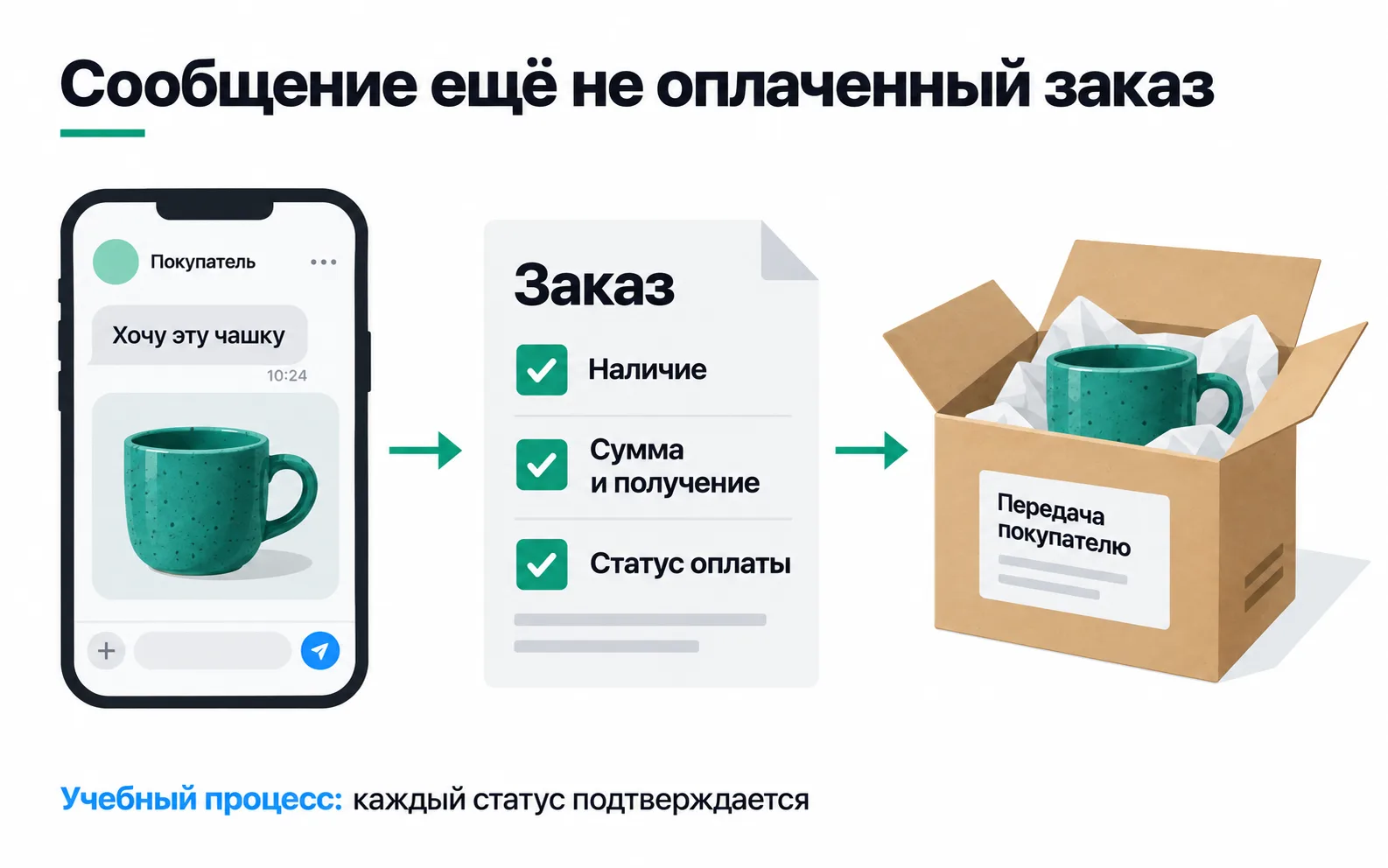
A chat doesn't remember who was promised what, especially when two people answer: the owner and her assistant. So every mug has a number within its batch and a row in a shared spreadsheet, and a mug can only be reserved there.
| Mug | Buyer, channel | Status | Reserved until | Source |
|---|---|---|---|---|
| G-03 | Asem, WhatsApp | Awaiting payment | 21:40 | REELS |
| G-04 | Dinara, DM | Paid, money received | - | STORIES |
| G-05 | - | Available | - | - |
The statuses go in order: enquiry, reserved until a set time, awaiting payment, paid, handed over (collected at the studio or given to the courier), received. Each step is marked by whoever made it. A reservation that isn't paid by the deadline is released, and the mug goes to the next person in the queue. That way one mug no longer goes to two people: the second customer is told "reserved until 21:40, you're first in the queue".
A transfer screenshot isn't a payment yet
"I've sent it" and a screenshot show intent, not money in the account. The status changes to "paid" when the incoming payment shows in the banking app: the amount, time and sender match the reservation. If the studio is connected to Kaspi Pay, it can take payments by Kaspi QR, by card or remotely, and all of them arrive in one account (Kaspi's terms).
Transfers to a personal card for regular sales are a tax question, and this lesson doesn't answer it. If you or your client sell without being registered as a sole proprietor, talk to an accountant before sales become regular, and check the rules on the State Revenue Committee's website, kgd.gov.kz.
WhatsApp Business: catalogue, quick replies, labels
The studio puts each batch of mugs into the catalogue with a photo, price and number, so instead of a photo from the camera roll, the buyer gets a link to the item. The assistant pastes the price, delivery terms and reservation rule as quick replies. Labels mirror the log's statuses: "Enquiry", "Reserved", "Awaiting payment", "Paid", "Handed over", and filtering by "Awaiting payment" shows in a minute who needs a reminder. The night-time away message says "We'll reply from 10:00" and doesn't promise a reservation: a reservation starts when the person gets an answer from the studio.
On a website, UTM tags would show where a buyer came from; without a website, a WhatsApp link with pre-filled text does that job. WhatsApp opens a chat from a wa.me link with the number in international format, and the text parameter places pre-set text in the message field (click to chat). The links go into the profile, where Instagram allows up to five links (profile links), and into stories as a Link sticker (stickers). The studio has three links:
REELS and PROFILE are the first and second links in the profile, the Reels caption points to the first, and STORIES goes into the sticker. The word appears in the message field, the person adds their own text and sends it. Some will delete the word, so for messages without it the log records the answer to "Where did you hear about us?".
A month with the log
The first month with the log and the links looked like this:
| Source | Enquiries | Reserved | Paid | Handed over |
|---|---|---|---|---|
| Reels, word REELS | 70 | 30 | 26 | 25 |
| Stories, STORIES | 25 | 9 | 8 | 8 |
| Profile, PROFILE | 15 | 5 | 4 | 4 |
| No word, buyer's own answer | 20 | 3 | 2 | 2 |
| Total | 130 | 47 | 40 | 39 |
The kiln produces forty mugs a month: five firings of eight, all priced at 9,000 ₸, which comes to 360,000 ₸. Seven reservations lapsed without payment, and one paid mug is waiting to be collected.
What matters in the table is the ratio of 130 enquiries to 40 mugs. There were exactly as many payments as there were mugs, so Reels and stories can't be compared by payments. Sales are capped by the kiln. The 90 enquiries without a mug are candidates for a waiting list: those people get the first message when the next firing is done.
That settles the Kaspi question too. While there are three times more enquiries than mugs, the Kaspi.kz Shop would add buyers with nothing to sell them and take 1,125 ₸ from each 9,000 ₸ mug. It will make sense if the studio starts making sets in series and there are more mugs than enquiries in its chats. At this ratio Instagram ads can wait too; when the time comes, they're set up like any Meta campaign.
Returns, breakage and what the law says
Mugs break in transit, and the rule for that is set in advance: the buyer opens the box in front of the courier or at the studio and photographs any chip or crack straight away. The rest is set by the Law on Consumer Protection (as amended up to 20 August 2026), and this is what concerns the studio:
- A seller in e-commerce gives the price and the payment procedure before the purchase (Art. 24). The price and reservation rule in the post caption cover this before the first message.
- When selling online, the seller links to the authorised body's website to give its contacts and those of the pre-trial dispute resolution bodies, along with the buyer's right to turn to them or to a court, and shows its own actual address and phone number on the online resource it uses (Art. 33-2(2)). As we read it, an Instagram profile is such a resource, so all of this goes in the bio.
- In e-commerce, the product name, price, purchase terms and main properties are given in Kazakh and Russian (Art. 25(3-1)), so the post caption and the catalogue card are written in both languages; the example above shows only one of them.
- Non-food goods of proper quality can be exchanged or returned within 14 days if they haven't been used and their condition and proof of purchase are preserved (Art. 30(1)).
- If a mug is defective, the buyer chooses the remedy, for example a replacement, a price reduction or a refund (Art. 15(1)).
A post with a price and "8 left" is, as we read the Law on Advertising, an advertisement, and untrue information in it about availability, price or delivery counts as unreliable (Art. 7(2)(2)-(4)). That's why the count in stories is updated right after a sale. And chats with buyers are posted as reviews only with their consent: the Law on Personal Data and Their Protection (as amended up to 14 September 2026), as a general rule, allows personal data to be disseminated in publicly available sources only with the person's consent (Art. 7(3)); comments and stories are, as we read it, such a source. This is a summary of the law, not legal advice.
Exercise: follow one order at a client's business
Take a client's or friend's business that sells through Instagram, WhatsApp or Telegram without a website, and go through the buyer's journey.
If the post has no price and everything starts with "how much?", that's fixed in an evening with post captions and quick replies. After that, people write to the owner about buying, not about the price.
If the owner's answer about payment is "the buyer sends a screenshot", you've found the place where money gets lost. And if orders live only in chats, with no log, double promises are only a matter of time, especially when two people answer.
The last item shows what the seller needs right now. If there are far more enquiries than goods, as at the studio, the job is not losing the people who want to buy: a waiting list and pre-orders. If there are more goods than enquiries, it's time to think about ads and Kaspi, and the pre-filled links will show where buyers come from.
Video: social commerce
An hour-long webinar on how Ozon, Wildberries and VK are building purchases into content: the market is Russia's, but the global social commerce overview from 03:53 shows where the platforms are heading.