The owner of an IELTS prep centre in Almaty wants to hire another teacher, open a third trial lesson and double enrolment. For a talk with his partner he made a slide: "IELTS is taken more than 4 million times a year worldwide. Our course is 135,000 ₸ for three months. If we take even 0.01%, that's 400 students and 54 million ₸ a year." The arithmetic is right, but no number on the slide says how many applicants the centre will find in Almaty next year.
Let's size the centre's market bottom-up, from statistics and explicit assumptions, and see whether it's big enough to double. The centre's course, leads and students are made up; the statistics, the exam fee and the sources are real.
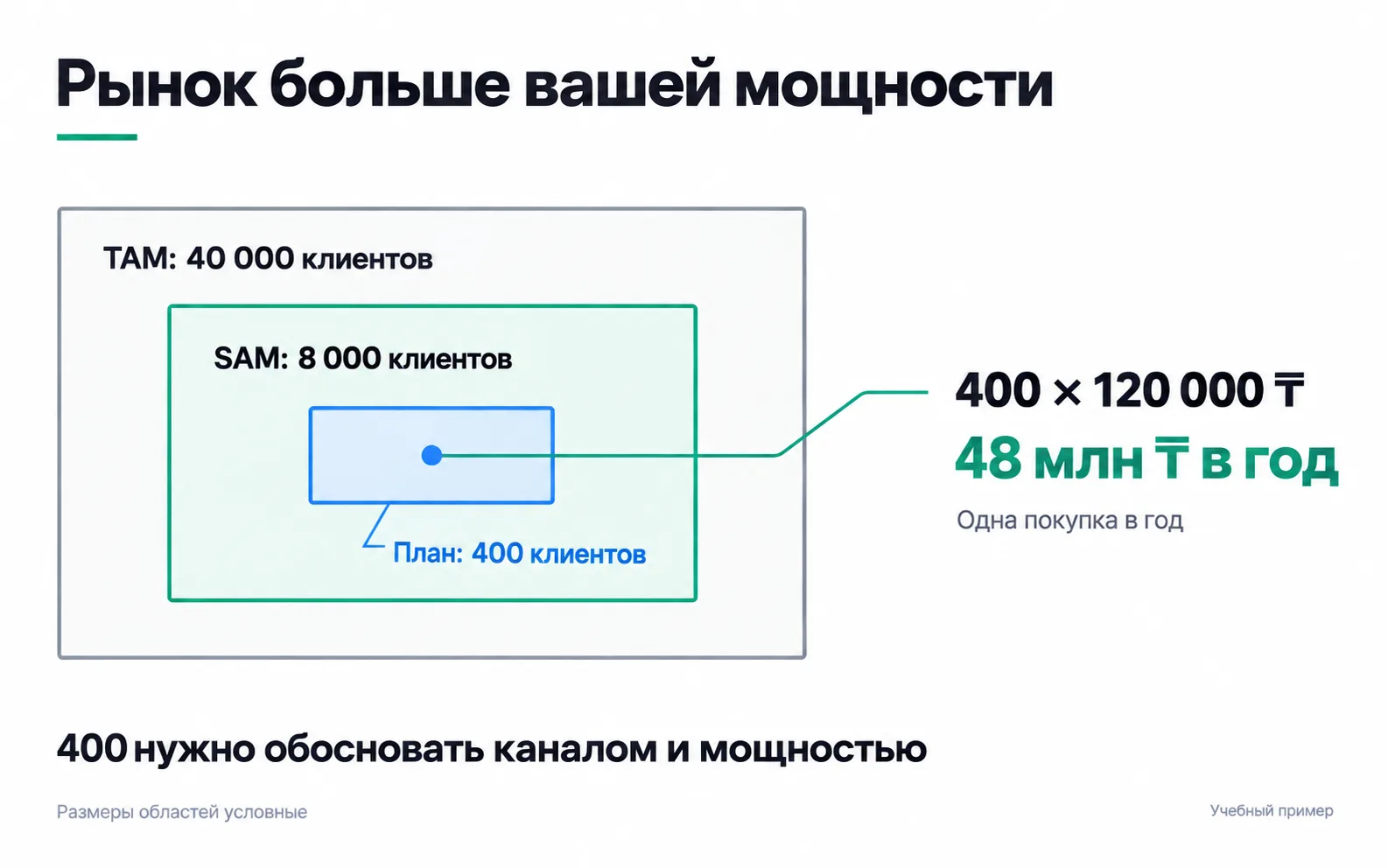
The diagram shows the three market levels of a different business, and it reaches the same conclusion the centre will: the plan has to be backed by a channel and by capacity.
Market boundary, unit and period
First decide what exactly you're counting. Two numbers on the owner's slide stand in for something else.
- 4 million is exams worldwide in 2023, not people: in its 2023 review, IELTS says more than 4 million tests were taken that year. How many of them were in Kazakhstan, IELTS doesn't make public.
- Sitting the exam and paying for preparation are different purchases: every one of the 4 million paid the organiser, but not everyone pays for preparation. IELTS Academic on computer at the IDP centre in Almaty costs 110,250 ₸ (the centre's page on ielts.org, 13 October 2026). That's the exam market, and a prep centre has no part in it.
The centre already has its market boundary. When it went through the five forces, it wrote it down as paid IELTS preparation for Almaty residents, offline and online. Self-study isn't part of this market: books and videos do the same job without a paid teacher. The unit is a person who pays for preparation, and the period is a year. To turn people into money, multiply by 135,000 ₸, the price of the centre's three-month course. Competitors' full price for preparation came out at 125,000 to 165,000 ₸, so that's good enough for an estimate.
TAM, SAM, SOM and the formulas
The three levels answer three different questions. The definitions below follow Carta and Salesforce, with formulas for a bottom-up calculation:
- TAM (total addressable market) is how much money there is inside the market boundary if every buyer came to you. TAM = number of buyers inside the boundary × what one of them pays per period.
- SAM (serviceable available market) is the part of TAM your product can serve with its format, segment and geography. SAM = buyers your product fits × the same amount.
- SOM (serviceable obtainable market) is what you'll actually get in the period.
For a small business it's convenient to take SOM as the smaller of two numbers: how many customers your capacity can handle and how many your channels bring in at your conversion rate. That's this lesson's rule; it isn't part of the Carta or Salesforce definitions.
The owner's slide takes a number from outside the TAM, worldwide exams, and turns it straight into next year's revenue. On the way it skips all three narrowing steps: the accessible segment, the limits on entering the market and the share the centre can realistically take.
Top-down won't work, so go bottom-up
The top-down approach takes a ready-made market figure and narrows it. There's no such figure for IELTS prep in Almaty, and the worldwide 4 million exams can't be narrowed down to Almaty: every step would mean inventing a share. The bottom-up approach builds the market from the number of buyers and the price, and you can see where every row came from.
We size SAM on the centre's pilot segment, people applying to universities abroad. Official figures exist for university graduates, so the chain starts with them, that is, with people applying for a master's. That makes SAM narrower than the pilot segment: bachelor's programmes, which 11th-graders apply to, are left out.
| Step | People a year | Source |
|---|---|---|
| Graduated from universities in Kazakhstan in the 2024-2025 academic year | 152,800 | Bureau of National Statistics |
| Of them, from universities in Almaty | ≈ 51,000 | Assumption: a third |
| Apply for a master's abroad that requires IELTS Academic | ≈ 1,530 | Assumption: 3% |
| Pay for preparation rather than study on their own | ≈ 765 | Assumption: half |
That comes to about 765 people a year, or about 103 million ₸ at 135,000 ₸ each. Graduates by city are in the table of higher education graduates in the Almaty section of the Bureau's site. The Bureau publishes it as a file, and the city figure didn't make it into this lesson, so the third stays an explicit assumption: in your own calculation, replace it with the number from the table. Ways to check the other rows are in the register below.
For TAM you need everyone in Almaty who pays for IELTS prep: besides applicants, that's people relocating with General Training and school students preparing early. There are no official numbers for them, so the centre takes the roughest estimate, the mix in its own leads. Of the last 120 leads, 90 people needed IELTS, and 40 of those were applying to a university abroad. If the whole market looks the same, TAM ≈ 765 × 90 / 40 ≈ 1,720 people, about 232 million ₸ a year. The mix in the leads depends on the centre's ads and may differ from the market in either direction, and bachelor's applicants are missing from this estimate too.
Check the estimate against what you know
The centre has its own number to check against. From August to October, 47 people paid for the course. If applicants make up the same share of them as they did among those who paid from the last leads, 7 in 10, that's about 33 people over three months. If that pace holds all year, it comes to about 130 applicants a year, 17% of SAM. Both the 7 in 10 and the pace are assumptions, and they're in the register too.
For a small centre with the three competitors from its analysis plus private tutors, 17% is suspiciously high. The estimate is probably too low, and it's clear where to look. The centre's 130 applicants include 11th-graders, while SAM has no bachelor's applicants. And the 3% is the figure the centre is least sure of: between 2% and 5%, SAM changes two and a half times.
| Share of graduates who go abroad with IELTS | SAM, people | Today's 130 applicants | Doubling, 260 applicants |
|---|---|---|---|
| 2% | 510 | 25% of SAM | 51% of SAM |
| 3% | 765 | 17% of SAM | 34% of SAM |
| 5% | 1,275 | 10% of SAM | 20% of SAM |
Even in the most generous row, doubling is a fifth of SAM. That figure is inflated while SAM leaves out bachelor's applicants, but it shows no room to double.
SOM: capacity and channel
The centre's SOM is the smaller of two numbers.
Capacity. There are two trial lessons a week with eight seats each, and one in three of those who come pays. If every seat is taken, that's 16 × 52 / 3 ≈ 277 students a year across all segments. The sixteen seats hold only while each trial lesson has two teachers: the centre's rule is no more than four people per teacher. If the second teacher doesn't come, there are eight seats, 8 × 52 / 3 ≈ 139 students a year, below the current ~190 a year across all segments. Even full trial lessons couldn't handle 400 a year. And not every seat is taken yet: from August to October, 140 people came to trial lessons with about 210 seats available. A new teacher would let the centre open a third trial lesson, which adds seats, not the people to fill them.
Channel. How many applicants ads will bring in at no more than 2,000 ₸ a lead, only a test will show. The centre already knows how to run one: the budget rises in steps, and after each step it works out the cost of the added leads. If an added lead costs more than 2,000 ₸ two measurements in a row, the centre has hit the ceiling of this channel with its current ads, whatever the TAM says.
Hence a plan instead of a hire. First fill today's 16 seats a week: up to 23 students a month, against about 16 now. Meanwhile, raise the budget for applicants in steps and watch the cost of the added lead. And check the 3%. The new teacher comes on once the seats are full and the added leads still fit within 2,000 ₸.
All three levels together:
| Level | People a year | Revenue a year |
|---|---|---|
| TAM: paid IELTS prep in Almaty | ≈ 1,720 | ≈ 232 million ₸ at 135,000 ₸ |
| SAM: master's applicants abroad who pay for preparation | ≈ 765 | ≈ 103 million ₸ at 135,000 ₸ |
| SOM: no more than 277 by capacity (all segments), by channel after the test | Now ≈ 130 applicants | ≈ 14.6 million ₸ at 112,500 ₸ |
| The owner's slide | 400 | 54 million ₸ |
And don't confuse the market's revenue with the centre's money. The 103 million ₸ of SAM is the revenue of everyone who prepares applicants. Its own 130 applicants a year will bring the centre about 14.6 million ₸ in revenue at 112,500 ₸ per student, as in the cohort table, and after paying the teacher and materials 5.2 million ₸ of contribution is left. Rent and the administrator come out of that contribution under the rules of unit economics.
Register of assumptions
| Assumption | Value | How to check |
|---|---|---|
| Share of graduates from Almaty universities | A third | The graduates table for Almaty on the Bureau of National Statistics site |
| Apply for a master's abroad with IELTS | 3% | A survey of graduates at two or three universities on a random sample, data from the universities' international offices |
| Pay for preparation | Half | The "How did you prepare before us?" field in the CRM and "How are you mainly preparing now?" in the questionnaire for people who came to the trial lesson |
| Applicants among those who need IELTS | 40 of 90 | Interest in "IELTS Academic" and "IELTS General Training" on one Google Trends chart, as when estimating market growth |
| Applicants among those who paid | 7 in 10 | Tag the segment for all 47 payers in the CRM |
| A pace of 11 applicants a month all year | ≈ 130 a year | The centre's payments over the next months and seasonality in Google Trends |
Each row can be replaced with a number once one turns up. Start with the row the decision depends on most, which for the centre is the 3%.
Exercise: TAM, SAM and SOM for your own project
Take a client's business or your own and go the same way.
If your TAM comes from someone else's country or world report, look at its unit: exams, revenue of the whole category or people. If your current sales already make up a noticeable share of SAM with several competitors around, doubt the SAM before you celebrate the share. If SOM came out bigger than capacity, SOM equals capacity, however many leads the ads bring. And at the very end, look at the decision. If it's the same at both the low and the high value of the key assumption, there's no point counting further. If it changes, check that assumption before you spend money.
Video: TAM, SAM, and SOM
As you watch, note the unit and the period behind each level. In your own calculation they have to match across all three.