A week after comparing prices with competitors, the owner of an IELTS prep centre in Almaty comes back with a new question. "7.0 Guarantee" is suddenly everywhere: in the Instagram feed, above the Google results for "IELTS courses Almaty", in Telegram channels for applicants. "They must be spending a million a month. We need to spend the same." The marketer spends an evening with public tools and writes down what can be learned about the competitor from the outside. The centre, its competitors and their numbers are illustrative; the tools' prices and limits are real.
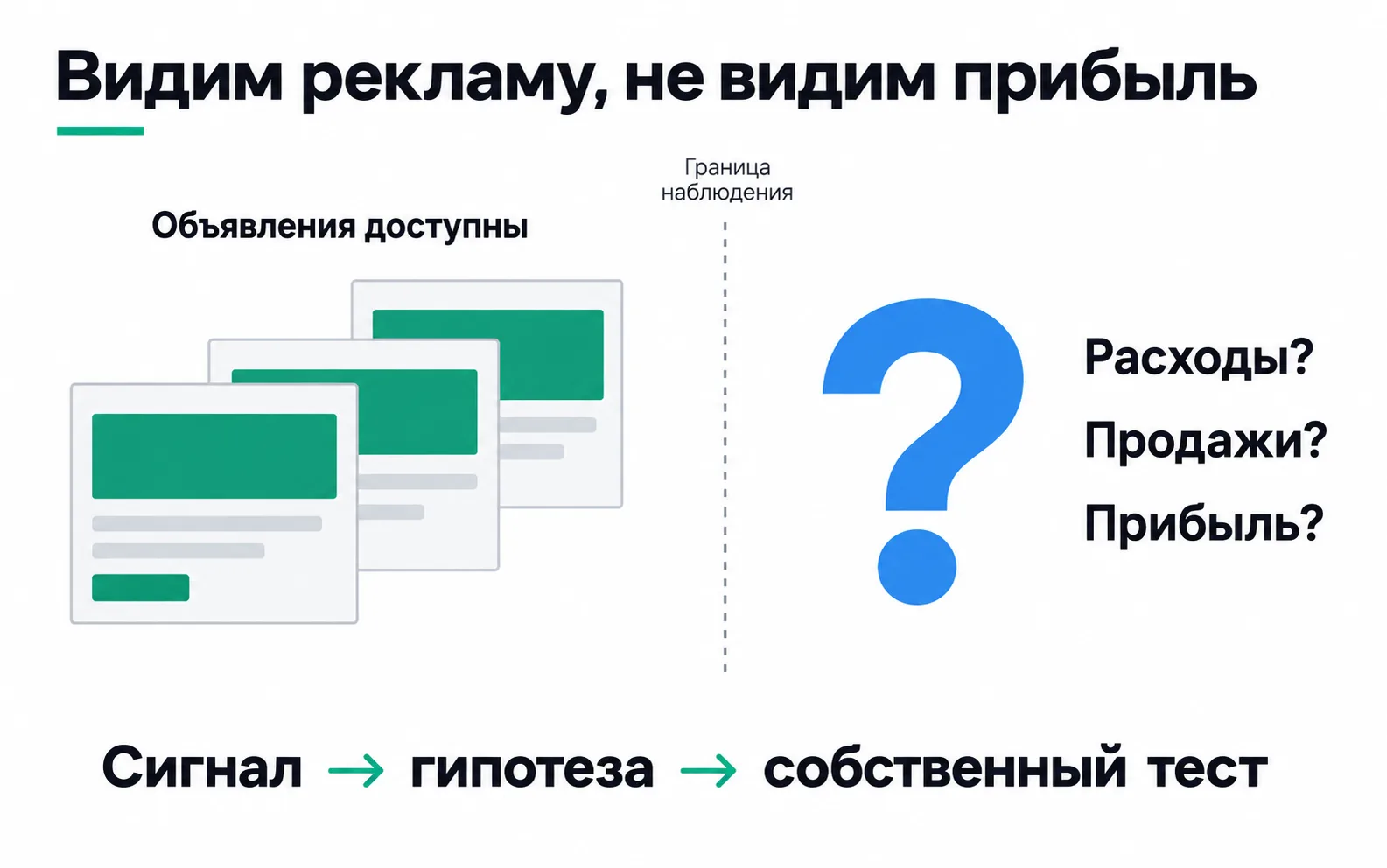
A lot shows from the outside: what the competitor promises, where it appears, and what people praise it for. How much it spends and how many students it gets for that money isn't there.
What to find out and where
Start with a question and pick the tool for it. Public data won't show a competitor's revenue, and swapping revenue for a traffic estimate doesn't work. But questions like "what do they promise", "where do they look for customers" and "what do their students complain about" do have answers:
| What to find out | Where to look | What you won't find there |
|---|---|---|
| What the competitor promises on Instagram and Facebook | Meta Ad Library | Spend, impressions, and ads that have already been switched off |
| Who advertises on Google and with what copy | Google Ads Transparency Center, Auction insights in your own account | Advertisers Google hasn't verified, and those with no impressions in a year |
| Which ads work on TikTok | TikTok Creative Center, Top Ads | An archive of every ad shown in Kazakhstan |
| How many people visit the website and from where | Similarweb, Semrush | Exact numbers: these are estimates, and rough ones for small sites |
| Which queries the competitor's site ranks for on Google | Semrush | The exact number of clicks from each query |
| When interest in a topic grows | Google Trends | The number of searches or people, only an index |
| What people praise and complain about | 2GIS reviews, Kaspi reviews for products | The share of unhappy customers among all customers |
| Where the competitor buys Telegram posts | TGStat | How many students the posts brought in |
| How the website, prices and promises have changed | Wayback Machine | A snapshot for every day |
The tool prices below are as of 13 October 2026; dollars and roubles are converted at the National Bank's official rate for the same date: 451.31 ₸ per dollar and 5.36 ₸ per rouble.
Ads: Meta, Google, TikTok
Anyone can browse the Meta Ad Library. It holds the active ads of any page across Meta's platforms. For regular ads served outside the EU and the UK, you get the creative, the page and the date the ad started running. There's no spend, no impressions and no reach, and once an ad is switched off it disappears from the library, so every visit gets a dated screenshot.
On 13 October "7.0 Guarantee" has six active ads, and four of them, launched in September, promise "7.0 or a free repeat course". The tutor has two videos running since July, the school three ads, one of them about IELTS. The competitor's main promise is clear; its budget isn't. A start date tells you how long an ad has been running, not how much is being spent on it.
On Google you look for ads in the Ads Transparency Center by advertiser name or website, with a country filter. It holds ads from verified advertisers on Search, YouTube, Maps, Google Play and Shopping for a year after their last impression, with up to five common variants of each. An advertiser that Google hasn't verified, or that has shown no ads in the last 365 days, won't be there. For "7.0 Guarantee" the marketer found search ads about the guarantee; for the school, an ad about English courses linking to its home page.
The centre runs its own search ads for "IELTS courses Almaty", which gives it one more source. The Auction insights report in Google Ads shows who takes part in the same auctions: how often their ad is shown alongside yours (overlap rate) and how often it ranks above yours (position above rate). Search campaigns have it, but it isn't shown when impression share is below 10% (about auction insights). All six of its metrics are about position on the page; there's nothing about money.
TikTok has no ad archive for Kazakhstan: the TikTok Commercial Content Library keeps ads shown in the European Economic Area, the UK, Switzerland and Turkey. The free TikTok Creative Center has Top Ads, a collection of high-performing ads that advertisers themselves have authorised for it (about Top Ads), with a region filter that included Kazakhstan on 13 October. Without logging in you get only five ads (how to use Top Ads). It's good for video ideas, but "7.0 Guarantee" ads may not be there at all.
Traffic and queries: Similarweb, Semrush, Google Trends
Similarweb estimates traffic from the outside. It blends data from sites that have connected their own analytics, from its own consumer products, from partners and from public data, and runs it all through models (Similarweb's methodology). If a site had fewer than 5,000 visits in the last month, Similarweb shows nothing for it (Similarweb's data accuracy). The centre's course page gets about 1,300 people in 30 days, and for all three sites, the centre's, the school's and the one for "7.0 Guarantee", Similarweb returned "Not enough data". The tutor has no website, only Instagram.
Semrush did show numbers: about 1,900 visits a month for the language school and 700 for "7.0 Guarantee". Before trusting them, the marketer entered the centre's own site: Semrush estimated 600 visits a month for the whole site, while GA4 shows about 1,300 people in 30 days on the course page alone, and the whole site has at least that many visits. The estimate came in at less than half the real figure, and for competitors of the same size the error may be just as large. Semrush itself says that small and new sites have a wider margin of error and that traffic numbers should be read as directional (how Semrush estimates traffic).
Semrush is more useful for something else: which queries a competitor's site ranks for on Google. It has a Kazakhstan database (countries in Semrush). The school's page is in the top ten for "IELTS courses Almaty", while the centre's site doesn't appear in the organic results for that query. Semrush gives you 10 reports a day for free; the SEO plan is $139 a month on monthly billing, about 63,000 ₸ (Semrush pricing).
Google Trends shows a share of interest on a 100-point scale and shows rare queries as zero, so there's no point looking up a small centre's name. A topic works better: for "IELTS" in Kazakhstan you can see which months have higher interest, and queries are compared on one chart, as when estimating market growth for the BCG matrix.
Telegram and the site's history
Applicants read Telegram channels about IELTS and studying abroad, and competitors buy posts there. TGStat keeps a catalogue of Kazakhstan channels: each channel lists its subscribers and average post reach, and the post search finds posts that mention a competitor. TGStat calculates average reach as the mean views of all posts over the last 30 days and updates it once a day (how reach is calculated). A red label on a channel means a TGStat specialist checked it and found inflated subscribers or views (the red label). Premium analytics costs 3,360 roubles a month, about 18,000 ₸, and Premium post search another 2,940 roubles a month, about 15,800 ₸ (TGStat pricing).
Post search found September posts by "7.0 Guarantee" in two channels about studying abroad, and one of the channels has a red label. That shows where the competitor was looking for applicants in September; how many students it got from there, the posts won't tell you. If the centre wants to buy a post in the same place, average reach alone isn't enough: a few popular posts pull it up, so you take the median views of the last 10-15 regular posts, as when buying ads in Telegram.
The Wayback Machine keeps snapshots of pages from past years, which lets you trace how a competitor's prices, promises and terms have changed. Snapshots are taken irregularly and can be incomplete. Sites the crawlers didn't know about, pages behind a password, pages blocked by robots.txt and sites excluded at the owner's request may not make it into the archive. No snapshot means you simply don't know.
A log: from signal to test
The marketer writes everything into a log. Each row has the observation with its source and date, what it might mean, and how to check it:
| Observation, source, date | What it might mean | How to check |
|---|---|---|
| Four new ads saying "7.0 or a free repeat course", Meta Ad Library, 13 October | The competitor has made the guarantee its main promise for the autumn intake | Ask at the trial lesson whether the person considered "7.0 Guarantee" and what caught their eye |
| "7.0 Guarantee" posts in two channels about studying abroad, TGStat, September | Applicants read these channels | A post of the centre's own in a channel without a red label, with a link following the UTM scheme and a promo code |
| The school's page in the top ten for "IELTS courses Almaty", Semrush, 13 October | The query has demand the school gets without paying | Impressions for this query in the search terms report of the centre's Google Ads account |
When several signals point the same way, the hypothesis is worth testing. They still don't establish what drives sales, especially when they are one signal repeated twice: two channels may be retelling the same post.
The marketer's answer to the owner: no tool showed how much "7.0 Guarantee" spends, so there's nothing to base "spend the same" on. What is clear is that the competitor has made the guarantee its main promise and is looking for applicants on Telegram. The centre already has an answer to the guarantee, and it will test Telegram with one tagged post before spending more on it.
Where the line is
Intelligence means what is open to everyone: no fake accounts and no messaging competitors' managers while posing as an applicant. Even open reviews and posts contain other people's data. Under Kazakhstan's law on personal data and its protection (in the version of 14.09.2026), a person's full name is on the list of identifiers in Article 6. A phone number isn't on that list, but it's safer to treat it as personal data. Competitor analysis needs neither: the log gets the topic, the date, the platform and the link, without the names of review authors or managers. This is a summary of the law, not legal advice.
Exercise: an intelligence log for your own project
You end up with a five-row log and one test with a date for looking at the result.
First, find any figures about the competitor's money in your log. If it says "spends about 500,000 ₸ a month", find out where that number came from. The Meta Ad Library doesn't show spend for regular ads, and a figure from Semrush or Similarweb is an estimate, so that word and the tool's name belong next to it.
Then look at how your own site compared with GA4. If the estimate was off from GA4 sessions by a factor of two or more, read competitors' numbers the same way: good for a rough order of magnitude, not for calculations. If Similarweb showed nothing for your site, you most likely had fewer than 5,000 visits last month, and it will stay silent about competitors of the same size.
The "how to check" column should hold something you can do yourself: a question to customers, a tagged post of your own, your own impressions in Search Console. "Find out the competitor's budget" will stay a question forever. And if all five rows are about ads, open 2GIS: in reviews, competitors' customers write about what they were missing.
Video: external traffic analysis
The video was recorded in 2021, so check the Similarweb interface against the current one. The 5,000-visit threshold above comes from Similarweb's help pages as of October 2026.