In one week, three people you know get in touch. Yerlan delivers business lunches to offices in Almaty, Marzhan runs an online service that reconciles an online store's orders, refunds and incoming payments once a month, and Timur owns a cleaning company that services offices on contract. All three ask for the same thing: "Run some Instagram ads, like everyone does." If you give them identical campaigns and compare leads a week later, the lunches will have orders, the service will have sign-ups and not a single payment, and the cleaning company will have two leads that turn into a contract in a month at best.
People buy these products in different ways, and you pick the channel for how they buy, not for where everyone else happens to advertise. Below are four questions that work this out, and a walk through all three businesses. The businesses and the numbers in this lesson are made up for the example.
Four questions about the product
Before you open an ad account, answer four questions about the client's product. Each answer rules out some channels, and by the last one there are only a few options left.
Do people search for it, or does it have to be shown
This is where choosing a channel starts, and you can answer it in an evening, from search phrases and what customers tell you. If people search for the product, the ad has to be where they search: Google search, 2GIS, and Kaspi or OLX for physical goods. If they don't, you will have to show the offer in the feed and explain why anyone needs it.
A business lunch at 12:15 is something people look for right now: they open 2GIS or a delivery app and pick whatever arrives fastest. Nobody searches for a reconciliation service by name. A store owner doesn't know such a thing exists and spends a day every month on spreadsheet exports, and Keyword Planner showed Marzhan nothing for "payout reconciliation service". Office cleaning gets searched when the previous contractor lets a company down or it moves: "office cleaning Almaty", "office cleaning price".
What it costs and how long people think about it
Price and decision time set what an ad can achieve at all.
Lunch costs 2,500 ₸, people choose it in a minute, and tomorrow they will be choosing again. A bad pick costs one disappointing meal, so an ad can sell on the spot: see it, order, eat 40 minutes later. You judge that channel by orders placed the same day.
The reconciliation service costs 15,000 ₸ a month, with the first month free. The owner sees the value at the end of the month, when reconciling takes half an hour instead of a whole day off. The ad brings a sign-up, and the buying decision comes a month later, after the first reconciliation. So the channel needs a way to get back to that person: retargeting, email, a WhatsApp chat. Otherwise people who signed up forget about the service before they reach their first reconciliation.
Cleaning costs 600,000 ₸ a month on a one-year contract. Nobody signs that after one ad. The ad's job is to get a request for an office walkthrough, and from there a manager takes over: estimate, meeting, trial clean, contract. A month or two passes between the lead and the signature.
The more expensive the purchase and the longer the decision, the further payment sits from the click and the more steps lie between them. You choose the channel for the first step, and you judge the test at the step people managed to reach while it ran.
Who decides and who pays
For lunch it is one person: the employee chooses and pays. That is B2C, and the ad talks to whoever will take out the card.
The reconciliation service is sold to businesses, but the store owner decides alone, with no approvals. In the evening he scrolls Instagram like any shopper and can sign up straight from the feed. On paper it is B2B; in practice it is bought like B2C.
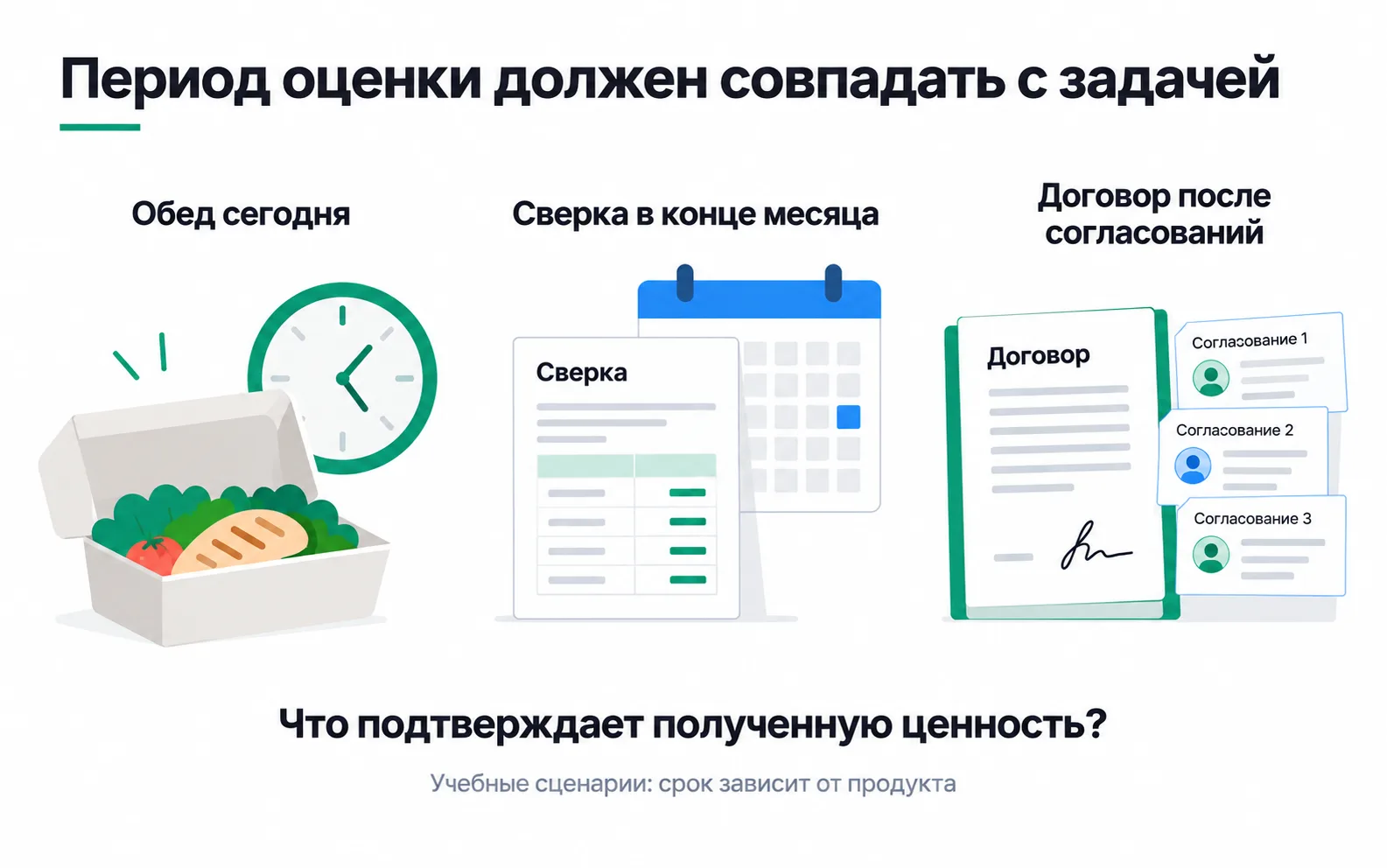
Cleaning is different, and the illustration shows it: the contract goes through three approvals. The office manager looks for a contractor, the director chooses, and accounting checks the contract. Your ad reaches one of them, and that person needs something to take to the others: a price per square metre, a sample contract, a list of offices you already clean. Who checks what shows up clearly in the CRM purchase used to explain the difference between B2B and B2C.
Hence the B2B rule: look for the channel where the person with the task is, not the company. Search finds an office manager on the same day they are told to find a cleaner. A business centre manager can be written to by name. And don't assign one social network to "all of B2B": the store owner lives on Instagram, but the director who signs the cleaning contract never needs to see the ad in a feed, because the office manager will bring them the proposal.
Where the customer is: nearby or nationwide
Yerlan's kitchen can deliver a hot lunch within three kilometres. An impression in the next district is wasted money: the person wants to order, and there is no delivery to them. A business like this needs channels that target by address: a 2GIS listing, Meta ads on the surrounding area, district Telegram channels, business centre chats. Which of these exist in Kazakhstan and what they cost is collected in the map of local platforms.
A local business also has a ceiling. There are only so many offices within three kilometres of the kitchen, and the bigger the budget, the more often the ads reach the same people. Doubling the budget here will not double the orders.
The reconciliation service works in any city and can be advertised across Kazakhstan. Timur's cleaning company works only in Almaty, but its customers are companies, not residents of a district. Here the task selects people, not the radius.
Put the answers in a table
Here are the answers for the three businesses. The bottom three rows are the conclusion: which channel to start with, what to add, and what counts as the test result.
| Question | Business lunches | Reconciliation service | Office cleaning |
|---|---|---|---|
| Searched for or shown | Searched for at lunchtime | Has to be shown and explained | Searched for when a contractor is needed |
| Price and decision time | 2,500 ₸, a minute | 15,000 ₸ a month, decided after the first reconciliation | 600,000 ₸ a month, a month or two |
| Who decides | The employee | The store owner | Office manager, director, accounting |
| Where the customer is | 3 km from the kitchen | All of Kazakhstan | Companies in Almaty |
| First channel | 2GIS and delivery apps | Meta with a video of a reconciliation | Google search with a walkthrough request form |
| Second channel | Meta on the surrounding area | Accountants who work for online stores | Emails to business centre managers |
| Test result | Same-day orders and a repeat order within two weeks | The store uploaded its data and completed a first reconciliation | Walkthrough requests; contracts counted after two months |
"Instagram ads like everyone does" came out as the first channel only for the reconciliation service, and even there the test result is a completed reconciliation, not a sign-up. For the lunches, Meta works as a second channel. The cleaning company might use it at most for retargeting people who have already visited the site.
What counts as a result, and when
You judge a channel by the result that shows the customer got what they came for. For different products that is a different event:
| Product type | The result you judge the channel by |
|---|---|
| Online store | A paid order that was not returned |
| Subscription service | The first completed task, then payment and renewal |
| B2B service | A suitable company, a meeting, a contract, a paid first invoice |
| Mobile app | A useful action after install, and a return when the app is needed again |
| Local service | A confirmed booking and a visit |
| Marketplace | A deal in which the buyer found a suitable offer |
An app for a trip people take once a year doesn't have to be opened every day. Its result is that the person came back for the next trip.
A result needs time. In September, Meta ads brought Marzhan 60 sign-ups, and forty days later 12 of those stores had completed a first reconciliation and seven had paid after the trial. Ten days after launch, the October sign-ups look like a failure, with zero payments. But the trial is not over and nobody has reached the end of the month yet, so October can only be compared with September after the same forty days. Compare groups of the same age, and don't mix a finished cycle with decisions still in progress.
With a subscription, the first payment tells you nothing about renewals: a store can pay for October and leave in November. In B2B, a lead, a company and a contract are different units. Two leads from employees of the same company are one possible deal, not two.
Don't compare channels across different businesses. Say that in a week Meta brought Yerlan 40 orders and Timur two walkthrough requests. A lunch leaves Yerlan 700 ₸ of contribution after food and courier, so 40 orders produced 28,000 ₸. One signed cleaning contract would give Timur 120,000 ₸ of contribution every month, but whether it gets signed will only be known two months from now. Each business is measured against its own target.
Can the business serve new customers
Before adding budget, find out how many customers the business can serve. Yerlan's kitchen turns out 150 lunches between 12:00 and 14:00 and currently sells 110. If the ads bring 80 new orders on Monday, 40 people will get lunch an hour and a half late or not at all, and they won't order a second time. For Timur the limit is the number of cleaning crews; for Marzhan, how many stores she can onboard in a week.
Money works the same way. If a new customer costs Yerlan 3,000 ₸ in ads, at 700 ₸ of contribution per lunch they pay back on the fifth order. That is, if they order five times, which you can see from how many September customers ordered again in October. An LTV forecast with nothing behind it will justify any expensive campaign, so contribution and payback are worked out by the rules of unit economics, on real repeat orders.
Exercise: an industry and a channel for three months
This is the first step of the Start track: one industry, one channel and a city for the next three months. The section on one specialisation will help you pick the industry, and the table in this lesson the channel.
"Dental clinics, Meta, Almaty" works. People think about treatment when something hurts, but cleaning, whitening and implants can be shown, and booking a consultation is a quick decision you will see within the five days of a Meta lead campaign.
If Meta is only the second channel for the industry, as with the lunches, still put Meta in your profile: "Lunch delivery, Meta, Almaty". You will run the week 2 test in it, and mention the first channel, the 2GIS listing, to the client separately: they can fill it in themselves.
An industry like office cleaning is awkward for a first case study. Five days of testing produce no contracts, just two or three walkthrough requests, and the case study is left with nothing but CPL. Come back to industries like that once you have two case studies and a client willing to wait two months.
If the "searched for or shown" row in your table says "I think they search", type the niche's phrases into Keyword Planner and ask an owner you know where their last customers came from. Write the line into your profile after that.
Video: SaaS marketing
The video is about products like the reconciliation service in the example. Carry its techniques over to your own product after you have answered the four questions.