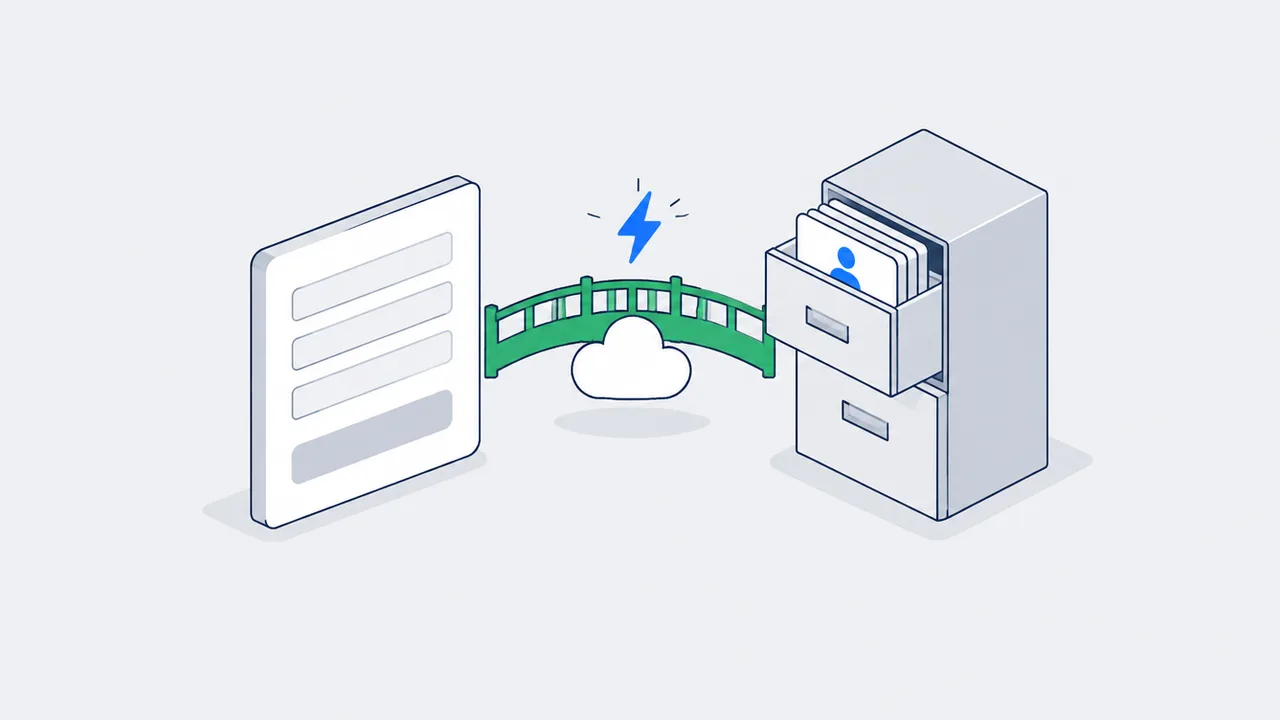
You can get Meta Lead Ads into the CRM within seconds without Zapier or a VPS: a stateless Cloudflare Worker takes the leadgen webhook, checks its signature, reads the lead from the Graph API, remaps it to the CRM contract and forwards it signed. It's a few dozen lines, with no server and no third-party SaaS in the PII path. The step you can't skip is an end-to-end test lead before launch: one non-existent field, form_name, would have dropped 100% of leads.
Meta Lead Ads (Instant Forms in Facebook and Instagram) has one irritating habit: it captures the lead and then keeps it locked inside Meta. A manager might catch it in Ads Manager or get an email; the sales team, if they're lucky, gets a once-a-day export. By the time the lead reaches the CRM and someone picks up the phone, hours are gone - and in performance lead-gen, the first five or ten minutes are what decide whether a lead turns into a deal.
The usual fixes all work, but each one quietly charges you for it. Zapier and Make route your customers' phone numbers and national IDs through a third party and bill you by volume. A "vendor integration" is a black box you don't control. A homegrown webhook on a VPS means standing up and babysitting a whole server - nginx, pm2, certbot - for a job that really comes down to five steps: take the webhook, check the signature, remap the payload, sign it, forward it.
The job, stated honestly
"Send Instagram leads to the CRM" sounds like one task. It's really five requirements, and the last four tend to surface only once you're in production:
- Speed. The lead should hit the CRM within seconds of the form submit, not in a nightly batch.
- Attribution. It has to arrive with
campaign_id / adset_id / ad_id / form_idand the platform (ig/fb). Without that, sales and marketing end up arguing about which creative drives deals instead of just leads. - Reliability. The network hiccups, the receiver throws a 500, Meta redelivers a duplicate - through all of that, no lead can go missing and none can be counted twice.
- Security. You have to verify the inbound webhook, or anyone who finds the URL can flood you with junk. You have to sign the outbound call, or the CRM will swallow anything. And phone numbers, national IDs, and names can't leak into logs or through third parties.
- Cheap to run. Nobody wants to maintain a VPS for a proxy that handles a handful of leads an hour.
Line all five up at once and the architecture pretty much picks itself.
Why a Cloudflare Worker, not a VPS
The bridge has no state of its own. It stores no leads, keeps no queue on disk, holds no sessions. All it needs is:
- a public HTTPS endpoint for Meta to hit;
- somewhere to keep secrets (the app secret, the tokens, the CRM signing key);
- a small cache for the page token;
- a few milliseconds of CPU to run the transform.
That's the exact shape of an edge function. A Cloudflare Worker hands you public HTTPS out of the box - no certbot, no renewals - runs at the edge close to the user, needs no nginx, pm2, or systemd, and ships a built-in KV store for the token cache. Secrets live in the Worker's encrypted store instead of a .env on a box half the team can SSH into.
A VPS here is just over-engineering: a whole machine to babysit for a stateless proxy. The Worker is the deliberate opposite - the smallest operational surface that does the job. Thin job, no state, so no server.
Know where the line is, though. The Worker is a great fit precisely because the bridge is thin. The moment you need real business logic, your own lead database, dedup over a long window, or complex routing into telephony, you're past what an edge proxy should do - and you're better off moving that logic into a backend and letting the Worker go back to being a dumb receiver.
The flow

Meta Lead Ads (company Page, Instant Forms in FB/IG)
- app subscription: object=page, field=leadgen, active
POST /webhook
Cloudflare Worker
- 1) verify X-Hub-Signature-256 (HMAC over APP_SECRET)
- 2) read leadgen_id, form_id, ad_id, page_id from the body

Graph API GET /{leadgen_id}
PAGE access token
- (page token resolved from a non-expiring system-user token, cached in KV so we don't fetch it on every lead)

transform → CRM contract
- (phone normalization, heuristics on custom fields, id prefixes, platform ig/fb)
POST https://crm.example/api/marketing/leads
- X-Webhook-Signature = hex(HMAC-SHA256(rawBody, CRM_SECRET))
The thing to notice: the leadgen webhook only hands you a leadgen_id - the lead's identifier, not the form fields. You have to go back to the Graph API and read the full lead in a second request. That turns out to be a feature, not a chore: if anything breaks on your side, the lead isn't lost - you can always re-read it from Graph by its leadgen_id.
The token model: system user → page token → KV
To read a lead from the Graph API you need the page access token for the Page the form belongs to. Storing that token as-is is asking for trouble - it can expire on you. The right setup:
- create a system user in Business Manager and give it a non-expiring token with the scopes you need;
- resolve the page token from it on startup, or whenever the cache misses, with a Graph call;
- cache the page token in KV with a TTL so you're not fetching it on every single lead.
Keep the scopes tight and deliberate: leads_retrieval to read leads, plus pages_show_list, pages_read_engagement, and pages_manage_metadata to subscribe the Page to leadgen. Nothing more - fewer scopes, smaller blast radius.
And the Page itself has to be subscribed to the leadgen field (object=page, field=leadgen, active=true), or the webhooks simply never arrive. That's the first thing to check if the Worker is clearly alive but no events are landing.
Field mapping: why you usually don't need a FIELD_MAP
The classic worry with lead-form integrations is "what happens when the client renames a field and the whole thing falls over." In practice, as long as the custom questions are written in plain language in the audience's own tongue, default heuristics pick them up without any hardcoded mapping table:
| Question in the Meta form | CRM field | How it matches |
|---|---|---|
| "Do you have an LLC or sole proprietorship?" | business_type | substring match on the local terms |
| "Enter your national ID / business ID" | identification_number | id terms + a 12-digit number |
full_name / phone_number / email / city | same names | exact key match |
Phone gets normalized on its own: strip everything but digits and convert the local format to international (for Kazakhstan, 8XXXXXXXXXX → 7XXXXXXXXXX). IDs get prefixes so nothing gets confused in the CRM: lead → l:, campaign → c:, adset → as:, ad → ag:, form → f:. Platform is short: instagram → ig, facebook → fb.
Reach for a hardcoded FIELD_MAP only when the questions are genuinely ambiguous or written in several languages at once. The rest of the time the heuristics hold up better - they shrug off small wording changes.
The bug a test lead caught before launch
The sharpest lesson from this build was a field that doesn't exist.
It feels obvious that if the Graph API gives you ad_name, adset_name, and campaign_name, it also gives you form_name. It doesn't. Ask for it - GET /{leadgen_id}?fields=...,form_name,... - and you get back:
That's an HTTP 400 on every lead. If this had shipped, the integration wouldn't have "degraded a little" - it would have dropped 100% of leads, silently and completely. Take form_name out of the request; the CRM doesn't need it anyway (only form_id is required). If you really do want the form's name, that's a separate lookup with its own cache and an extra pages_manage_ads scope - but life's simpler without it.
What caught it was an ordinary test lead from Meta's Lead Ads Testing Tool. The lesson is boring and repeatable: before you go live, push a test lead all the way through to the CRM - not just far enough to watch the Worker return a 200.
[!note] One more test-lead quirk that looks like a bug but isn't: Meta drops a placeholder like
<test lead: dummy data for phone_number>(no digits) into the phone field. If phone is required in your contract, the validator will correctly route that one to the DLQ. That's the right call - real leads come with real phones.
Reliability: let Meta's retries be your queue
A stateless bridge has no queue of its own, and it doesn't need one - as long as you lean on Meta's behavior instead of fighting it.
Idempotency. Dedup on the lead id. Redeliver the same lead and nothing bad happens - the CRM upserts, no doubles.
Transient failures (429, 5xx, a dropped connection to Graph or the CRM): the Worker returns a deliberate 500 to Meta, and Meta redelivers the batch. Its own retry machinery becomes your delivery queue - reliable retries, for free, with no Redis or SQS to stand up.
Permanent failures (401, 400, 422 - an expired token, a broken contract): retrying is pointless, so you write a structured dlq.* log to Workers Observability and deal with it by hand. And crucially, no PII goes in the logs - not the phone, the national ID, the name, or the email. The log carries identifiers and error codes, and from those you can always re-read the lead from Graph by its leadgen_id.
That one fork - "500 and let Meta retry" versus "log it and triage" - covers nearly every failure without a line of queue code.
Security: sign on the way in, sign on the way out
The bridge sits between an ad platform and a CRM with personal data running through it, so both ends need to be locked down.
On the way in, verify X-Hub-Signature-256 - an HMAC of the request body keyed on your APP_SECRET. Skip this and anyone who learns the Worker's URL can pump fake leads into your CRM.
On the way out, sign the request to the CRM with your own key: X-Webhook-Signature = hex(HMAC-SHA256(rawBody, CRM_SECRET)). The CRM checks it and only accepts what genuinely came from your bridge.
There's a subtle trap here that catches out anyone working in a non-Latin alphabet: compute the signature over the raw body bytes, not over re-serialized JSON. If something in the chain parses the body into an object and builds it back up, the key order and the way Cyrillic gets escaped can shift, the bytes change, and the signature stops matching - even though "the data is the same." The Worker uses Web Crypto (crypto.subtle) for this, and it's worth confirming its HMAC matches a reference on the CRM side byte for byte (Node's crypto, say). Nail that down before launch instead of debugging it live on Cyrillic leads.
Things to settle with the CRM team while the contract's still being written:
- is the signature over raw bytes or over rebuilt JSON (this is the Cyrillic gotcha);
- does the CRM return a 5xx on an internal error, or a silent
200(a silent 200 loses the lead and you never hear about it); - does a
429come back with aRetry-After; - is the phone format pinned down (leading
+, or bare digits).
Rotate the secrets in pairs
The one operational trap in this design is that the secrets live in two places at once. META_APP_SECRET and the CRM signing key both sit in the Worker and on the other side (Meta, the CRM). Rotate one without the other and the mismatch breaks signature verification on the spot: inbound webhooks start bouncing with 401s and leads stop arriving. The rule is simple - rotate them in pairs, in lockstep with the Worker's secrets, and write it into the runbook instead of trusting yourself to remember.
What you're left with
A Meta Lead Ads → CRM bridge on a Cloudflare Worker is a few dozen lines, no server, no third-party SaaS in the PII path, and no monthly bill that scales with your lead volume. It:
- gets a lead into the CRM within seconds of the submit;
- carries the attribution (
campaign / adset / ad / form,platform) so you can judge creatives honestly; - is idempotent on
idand rides out failures on Meta's retries; - verifies what comes in and signs what goes out;
- never stores or logs personal data.
The pattern moves almost unchanged to any CRM - all that really changes is the outbound contract and how you sign it. But the biggest lesson has nothing to do with Cloudflare: before you launch, run a test lead the whole way to the CRM. A field that doesn't exist, form_name, was one deploy away from taking down 100% of production leads - and it was the end-to-end test, not code review, that caught it.
FAQ
Why a Cloudflare Worker instead of a VPS or Zapier?
The bridge is stateless: verify the inbound signature, pull the lead from the Graph API, dedupe, sign the handoff to the CRM. A Worker means no host to patch and no third-party SaaS holding a copy of your PII.
What breaks when Meta sends a test lead?
A test lead is how the form_name bug surfaced: requesting that non-existent field from the Graph API returns HTTP 400 on every lead, so remove it; the CRM needs only form_id. The test lead's own quirk is a phone placeholder like <test lead: dummy data for phone_number> with no digits. If phone is required in your contract, the validator correctly sends it to the DLQ. That is expected, not a bug.
Do I need my own retry queue?
Usually not. Meta retries the webhook, so returning the right status codes turns the platform's own retry behaviour into your reliability layer. Dead-letter only what genuinely cannot be retried.
Seeing this in your own funnel?
Two weeks, fixed scope, read-only access. You get the findings and a 90-day roadmap whether or not we work together afterwards.