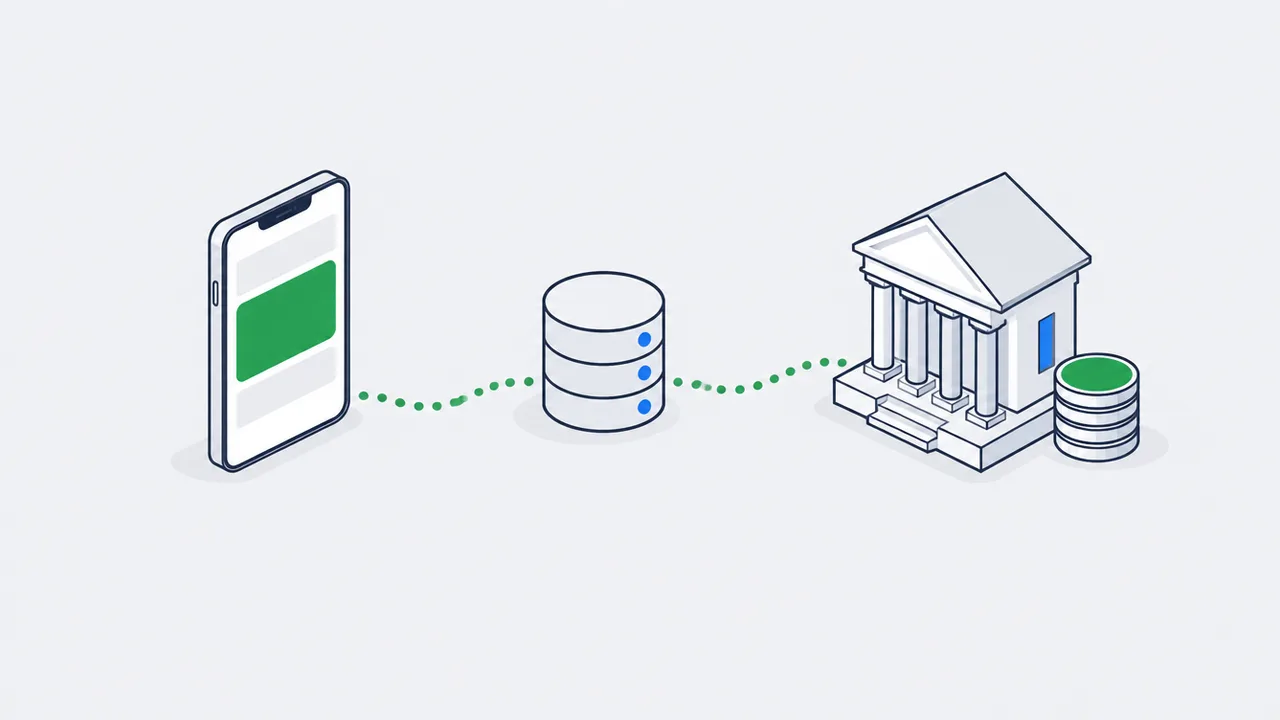
A bank links ads to branch outcomes with its own offline event ledger. The click context is saved on the landing page and carried into the branch on a lead_id; the branch visit is only a bridge metric, and the validated loan, deposit or card event goes back to Google Ads and Meta CAPI with margin-based value, not principal. A monthly upload is too slow for bidding, so start with a daily batch.
Banking marketing has a classic blind spot: the ad platform sees the click, the landing page, the form, or the call, but the money shows up later and somewhere else - in a branch, a call center, the CRM, the core banking system, or the DWH. For ecommerce this would look absurd: buying traffic on AddToCart but never sending Purchase back. In banking it is often treated as normal.
This is especially visible for loans, cards, deposits, and regional products. A user can see an ad on Google, Meta, or TikTok, open a landing page, study the terms, get an SMS, close the site, and two days later walk into a branch. The manager files the application, the bank issues the loan or opens the deposit, finance sees the margin, but the ad platform only sees a weak lead or even a bounce.
The problem is not that offline cannot be measured. The problem is that the bank often does not build a proper O2O contract between digital intent and branch outcome. What is needed is not "monthly sales uploads" but an operational system: click capture, lead bridge, branch handoff, offline event ledger, value model, postback service, and QA.
The main point
This is not a reach campaign and not a Brand Lift exercise. If the brief is "bring people into a branch and convert them to a purchase", the campaign has to work as O2O demand capture: ads create product intent, the digital flow gives the person a clear reason-to-visit, the branch confirms the visit, and the DWH returns a validated outcome to the platforms.
A branch visit is not, by itself, a good final optimization goal. It is a controllable mid-funnel signal. For banking O2O what matters are confirmed business events:
- The client came to a branch after a digital touch.
- The manager started a consultation on the right product.
- An application was created and passed review.
- The product was issued, activated, or funded.
- The bank computed the expected value of that event.
- The ad platform received a consent-safe offline conversion with value.
If you stop at "the user left their phone number", the algorithm will hunt for cheap phone numbers. If you stop at "visited a branch", the algorithm will hunt for people who walk into branches. If you only send the fact of issuance without a correct link to the click, most of the offline value will remain unattributed. That is why the visit is needed as a managed bridge metric, but purchases and margin value have to become the signal the system learns from when allocating budget.
Why the old logic breaks
A typical digital funnel for a bank looks like this:

ad click

landing page

lead form

CRM

manager call

branch visit
product issue
But analytics often only sees the first half:
ad click
landing page
lead form
After that, the organizational gap kicks in. CRM lives separately, branch managers work in their own system, the credit pipeline lives in the core banking system, the DWH updates in batches, and the ad account receives a Lead at best. As a result, marketing optimizes for CPL, while the business needs issued loans, funded deposits, or activated cards.
In banking O2O you have to accept a hard rule:
A digital lead is not revenue. A CRM status is not revenue. A branch visit is not revenue. Revenue starts where the bank can confirm a financial event and its expected contribution value.
Architecture: from click to offline value
A good O2O system is not built around a single pixel but around an event ledger. The pixel captures online intent. The ledger links intent, branch activity, and the financial outcome.
O2O banking: from click to offline value
The event ledger links online intent, branch activity and the financial outcome
Click capture
landing page and UTM
click context before the form
- gclid
- _fbc / _fbp
Lead bridge + handoff
phone / email with consent
SMS, QR, appointment
- lead_id
- SHA-256
Branch CRM / OCRM
visit and consultation
application, approval, issuance
- event_time
DWH + postback
margin-based value model
Google Ads, Meta CAPI
- dedupe_key
- validated
A lead is not revenue. Revenue starts with a confirmed financial event.
The ledger links the click, the branch visit and the product issuance to expected value.
Minimal stack:
| Layer | What it does | Key risk |
|---|---|---|
| Click capture | Stores gclid, gbraid, wbraid, fbclid, _fbc, _fbp, UTM, offer id, landing URL | Parameters get lost before the form or appointment |
| Lead bridge | Creates lead_id, captures phone/email with consent, ties them to the click context | Cannot match a CRM outcome later |
| Branch handoff | Passes lead_id into SMS, QR, appointment, queue token, or manager workspace | Manager creates a new application without the original lead id |
| Branch CRM / OCRM | Records the visit, consultation, application, approval, rejection, issuance | Statuses are not normalized and have no event time |
| DWH value model | Computes expected value by product | Principal lands in value instead of margin |
| Postback service | Sends validated offline events to Google Ads, Meta CAPI, and BI | Duplicates, wrong event time, PII leakage |
Click capture: what to save in the first moment
When a user arrives from an ad, the bank has to create a click_context before the person disappears into a form, an app, a call, or a branch.
This object does not have to contain the phone number or national ID up front. It has to lock in the ad context and the destination. Later, when the user leaves a phone, books an appointment, or shows an SMS in a branch, this click context will be linked to a lead_id.
For Google Ads there are two main paths. The old reliable path is to store the GCLID and then import an offline conversion with that GCLID. The more modern path is Enhanced Conversions for Leads, where first-party user-provided data, such as email or phone, is normalized, hashed, and helps improve match and bidding. Google explicitly describes offline conversion imports as the way to measure actions that happen after the ad click in the offline world.
For Meta the old "offline conversions" logic has gradually moved toward the Conversions API and datasets. The practical approach now is to send server/offline events into Meta CAPI with the right source/action context, event time, event id, match parameters, and value. There is no need to pretend that a branch sale is a "web purchase"; the source should honestly describe where the event happened.
Lead bridge: how to glue digital and the branch together
The user should not be entering sensitive data "just for analytics". They need a useful reason:
- Get a preliminary loan calculation.
- Book a slot at a branch.
- Get a QR or SMS code for the manager.
- Check eligibility for a product.
- Get a personalized offer in the app.
- Save the terms of a deposit or a rate.
This is the moment a lead_id is created:
Important: the national ID (IIN) can be a strong internal key for bank-side matching, but that does not mean it should be sent to ad platforms. Even a hashed national identifier remains sensitive from the perspective of compliance, banking secrecy, platform policies, and local law. Into ad systems you should only send user identifiers permitted by your contract, consent flow, and platform policies: typically phone/email in normalized hashed form, plus click ids where they have been stored.
Branch handoff: not losing the lead_id inside the branch
The most common O2O failure happens not in an API, but in the branch. The user arrived, the manager created the application by hand and did not pull in the original lead. Everything is gone: the ad-side link is broken.
You need a branch handoff that the manager actually uses:
| Handoff method | How it works | Pros | Risk |
|---|---|---|---|
| SMS promo code | The user shows the code to the manager | Easy to explain to the client | Manager may forget to enter the code |
| QR appointment | An SMS or app screen shows a QR for the desk/manager | Quickly ties the visit to a lead_id | Requires branch-side infrastructure |
| Queue token | The user picks a product-specific queue ticket from the digital flow | Good for branch ops | Requires queue system integration |
| Manager workspace | CRM shows online intent when the manager looks up a phone | Best option for sales | Needs CRM/OCRM development |
| Call center pre-qualification | An operator creates the appointment and lead_id | Higher quality control | More expensive and slower |
The minimal working option: when the manager searches for a client by phone, the CRM has to show active digital leads from the last N days:
If the manager cannot see the digital intent inside their usual workspace, O2O attribution will depend on the discipline of individuals. That is not a system.
Offline event ledger: a CRM status is not enough
CRM statuses are often built for managers, not for bidding. You can find statuses like "in progress", "callback", "documents collected", "submitted", "waiting". For ad optimization you need a separate event ledger with normalized events.
An offline event ledger instead of CRM statuses
Normalized events for bidding, not 'in progress' statuses
Visit
branch_visit_matched
consultation_started
- not a final goal
Application
application_submitted
application_approved
- quality signal
Issuance
offline_loan_issued
offline_deposit_funded
offline_card_activated
- primary value event
Correction
offline_reversal
refund, fraud, cancellation
- value correction
A CRM status is built for the manager. Bidding learns from normalized events.
Every event carries event_time, event_id, dedupe_key and value.
Example event taxonomy:
| Event | When to push to the ledger | Use |
|---|---|---|
branch_visit_matched | Client showed up, lead_id found or matched on an allowed key | O2O diagnostics, not a final goal |
branch_consultation_started | Manager started a consultation on the product | Quality signal |
offline_application_submitted | An application was created in the core banking system | Mid-funnel conversion |
offline_application_approved | Application was approved | Strong quality signal |
offline_loan_issued | Money is disbursed / contract is active | Primary value event |
offline_deposit_funded | Deposit is opened and funded | Primary value event |
offline_card_activated | Card was issued and activated | Primary or secondary depending on product economics |
offline_reversal | Cancellation, refund, fraud, early closure | QA and value correction |
The final event should look like a product fact, not a CRM row:
Notice the event_time. In an offline import you have to send the time the business event happened, not the time the nightly batch job sent the file to the ad account. Otherwise lag analysis and attribution will break.
Value model: what to send as conversion value
A common banking O2O mistake is sending the loan principal or the deposit balance as value. It looks great in ROAS but it is technically and economically wrong.
| Product | Do not send as value | Better to send |
|---|---|---|
| Loan | Principal / loan amount | Expected net margin - expected loss - subsidy cost |
| Deposit | Full deposit balance | Net interest margin over window × retention probability - bonus |
| Card | Card limit | Expected interchange + fee income - cashback/acquisition cost |
| Insurance | The full premium, if the bank is an agent | Commission / gross margin |
| Branch transfer / payment | Transaction amount | Fee, commission, activation value |
Formula for a loan:
Formula for a deposit:
In the first iteration the value model can be approximate. For example, by product and risk band. But it has to be comparable across campaigns and must not turn principal into fake revenue.
Offline postback loop
When a financial event is confirmed, the postback service decides where and how to send it.
Offline postback loop
Validated events go to the platforms with value, time and deduplication
Event ledger
validated events
value and currency
- event_time
- dedupe_key
Postback service
routing and retry
consent filter
no raw PII
- daily batch
Google Ads
import by GCLID
Enhanced Conversions
- order_id
Meta CAPI
offline / CRM source
hashed user data
- event_id
- EMQ
A successful API response does not mean the conversion was attributed to the click.
Diagnostics, match rate, duplicates and lag are checked every week.
For Google Ads:
- If you have a
gclid, use offline conversion import by click id. - If Enhanced Conversions for Leads is set up, send normalized hashed first-party identifiers that were collected on the lead form with the right consent.
- Do not send only "Google-attributed issuances". Google recommends importing all available offline events, even if some did not come from Google Ads: it helps with diagnostics and correct reporting.
- Use
order_idor a dedupe key so you do not upload the same issuance twice. - Watch diagnostics and partial failures. A successful API response does not always mean the conversion was attributed to a click.
For Meta:
- Send events through the Conversions API into the right dataset/pixel setup.
- Use
event_idfor deduplication and traceability. - Pass hashed user data only in the allowed format and only with valid consent.
- For branch outcomes do not pretend it is a website event. Use a source/action context that reflects the offline/physical/CRM origin.
- Watch Event Match Quality, deduplication, and event time.
For TikTok, Snap, and the other platforms the logic is similar: do not upload a banking record but send a normalized conversion event with event time, value, currency, hashed match keys, and a dedupe id.
Not reach, but O2O demand capture
If the business says "we need branch visits and purchases", do not translate that into a media logic of "let's buy reach near our branches". Reach can be a top layer, but the operational goal is different: bring a person with clear product intent into a specific service channel and return the outcome back into the ad system.
A practical campaign contract looks like this:
| Layer | What we optimize | What we do not count as success |
|---|---|---|
| Product intent | Click on a product, calculator, eligibility, appointment, callback | Just reach or video views |
| Visit bridge | SMS/QR/appointment/route click that carries the lead_id | Anonymous footfall without product context |
| Branch outcome | branch_visit_matched, consultation, application submitted | Any branch visit |
| Purchase/value | offline_loan_issued, offline_deposit_funded, offline_card_activated with value | CRM status without a financial fact |
On the Google Ads side you can use store visits and store sales where the account and geography pass eligibility, but that does not replace the bank's own event ledger. Store visit helps you understand footfall after ad interactions, and store sales/offline imports help you return sales to the platform. For loans and deposits it is better to build your own chain lead_id -> branch application -> validated product event, because the platform's store visit model does not know whether the person was in the branch for a loan, a deposit, a cash operation, or a service issue.
On Meta and other paid social platforms the logic is the same: a reach campaign can build product awareness, but driving branch visits and purchases requires a lead/message/conversion flow, server/offline events, dedupe, value, and match keys. Otherwise the algorithm will optimize for cheap attention rather than people who made it to a branch and bought the product.
What to do with branch visits
Visits are useful, but they should not be confused with sales.
branch_visit_matched is good for:
- Judging the quality of creatives and offers.
- Geographic optimization by region and branch.
- Diagnosing the branch handoff.
- Building re-engagement audiences.
- Understanding the lag between click and visit.
But if you make the visit the primary conversion too early, the algorithm will start hunting for foot traffic rather than profit. For loans, deposits, and cards the final goal should be closer to a validated product outcome.
Exception: if the bank does not yet have a reliable purchase in the feedback loop, the visit can temporarily be made primary or the account-default goal for campaigns that genuinely sell through branches. But then there have to be guardrails: product-led creative, branch capacity, regional eligibility, exclusion of service visits, and regular reconciliation with downstream approvals/issuance. As soon as there is enough volume of validated purchases, the visit moves back into the secondary/diagnostic layer.
The right maturity path:
Campaigns and geography
O2O campaigns cannot be run like ordinary nationwide leadgen if the product closes inside branches. Branch capacity, regional economics, and product eligibility all matter.
Recommended structure:
| Campaign | Goal | Bidding |
|---|---|---|
| Regional demand capture | Cheap qualified intent by region | tCPA / Max conversions |
| Branch appointment / callback | Drive to visit or consultation | tCPA on qualified appointment |
| Branch visit bridge | Prove that digital intent reaches the branch | Store visits / imported branch_visit_matched, usually secondary |
| Offline loan value | Issued loans with risk-adjusted value | Max conversion value / tROAS once you have volume |
| Deposit funded value | Funded deposits by category | tROAS only with sufficient volume |
| Re-engagement | Bring back matched leads without a final outcome | Audiences + product-specific creative |
Reach campaigns are not the main mechanism here. They can be kept separate for product education, a new branch opening, or a regional launch, but should not be mixed with O2O acquisition reporting. If a single campaign carries reach KPIs, branch visit KPIs, and offline purchase KPIs at once, the team will quickly lose causality: media will defend CPM, sales will defend issuances, and the algorithm will receive conflicting goals.
Do not split campaigns by individual branch unless you have volume. Better to pass branch_id, region, city, product_type into BI and the offline ledger, and split campaigns only where economics, capacity, or legal messaging differ. For branches with limited throughput use budget caps, location targeting, scheduling, and appointment availability, otherwise the campaign will drive people somewhere they cannot be served.
QA: without this O2O falls apart
Technical QA has to be strict.
- Click IDs are saved before lead creation.
lead_iddoes not change between landing, SMS, CRM, and branch application.- Manager workflow actually pulls in online intent.
- Every offline event has
event_time,event_id,dedupe_key,source_system. - A single issuance is not sent twice to Google/Meta.
- Refund/reversal/early cancellation are reflected in BI and value correction.
valueis not equal to principal, deposit balance, or contract amount unless that is truly revenue.- Phone/email normalized before hashing: trim, lowercase where applicable, E.164 for phone.
- National ID, account number, contract number, manager notes, and raw PII never leave bank-controlled systems.
- Google Ads import diagnostics checked weekly.
- Meta Event Match Quality and deduplication checked weekly.
- Conversion lag is visible by product and region.
- Offline conversion volume is high enough before switching primary bidding to tROAS.
SQL checks you need in the DWH
Matching online lead to offline sale:
Duplicate check:
Lag report:
Antipatterns
- "Let's just dump all loans into Meta". Without click context, consent, dedupe, and a value model that is not attribution, it is a data dump.
- "The national ID is hashed, so we can send it anywhere". No. Hashing does not remove sensitivity and policy restrictions.
- "A branch visit equals a sale". No. For some products it may only be a curiosity or service visit.
- "The manager will enter the promo code on their own". If it is not built into the workflow, they will not.
- "One upload a month is enough". For bidding that is too slow. You need a stable cadence: daily or near-real-time where possible.
- "Make all offline events primary". Only the events you want optimized should be primary goals.
- "Value = the loan amount". That breaks tROAS.
30-day playbook
Week 1: route audit.
Collect all lead sources, landing pages, app forms, call center flows, SMS templates, and branch workflows. Find where gclid, fbclid, UTM, phone, and lead_id are getting lost.
Week 2: event contract.
Define canonical events: online_intent_captured, lead_created, branch_visit_matched, offline_application_submitted, offline_application_approved, offline_loan_issued, offline_deposit_funded, offline_reversal.
Week 3: branch handoff.
Embed lead_id into SMS, QR, appointment, or manager workspace. The manager should not be guessing the source of the client by hand.
Week 4: postback service.
Start with a daily batch into Google Ads and Meta CAPI. Watch diagnostics, match rate, duplicate rate, lag, and conversion value distribution. Only after that should you promote final offline value events to primary optimization.
Wrap-up
O2O banking attribution is not a report on "how many people walked into branches". It is a system that links paid intent to a banking outcome. It contains click context, lead bridge, branch handoff, an offline event ledger, a value model, and platform postbacks. When this system works, marketing stops arguing with sales about CPL and starts allocating budget against what the bank actually earns: issued loans, funded deposits, activated cards, and validated margin.
Sources
- Google Ads Help: About offline conversion imports
- Google Ads Help: Set up offline conversions using Google Click ID
- Google Ads Help: About store visit conversions
- Google Ads Help: About store sales availability and eligibility
- Google Ads API: Manage offline conversions
- Meta Business Help: About Conversions API
- Meta Developers: Conversions API server event parameters
FAQ
Why does optimizing on form submissions stop working when the sale closes in a branch?
Because the algorithm learns to find people who fill in forms, not people who take loans. Once the outcome happens offline the platform never sees it, so it keeps buying the cheapest lead. The branch outcome has to be sent back as a conversion before bidding can improve.
Is a CRM status enough to send as an offline conversion?
No. A CRM status has no event_time, no event_id, no dedupe key and no source system, so it cannot be deduplicated or aligned to a click. You need a separate offline event ledger where every confirmed financial outcome is a row carrying those fields.
What should a bank send as conversion value for a loan?
Not the principal. Send expected net margin adjusted for repayment quality, minus expected credit loss, promo cost and servicing cost. It can start out approximate, by product and risk band, but it has to be comparable across campaigns, and refunds, reversals and early cancellations must flow back as corrections.
Seeing this in your own funnel?
Two weeks, fixed scope, read-only access. You get the findings and a 90-day roadmap whether or not we work together afterwards.