The IELTS prep centre's Meta lead test is over: 9,860 ₸ in five days, 11 leads, a CPL of 896 ₸ against a plan of 2,000 ₸. The owner messages you on WhatsApp: "If it's that cheap, let's go to 10,000 ₸ a day". It's too early to agree. Three people came to the trial lesson, and they tell you neither what a student costs nor what a lead will cost at five times the budget.
Scaling means growing the result while each additional customer still pays for itself. First make sure the first customer pays for itself, then write a growth plan with a stopping condition and see how it plays out in numbers. The centre's economics and the figures after the test are illustrative.
What to check before raising the budget
How much you can pay for a student. The course costs 45,000 ₸ a month. After paying the teacher and for study materials, the centre keeps 16,000 ₸ a month per student, or 48,000 ₸ over three months. The owner is willing to spend up to half of that on ads, which is 24,000 ₸ per paying student. According to the centre's CRM history, roughly one in four people who submit the form come to the trial lesson, and one in three of those pays for the course. So one student takes 12 leads, a lead can cost up to 2,000 ₸, and a person who comes to the lesson up to 8,000 ₸. That is where the 2,000 ₸ in the test plan came from.
Refunds and payback. The course is paid monthly, so the 24,000 ₸ of advertising only pays back in the second month: the first month brings the centre 16,000 ₸. A student who leaves after the first month is a loss. If one in three leaves that way, the average contribution drops from 48,000 to 37,333 ₸, and the affordable cost per lead from 2,000 to 1,556 ₸. If those who leave also ask for the first month back, both numbers fall further. So before growing, look in the CRM at how many students finish the course. The full calculation of a customer's contribution is in the topic on unit economics.
Whether the result holds. The test ran in the learning phase. To exit it, an ad set needs about 50 results in a week, and there were 11. Meta itself says results during the learning phase are less stable and don't always show how the ads will perform later. Google Ads has a similar rule: Google recommends judging Smart Bidding strategies over a period with at least 30 conversions, which means a month or longer.
Whether sales and the product can cope. At 10,000 ₸ a day and the same CPL, the centre would get about 11 leads a day. The manager can handle that, but the centre runs two trial lessons a week with eight places each. Out of 77 leads a week, about 19 people would come to a lesson, and there are 16 places. Everyone who doesn't get a place has already been paid for in ad spend, and there is nowhere to put them.
The growth plan: budget, audiences, creatives and the stop
Instead of 10,000 ₸ a day, send the owner a half-page plan. Its first step was set out after the test: a second test on a bigger budget, with the price added to the speaking-pauses ad as well. After that the plan answers the question of what changes if CPL comes in 30% under target, which is about 1,400 ₸.
| What changes | What we do | Condition |
|---|---|---|
| Budget | Second test: the same 2,000 ₸ a day, but for two weeks, about 28,000 ₸ instead of 10,000 ₸. Then 3,000 ₸ a day, each step held for two weeks | Raise if CPL on the step is at least 30% under target. After that, only if added leads cost up to 2,000 ₸ and added people at the lesson up to 8,000 ₸ |
| Audiences | Almaty stays broad. Astana as a separate ad set | Only once the centre has an online group |
| Creatives | The price in the copy of the speaking-pauses ad: testing the hypothesis from the test | In the second test, where the daily budget doesn't change |
| Stop | Go back to the previous step and stop growing | Added leads cost more than 2,000 ₸ two counts in a row, the manager can't reply within an hour, trial lessons are full a week ahead, or more students leave after the first month than before |
Audiences. With the Leads objective the audience is already broad, and interests barely change anything when optimising for conversions, as the Meta audience setup shows. What's left to expand is geography and people who have already visited the site. Adding Astana only makes sense if the centre can serve it: nobody will travel from there to a trial lesson in Almaty. People who opened the course page and didn't submit the form can be reached with retargeting. Launch a new audience as a separate ad set so that its numbers are visible on their own. If the budget is set at campaign level (Meta calls this Advantage+ campaign budget), a new ad set doesn't send the others back into learning.
Creatives. When people see the same ad too many times, they respond to it less and the cost per result goes up. Meta calls this creative fatigue. If the cost per result has at least doubled compared with earlier ads, the Delivery column may show "Creative fatigue", and Meta then advises a new ad with a noticeably different image or video. Don't wait for the status: watch the cost per result of each of the three ads yourself. The creative log will suggest the angle for a new ad, once the gap between angles rests on more than one or two people.
Meta counts a new ad in an ad set as a significant edit, and learning starts over after it. So change one thing per step. If you raise the budget and add creatives on the same day and the cost per lead goes up, you won't know which of the two did it.
Where to stop. Apart from the cost of added leads, growth has a ceiling that has nothing to do with advertising. For the centre it is the places at trial lessons: 16 a week, which is about 64 leads a week at the current share of people who come. The centre can't serve more than that, however cheap the lead. Raising the ceiling takes a third trial lesson, and that is the owner's decision, not the media buyer's.
How the plan played out: average CPL and the cost of added leads
The owner agreed. The second test ran for two weeks at the same 2,000 ₸ a day, then the budget went up to 3,000 ₸ for another two weeks:
| Period | Daily budget | Spend | Leads | CPL | Came to the lesson |
|---|---|---|---|---|---|
| Week 2 test, 5 days | 2,000 ₸ | 9,860 ₸ | 11 | 896 ₸ | 3 |
| Second test, 2 weeks | 2,000 ₸ | 28,000 ₸ | 20 | 1,400 ₸ | 5 |
| 3,000 ₸ step, 2 weeks | 3,000 ₸ | 42,000 ₸ | 26 | 1,615 ₸ | 6 |
In the second test CPL came to 1,400 ₸, 30% under target, so the plan raised the budget. The first test's 896 ₸ came from eleven leads and with no price in the speaking-pauses ad; these numbers can't separate which of the two changed the figure.
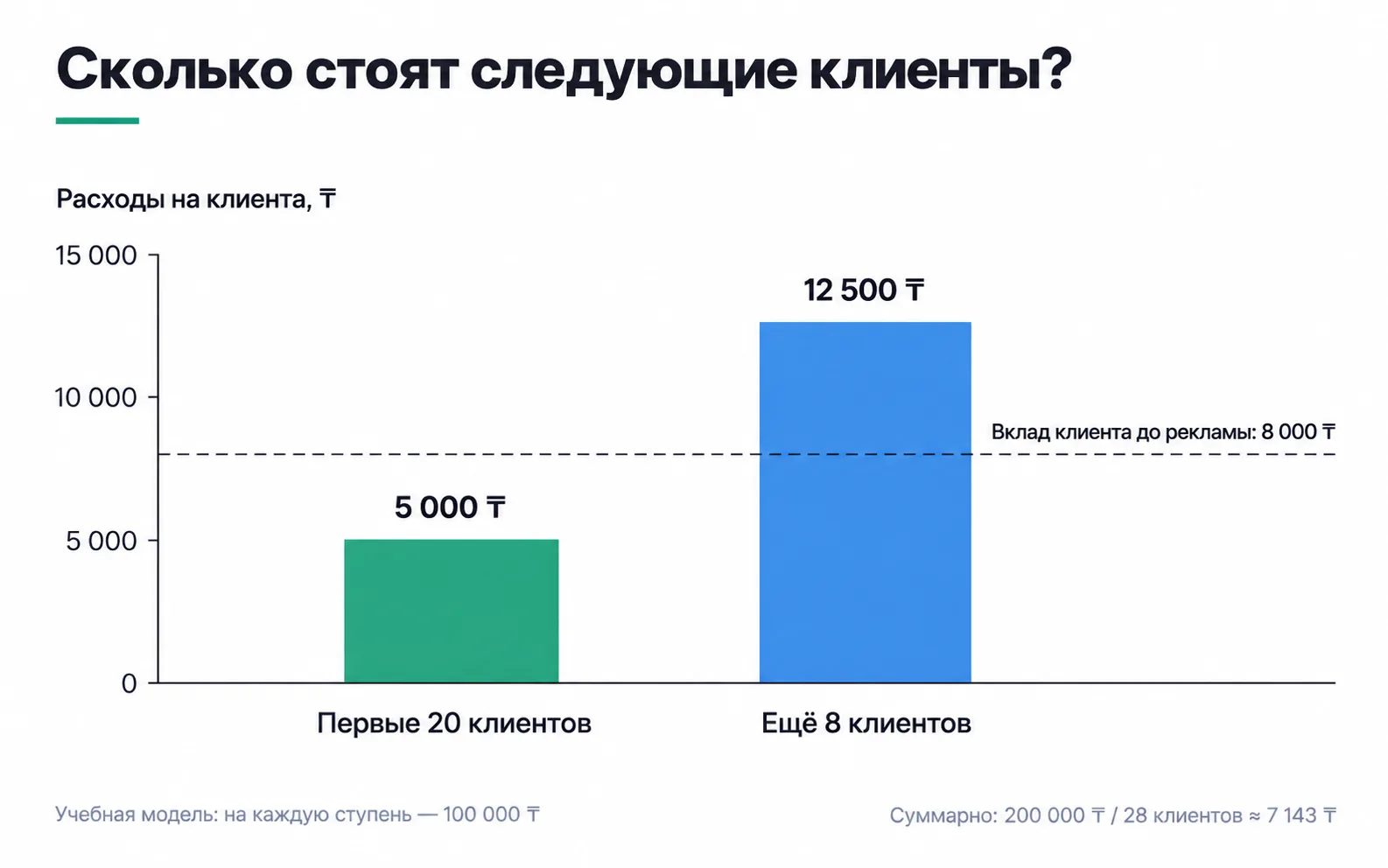
At the 3,000 ₸ step the average CPL is 1,615 ₸, still under target, and it looks as if you can keep raising. But work out what the extra money bought. Spend went up by 14,000 ₸ and there were six more leads, so each added lead cost 14,000 / 6 = 2,333 ₸. That is above target. Of those six, one person came to the lesson, and that person cost 14,000 ₸ against a target of 8,000 ₸. The average CPL looks fine because it blends the earlier 20 leads at 1,400 ₸ with the new six at 2,333 ₸, assuming the first 2,000 ₸ a day still brings in what it did before.
Six leads and one person are too few for a verdict. With seven added leads each would have cost exactly 2,000 ₸; with five, 2,800 ₸. And comparing two periods is not an experiment: over those weeks there could have been holidays, a change in competitors' prices or in how the manager worked. So the conclusion from the table is a cautious one: don't go higher, hold 3,000 ₸ for another two weeks and recount. If the added leads again cost more than the target, the budget goes back to 2,000 ₸, and growth is looked for in creatives, a new audience or the landing page.
The image shows the same thing in round numbers. The first 100,000 ₸ brings 20 customers at 5,000 ₸ each, the next 100,000 ₸ brings 8 more at 12,500 ₸, and each customer contributes 8,000 ₸ before advertising. The average is about 7,143 ₸ per customer, below 8,000, even though the second 100,000 runs at a loss: 8 customers bring in 64,000 ₸ for 100,000 ₸ of spend.
How Meta reacts to a bigger budget
A budget change can send an ad set back into the learning phase. Meta lists budget among the settings whose change counts as a significant edit depending on its size: going from 100 to 101 dollars is unlikely to restart learning, going from 100 to 1,000 may. Meta gives no exact threshold, and the "no more than 20% a day" rule that circulates in media buyers' chats isn't on that page either.
At the centre's budget this hardly matters: the ad set won't exit learning anyway. 50 leads a week at a CPL of 1,400 ₸ is 70,000 ₸ a week, or 10,000 ₸ a day. While you're far from that, the step size comes down to two questions: can you measure it, and can sales absorb it. The example uses a +50% step, because a smaller increase would have produced about three extra leads in two weeks, and three leads don't give even a rough cost per added lead. Once an ad set has left the learning phase, it's better to make smaller steps and wait a week after each: a week is usually how long Meta takes to collect those 50 results, and every restart of learning means another stretch of unstable numbers.
Also warn the owner that Meta spends a daily budget unevenly. On a good day spend can exceed it by 75%, though over a week it won't go above seven daily budgets. At 3,000 ₸ a day some days will cost up to 5,250 ₸. If you change the budget mid-week, Meta recalculates spend for the remaining days.
If the budget has already been raised sharply
In an online shop the ceiling is set by the warehouse and the couriers. Say the budget was doubled in one go, CAC went up, and orders are shipping late. Carrying on in the hope that the average CAC will recover by itself means growing both the advertising losses and the operational ones. Take the budget back to the step where the economics worked, and look at three things:
- the economics: what the added customers cost and how many of them cancelled;
- the audience: who came with the growth, the same cities and products or new ones;
- capacity: how many orders the warehouse ships a day without delays.
Keep delayed and cancelled orders in the report. They are part of what the growth produced, and without them the economics look better than they are.
Exercise: a plan for when CPL comes in 30% under target
Take your own campaign from week 2 of the Start track and write a half-page plan: what you'll do if CPL comes in 30% under target two weeks in a row. Take the target from the client's economics or, if there's no client, from your test plan.
The plan is done when it says what changes in budget, audiences and creatives, and under which condition you stop.
If your stopping condition reads "keep raising while CPL is under target", rewrite it in terms of added leads. In the centre's example the average CPL at the 3,000 ₸ step was 19% under target, while each added lead already cost more than the target. If there's no line about the ceiling, ask the client how many leads a week their managers and schedule can really take. For a test site without a client, write down the question you would ask. And if budget and creatives change on the same step in your plan, separate them: otherwise you'll be guessing why CPL went up.