A grocery delivery service in Almaty and Astana spends 5,000,000 ₸ a month on app ads and gets 10,000 installs for it. The owner has heard about ASO and messages the marketer: "Is that SEO for apps? Are those installs free? Can we cut the ads?" There is no one-word answer. First you need to know who looks for the service in Google, who looks in the App Store and Google Play, and how many of those people would have come without any work from you. The service's numbers in this lesson are made up; the store rules come from the stores' own help pages.
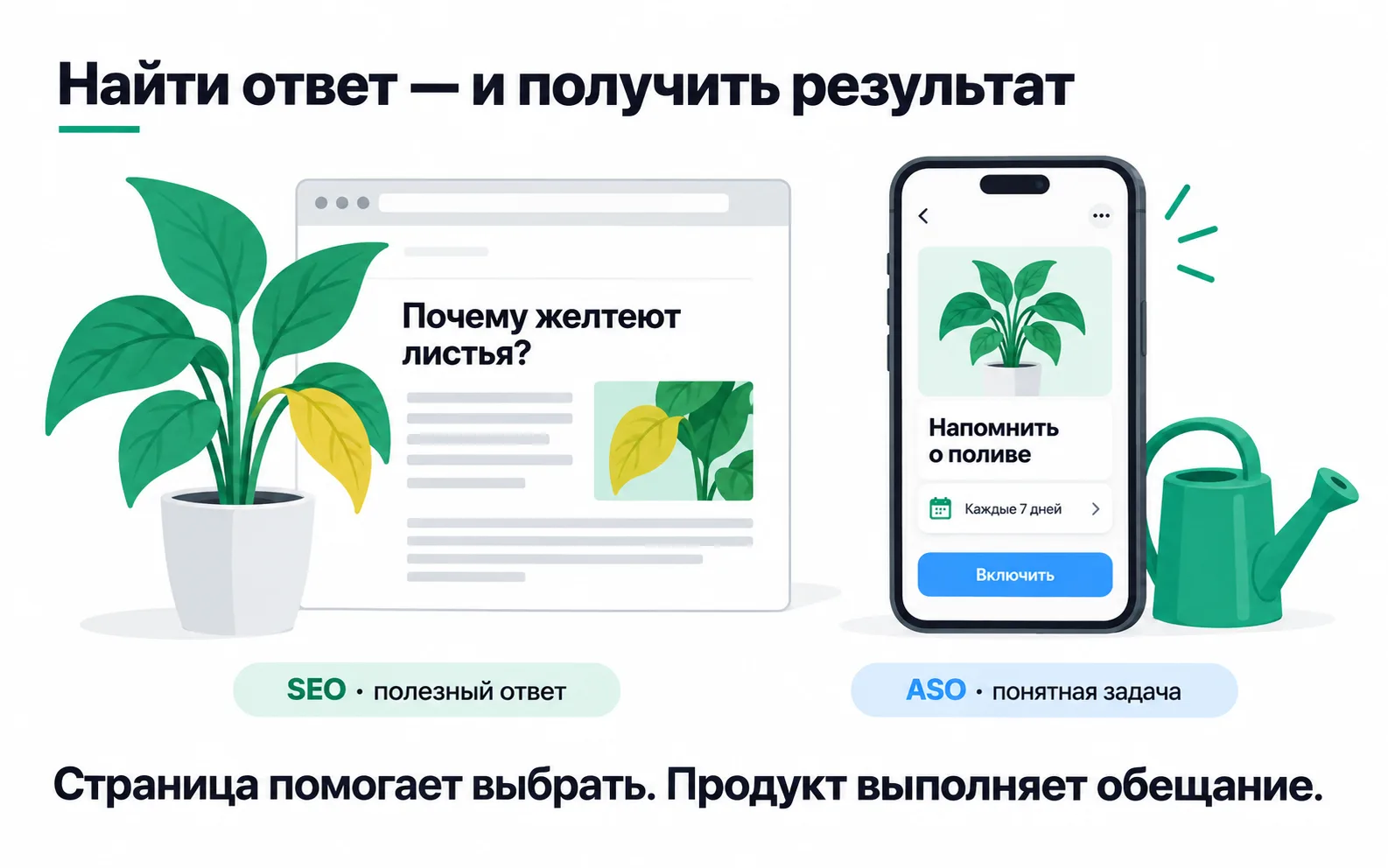
One person, two searches
Someone who wants groceries delivered can type доставка продуктов астана ("grocery delivery astana") into Google and land on the service's website. Or they can open the App Store and type доставка продуктов ("grocery delivery") there. Same task, different shelf. SEO (search engine optimization) is the work of getting a website found in search engines. ASO (app store optimization) is the work of getting an app found in the app stores and installed.
The two have more in common than it seems:
- A visit from search costs nothing per click. The cost is work: copy, pages, screenshots, and for a website a developer as well.
- The platform decides the ranking. Google doesn't promise to show even a page that meets all its requirements (how Google Search works). How Google finds and shows pages, and what depends on you, is set out in the Google Search Central guide.
- Both start from the same place: the words people use to describe their task, in other words the keyword list.
- In both, queries split into brand queries (the service's name) and category queries ("grocery delivery"). That split is the core of this lesson: a brand query is typed by someone who already knows the service, and they were brought by an ad, a courier with a branded bag or a friend, not by your page.
How an app store differs from Google
The stores have their own search rules and describe them briefly, and the copy and images are prepared for them following the rules for setting up the app page.
| Website in Google | App in the App Store and Google Play | |
|---|---|---|
| What you can change | Any text on any page | A few fields with limits: a name of up to 30 characters in both stores, plus a subtitle and a hidden keyword field in the App Store, and a short and full description in Google Play |
| How fast it changes | You fix the page, and Google sees it on the next crawl | In the App Store the name and keywords change only with a new app version |
| Where the person decides | On the website, after the click | In the results and on the store page, from the icon, screenshots and rating, before installing |
| Where you see results | Google Search Console and Yandex Webmaster | App Store Connect and Google Play Console |
The third row matters most. On a website, people click first and decide later. In a store they decide from a picture and some stars before they ever open the app. And the person who taps an Instagram or TikTok ad lands on the same store page before tapping Install. So the app page works on everyone who sees it, not only on people who found it through search.
Ratings are another difference. Both stores list them among their search factors (App Store search, Google Play search), and in the App Store the average rating shows right in the results (App Store product page). A website's reviews live elsewhere: on 2GIS and in the Google business profile.
Where the website and the app help each other
The website can send people to the app. On the iPhone there is the Smart App Banner: one line in the page's code, and Safari shows a strip for the app at the top. If the app is installed, the button opens it; if not, it goes to the App Store (Smart App Banners). Put the page address in app-argument, and someone on the strawberry product page on the website lands on the same product in the app:
For Android, the website gets an ordinary button linking to Google Play. To make website links open straight in the app you need deep links, which is a job for the developer.
It works the other way round as well: Apple also uses the App Store description for search engine results once the app is released (platform version properties in App Store Connect).
And the promise has to match. If the website says "delivery in Almaty and Astana" and the store page says nothing about cities, someone in Karaganda will install the app and only find out at the address step.
What free installs are worth
The Google Play Console store listing report has a Search term dimension: the query after which the person opened the page (store listing report). Google counts searches for the app's name under the Google Play search source, and searches for a category under Google Play explore. App Store Connect doesn't show queries, so Android is the easier place to count. Here is the delivery service's September:
| Search queries in Google Play (Search term dimension) | Store listing visitors | Tapped Install |
|---|---|---|
| With the service's name | 800 | 480 |
Category: доставка продуктов, продукты на дом ("groceries to your door") and similar | 400 | 120 |
| Total | 1,200 | 600 |
ASO didn't create the 480 install taps from brand queries: those people already knew the service. A good page won't lose them, a bad one will lose some, and that's where its role ends.
The room for ASO to grow is in the second row. Suppose one in ten of those 120 people places a first order, as with the ads on average. That's 12 first orders a month. In September a first order from ads cost 5,000 ₸, so the same orders bought through ads would cost about 60,000 ₸ a month. iOS queries aren't visible; even if there are as many there, that's around 120,000 ₸ against 5,000,000 ₸ of ads.
That won't let you cut the ads. The conclusion still isn't "skip ASO". If a few percent more of the people who reach the page from ads install the app, the cost per install drops at the same budget for every network that sends people to that page. The fields and screenshots get reworked following the rules for setting up the app page, and whether the new page brought orders and not only installs is shown by a page test and the cohorts after it.
What to tell the owner
The answer to the owner fits in three sentences. Free installs exist, but in September category search in Google Play produced about 120 Install taps, while brand search rests on ads and the other channels that tell people about the service. Cutting ads in the hope of ASO won't work. The store page, though, is seen by the people from ads too, so start there: it can be improved and tested.
Don't promise rankings, for the website or for the app: Google, Apple and Google Play set them. A contractor who guarantees the top spot in the App Store is promising something they don't control.
Exercise: your client's two searches
Take a client who has both a website and an app, or any local delivery, taxi or banking service: their apps are easy to find in both stores.
A table like this shows where the client's money is. When nearly everyone in the store arrives by brand name, the keyword fields will add little, and the time is better spent on screenshots. When there are many category queries, work on the fields pays off as well. A mismatch of promises, say "delivery in 2 hours" on the website and "in 30 minutes" in the store, gets fixed first: it costs nothing, and the "30 minutes" promise brings in people the app will disappoint on their very first order.
Video: similarities and differences
A short talk from ASOMobile on what SEO and ASO share and where they differ.