An online coffee shop in Almaty sells beans from its own roastery and delivers across Kazakhstan. When it ran an Instagram ad with a cup of cappuccino, 14 of the 23 direct messages asked for the address of a café the shop doesn't have. Since the start of this month, the roastery has a pickup point: on weekdays from 10:00 to 19:00, customers in Almaty can collect their order or buy a bag on the spot. The owner is pleased: "People are looking for us on the map, so let's set up a 'Café' listing on Google, like the one on 2GIS." The shop and its numbers are made up.
That sentence contains one right idea and one mistake. The shop now qualifies for a map listing: it has a place people come to. But "Café" will bring in the same people who asked about the address, people who want a cup of coffee.
Who qualifies for a map listing
Google's rule is short: a business can have a profile if its staff meet customers in person during its stated hours (who can create a profile). The same page lists organisations that operate only online among those that aren't eligible. Until the pickup point opened, that is what the shop was: an order on the website, a courier, no door to walk through. Now there is a pickup counter at the roastery, with someone behind it handing out orders from 10:00 to 19:00.
A business that travels to its customers, like a plumber or a repair technician, can also have a profile, but with a service area and no address on the map. A PO box or a virtual office where nobody works doesn't qualify (guidelines for representing your business).
On 2GIS, the business edits its own card in a free business account: company details, categories, photos, work with reviews. What paid 2GIS packages in Almaty cost comes up at the end of this lesson.
How Google decides whom to show
Google names three foundations of local results: relevance, distance and prominence (how Google ranks local results). Relevance is how well a profile matches what the person is searching for. Distance is measured from the person searching. Prominence comes partly from the number of reviews and the number of sites linking to the business. There is no way to buy a higher place, paid or otherwise, and businesses with complete and accurate information, Google says, are more likely to be shown.
Because of distance, everyone gets their own results. A screenshot taken at the roastery door won't tell you how the shop shows up in the Almaly district or on Baizakov Street. So position is recorded as an observation: the query, where the search was made from, the date, the phone. Once a month the shop's marketer searches "coffee beans" from a phone at three spots in the city and notes whether the shop appears in the map block.
The profile: name, category, hours, link
The name is written as it appears on the sign. "Coffee beans Almaty | delivery across KZ" in place of the real name counts as extra information for Google, and the profile can be suspended for it.
The primary category is chosen from Google's list; you can't create your own. Google recommends the one that describes the business most precisely (how to choose a category). For the shop, that isn't "Café". With it, the profile would match searches like "café near me", and people would come for a cappuccino, find a counter with bags of beans and write about it in their reviews. Search the list for options with the words "coffee" and "roaster" and pick the one about selling beans. Additional categories go in only if they genuinely describe the business.
Hours means the pickup hours. The roasting floor may run longer, but what matters to customers is when the counter is open. Holidays are set in advance as special hours. The same hours appear on 2GIS, on the website and on the door: if they differ anywhere, someone will arrive at a locked door, and everyone will read the review about it.
Photos that help people find the entrance come first: the front from the street, the sign, the pickup counter. The roastery is in a courtyard, and before the entrance photo went up, the first customers were calling from the street.
The website link on both listings carries tags, so GA4 shows how many sessions came from the maps:
GA4 assigns utm_medium=organic to the Organic Search channel, so sessions from the Google profile stay in organic but can be separated by the map_card campaign. referral from 2GIS lands in the Referral channel.
Verification on Google
Google chooses the verification method, and the options differ from business to business: a phone call or text, an email, a live video call, a postcard with a code (how to verify your business). The shop was offered video. During the video call you have to be at the business address and show three things: where you are (a street sign, neighbouring shop signs), that this is your business (the roaster, labelled bags, the pickup counter) and that you have access to staff-only areas, for example by unlocking the storeroom with a key. Video calls are only available during business hours, and the review can take up to five business days.
Reviews: ask everyone, pay no one
The owner's first idea was to give a set of drip bags for a five-star review, the same set new customers got with bloggers' promo codes, which costs the shop 1,000 ₸. The two platforms have different rules on this:
| 2GIS | ||
|---|---|---|
| A gift, discount or money for a review | All incentives are prohibited | The company's own product or a discount on the next purchase is allowed for a review with any rating; money is not |
| Asking only happy customers for reviews | Not allowed | Rewarding only positive reviews is not allowed |
| Staff and company devices | You can't have staff collect a set number of reviews | Reviews can't be written on company devices or in front of staff |
The rules are in Google's review policy and 2GIS's guide to working with reviews. A gift for five stars breaks the rules of both platforms. A gift for a review with any rating is allowed on 2GIS and not on Google. The shop doesn't need two sets of rules for two maps, so it has one: ask everyone, give gifts to no one. Every order bag gets a card with two QR codes, one for Google and one for 2GIS, and the line "Tell us how you like the beans". People write at home, from their own phone, if they want to.
The Law on Online Platforms and Online Advertising (as amended up to 2 March 2026) explicitly requires reviews in sponsored content to be genuine and verifiable (Art. 21(3)). In our reading, an ordinary review on a map doesn't fall under that requirement, while a review written for a gift is already closer to sponsored content, which is one more reason not to give gifts. This is a summary of the rules, not legal advice.
By then the 2GIS card already called the shop a café, and three weeks later a two-star review appeared under it: "Came for a cappuccino, and all they have is order pickup." 2GIS recommends replying officially, under the review, and clarifying details there rather than asking the author to move to private messages. The shop replied: "Thank you for letting us know. We are a roastery and a coffee bean shop, we don't make drinks here, and our listing wrongly called us a café. We've fixed the category and the description and added a photo of the pickup counter. If you're nearby, you can buy a bag of fresh roast on the spot." For a reply to someone who didn't get what they were promised, see also the IELTS centre's reply on 2GIS.
The numbers: a free listing or a paid package
Four weeks after the pickup point opened, the marketer put CRM and GA4 side by side:
| Where to look | Four weeks |
|---|---|
| CRM, orders collected at the roastery | 46 |
| of which regular customers who used to take delivery | 27 |
| first orders, "How did you hear about us": 2GIS | 9 |
| first orders, "How did you hear about us": Google Maps | 3 |
| first orders, other or don't remember | 7 |
GA4, sessions with utm_campaign=map_card | 41 from Google and 63 from 2GIS |
The 41 and 63 are sessions on the site. Orders are counted only in the CRM.
Counting an average order of 15,000 ₸ and 6,000 ₸ of contribution from it, the 12 first orders that customers themselves linked to the maps add up to 72,000 ₸ of contribution, and all of that came from free listings. Repeat orders from the same people are left out as a margin of safety.
The 2GIS sales manager offers a "Media card" for 33,060 ₸ a month (Almaty, from 1 October 2026, VAT included). To pay off, the package has to add 6 first orders a month on top of what the listing already brings: 33,060 / 6,000 ≈ 5.5. One month can't tell you whether it will: the nine orders from 2GIS came without the package, and with nine orders a difference of six can turn up without it too, simply from month-to-month swings. The phone repair shop hit the same question after it bought a package. The coffee shop decided on two more months of free listings, with the corrected 2GIS category and Google category, the QR cards in the bags and the "How did you hear about us" field on every first order. After that it will know how many first orders a month the maps bring for free, and a month with the package can be compared against that number.
If there is more than one location
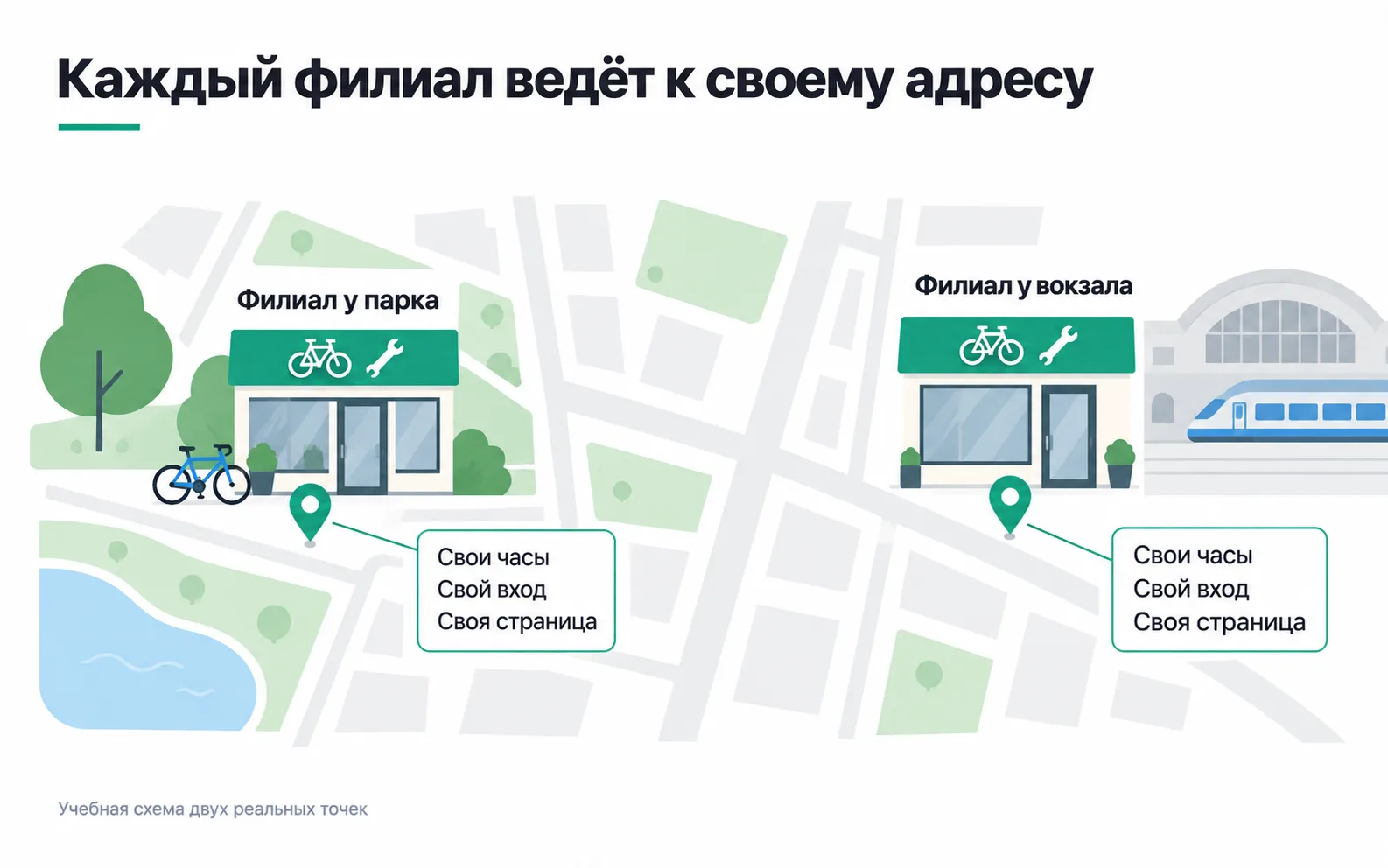
The picture at the top of this lesson is about a business with two addresses. Google asks for one listing per place and no more than one profile for the same address, even across different accounts. If a repair shop has two locations, each gets its own profile, its own hours, its own entrance photo and its own page on the website, which the profile links to. That way, someone who found the station branch won't read the park branch's hours on the website.
Exercise: the listing for your own location
Take the business of a client or someone you know, where customers come to an address.
Two findings are worth more than the rest: hours that differ from place to place, and a category that describes what the owner wishes the business were rather than what it is. The first takes ten minutes to fix and removes a whole class of bad reviews. The second means asking the owner what exactly a person gets when they walk through the door, and choosing the category from that answer.
If the business asks for reviews in exchange for a discount, a gift or "five stars", that goes first: Google prohibits it outright, 2GIS allows it with conditions, and two different sets of rules are easier to live with when there are no gifts at all. And if the business doesn't appear on the map for its main query in any of the three districts, go through the profile against this list before anyone discusses paid packages.
Video: working with a business profile
"Google My Business" is the service's former name; it is now called Google Business Profile.