The course page of an IELTS prep centre in Almaty has finally made it into the index, the marketer has rewritten its title and first screen, and now he is waiting four weeks to compare impressions. Meanwhile an SEO contractor writes to the owner: "50 links from sites with DR 30+ for 150,000 ₸. In two months you'll be in the top 10 for 'IELTS courses Almaty'." The owner forwards the email to the marketer: "Shall we?" The centre and its numbers are made up.
Links do matter. Google says it uses them to judge how relevant a page is and to discover new pages (links Google can crawl). But the contractor's email describes exactly what Google calls link spam. Let's go through the kinds of links there are, which ones the centre can get without paying, and what to do when someone wants money for a link.
Three kinds of links
Earned. Another site links to you because its readers need it. The centre already has one: an applicants' forum once linked to the old course page. After the site moved, that address returned a 404, and after the audit a 301 redirect to the new page brought the link back.
Advertising. You paid for a placement, and that is ordinary advertising. Google has no objection as long as the link is marked for it with rel="sponsored", and nofollow is still acceptable for such links too (how to qualify outbound links). Links in comments and forum posts are marked rel="ugc".
Bought for rankings. Someone pays for it so it passes a ranking signal, which is why it carries no marking. The 50-link package is exactly that.
What Google calls link spam
In Google's spam policies, link spam means links created mainly to manipulate rankings. These are the examples from that list a marketer actually runs into:
- buying or selling links that pass ranking credit, including paid articles with such links;
- exchanging goods or services for links, and giving away products on condition of a review with a link;
- excessive link swapping, "you link to us, we link to you";
- programs and services that place links to a site automatically;
- low-quality directories, identical links in the footers of many other people's sites, and forum comments with optimised links in the post or signature.
Sites that break these rules, Google says, may rank lower or disappear from the results entirely, and Google's specialists can take manual action. The marketer explained the refusal in money. Based on the August cohort, a student brings the centre 40,000 ₸ of contribution over the whole course, so 150,000 ₸ is almost four students. For that money the centre would get a promise of a ranking position, and a position isn't a lead. The risk of penalties comes free.
"DR 30+" in the email says nothing about the benefit to the centre either. Domain Rating is an Ahrefs metric on a 100-point scale that compares a site's backlink profile with the other sites in Ahrefs' database. It is the tool's estimate, not Google's, and it doesn't reflect the site's subject at all. An "articles about everything" portal with DR 30 may not have a single reader interested in IELTS.
Who has a reason to link to the centre
To get links for free, a site needs something worth linking to. The course page is no good for this because it sells, and another author needs an answer for their own readers. The centre has such an answer, and it grew out of its main promise, a study plan built from the exam date. The marketer created an open page, "How long to prepare for IELTS: a plan from your exam date". It has a table of how many weeks remain before the exam and what to do each week, links to the official exam registration, and the date it was last checked.
Who could use a page like that:
- agencies that help students apply abroad and have articles on application deadlines: a reader of such an article is deciding exactly when to sit IELTS;
- blogs and channels about studying abroad that publish lists of useful links;
- the applicants' forum that already links to the centre;
- school careers advisers who put together resource pages for graduates.
To find them, use Google searches on topics like "IELTS preparation timeline" and the competitors' backlink reports in Ahrefs or Semrush: whoever links to other people's useful pages may link to yours too. Semrush gives 10 free reports a day; the centre already used Semrush in its competitor research.
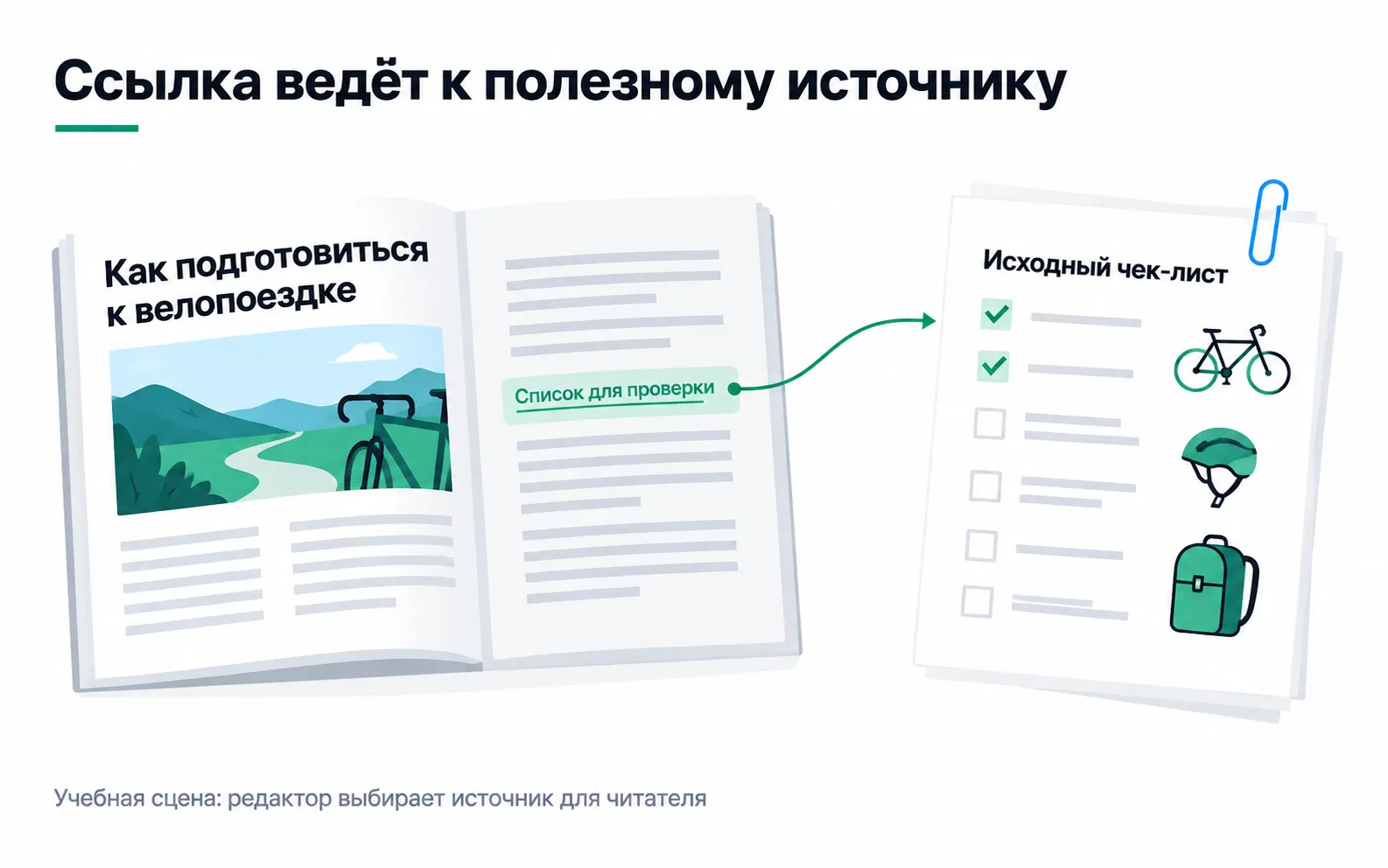
The picture shows the same principle on a different subject: the link sits at the point in the article where the reader needs a list, and it leads straight to that list rather than to the site's home page.
An email people actually read
The marketer picked 30 sites and over two weeks wrote each one a separate email. The emails share a template, but the first sentence is always about the other site's article:
Hello! Your article "How to get into a UK university in 2027" has a section on application deadlines. At our IELTS prep centre we've made a page with a study plan built from your exam date: how many weeks you need at different starting levels and what to do each week. It might be useful to your readers in that section. Link: … If anything in the plan is out of date or inaccurate, let us know and we'll fix it.
The email asks for no link in return and offers no money. It names the other article, the spot where the link would fit and what the reader gets. A refusal or silence is a normal outcome: the editor decides.
Of the 30 sites, 8 replied and 4 added a link: two agency blogs in articles about application deadlines, the forum moderator in a pinned thread, and an education portal in a list of useful resources. Two more sites offered paid placement.
When someone wants money for a link
One portal offered an article about the centre with a link for 60,000 ₸, on condition that it was "dofollow forever", meaning without rel="sponsored". That is buying a ranking signal, and the centre turned it down. Google doesn't forbid paid placement as such, but then it is advertising and gets handled as advertising:
- for the reader. In our reading, a paid article about the centre is advertising, and the Law on Advertising (as amended up to 17 May 2026) requires advertising to be recognisable (Art. 6(1)), so the article needs a label that tells readers at once it is an ad, such as "Advertising". This is a summary of the rules, not legal advice;
- for Google. The link carries
rel="sponsored"ornofollow; - for tracking. The link gets tags following the UTM scheme:
utm_medium=paid, as for a paid post, and a short Latin name for the portal inutm_source, such asportal_name; the new value goes into the UTM reference table first.
A placement like this is judged like any ad: 60,000 ₸ is the contribution of one and a half students. Before paying, you ask the portal for statistics on similar articles: how many people read them and how many clicked through. The second portal agreed to both the label and rel="sponsored" and promised to send statistics, and the centre put off the decision until it sees the numbers.
How to count what the links brought
After four weeks the marketer pulled together three sources:
| Where to look | What it shows |
|---|---|
| GA4, Referral channel, the plan page | 96 sessions from the four sites, most of them from the forum |
GA4, generate_lead in the same sessions | 5 leads |
| Search Console, Links report | Three of the four new links are already visible |
The 96 sessions and 5 leads came through the links, and you can count them as a channel. Whether the links helped the plan page climb in the results is another matter: one page over one month can't answer that, because a new page's impressions may grow without any links, simply over time. The Links report shows only some of the links Google knows about, so the fourth link may not have appeared there yet, or may never appear.
Links count on the map too. Among the things that make a business prominent in local results, Google lists the number of sites linking to it and its reviews (how Google ranks local results). For a query with a city in it, like "IELTS courses Almaty", the results sometimes include a map block, and getting into it follows the rules of local SEO.
You almost never need to disavow links
Sooner or later, third-party reports will flag "toxic" links from sites you've never heard of. Google says it can usually work out on its own which links to trust, so webmasters generally don't need the disavow tool, and if used incorrectly it can harm the site's performance in search (disavowing links). There is one reason to use it: lots of artificial links point to the site, and because of them a manual action has already been taken or is expected. A "toxicity" score in a third-party tool is no such reason.
Exercise: a list of sites for your project
The hardest column is "how it adds". If it comes out as "we have an article on this too", there is no reason to link to you: the author already has one just like it. Links are given for what the author lacks: current deadlines, a calculation with numbers, a table they don't have to build themselves. If you can't write that sentence for any of the ten sites, the problem is the page, and the emails can wait.
The Links report sometimes lists sites you were unaware of. Look at which pages they link to: that tells you what you already have that people link to unasked. And pricing a paid placement in customers is sobering. A 60,000 ₸ placement with 40,000 ₸ of contribution per customer has to bring two customers to pay off with room to spare, and "we'll lift your rankings" doesn't account for that amount.
Video: approaches to link work
The video is about promotion in foreign markets. Check any advice in it about buying links against Google's link spam list above.