The online analytics school's article "What you need to start learning analytics" has already been checked against the student guide: it now says 8 GB of RAM instead of the 16 the AI model made up, there is no Excel and no salary lifted from someone else's article. Before publishing, the marketer looks at Google's results for "which laptop do I need for data analytics". At the top sit three roundups, "10 best laptops for analysts", with links to Kaspi, no author and no date. The school's owner suggests doing the same plus an "Our expert" block with a stock photo: "Google loves E-E-A-T, right?" The school's numbers are made up.
The school has something none of the roundups have. The curators got 48 questions about preparing for the first class from the September stream, and before every stream the senior curator goes through all the preparation for it on a laptop with 8 GB of RAM. This lesson is about showing that to readers in a way they can check.
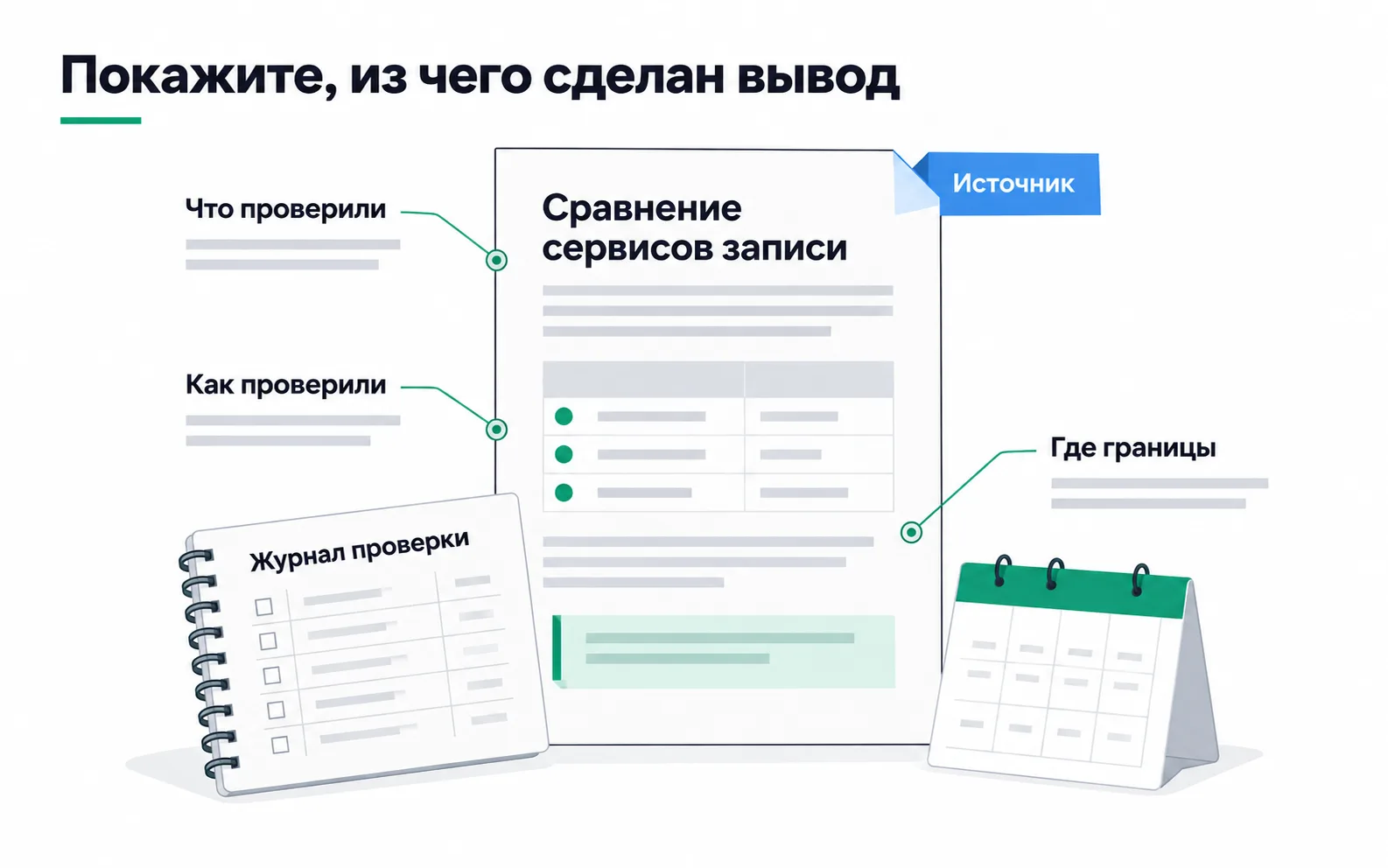
The picture shows the same check in another niche: the article compares booking services, but the margin notes are the same.
What Google calls E-E-A-T
E-E-A-T stands for experience, expertise, authoritativeness and trustworthiness. Google's guidance on helpful content names trust as the most important of the four and says plainly that E-E-A-T is not a specific ranking factor. Google identifies such content through a mix of signals, and there is no single lever that raises an "E-E-A-T score". A website plugin or an "expert" block switches nothing on.
The talk about E-E-A-T comes from the Search Quality Rater Guidelines, currently dated 11 September 2025. Raters are people who score pages from the search results against these guidelines, and Google uses their scores to check how well its algorithms work. Raters have no direct control over how pages rank, as Google says on the same helpful content page. Their real use is different: they collect the questions a sceptical reader will ask. Who wrote this? How do they know? Can I check it?
Google is strictest with YMYL topics (Your Money or Your Life): health, money, safety and civic matters. An article about a laptop for a course is about neither health nor money. One sentence in its draft was, though: "the average analyst salary in Almaty is 650,000 ₸". Someone could use that to decide whether to quit their job, so a claim like that needs the most reliable source there is. The school has no salary data of its own on its graduates, and the whole sentence came out.
Experience: show that you have done it
The author of the roundup most likely never opened a single class on those laptops. The school's curator did. Experience shows in details you can't copy from a manufacturer's website, and the school's article has four of them:
- what was done: at the last check before a stream, Dinara, the senior curator, went through all five sections of the guide on a Windows laptop with 8 GB of RAM in Chrome, from signing in to a Google account to opening the report in Data Studio;
- when: the date of the check and what the service was called that day. Since April 2026 it has been called Data Studio again, and the article says so: "Data Studio (formerly Looker Studio)";
- what went wrong: at the second step the report asked for access, because the curator had signed in with her personal email rather than the one she had given the school. The article now describes that step separately;
- where the questions came from: the three most frequent of the September stream's 48 questions come first in the article.
Dated screenshots of your own check persuade more than any author photo. That is why an AI-generated "screenshot of the check" never goes into an article. Small interface details give a fake away, and after that the reader won't believe the real facts either. If the page shows a check, the check has to have happened.
Who, how and why
Google suggests asking three questions about every piece of content.
Who wrote it. Google recommends adding authorship information where readers would expect it. The byline leads to an author page that says only what can be confirmed: "Dinara, senior curator. She marks homework for her group of 20 students and has maintained the guide for new students since September 2026." No "leading market expert" and no years of experience she doesn't have.
How it was made. If a reader might wonder how the text came about, Google recommends saying whether AI or automation was involved. An AI model wrote the draft, so a line under the article reads: "Draft prepared with an AI model. Facts checked against the guide and tested on a laptop by Dinara, senior curator." Whether the law requires a separate label is decided by the rules for AI-generated content; here the point is the reader's trust.
Why it exists. Google calls this perhaps the most important of the three. "So a person can tell whether they can manage the course and what to prepare" is a good answer. "To capture traffic for the laptop query" is not: Google contrasts content made for people with content made mainly to rank. A "10 best laptops" roundup with shop links is closer to the second answer.
Trust: what readers can check for themselves
Trust is built from small things a reader can verify without contacting the school:
| On the page | What it tells the reader | How to ruin it |
|---|---|---|
| Price and terms: the course costs 25,000 ₸, money back within the first 14 days | The school doesn't hide its terms | "Price on request via WhatsApp" |
| The date of the check and what changed since the last version | Someone maintains the text | A new date with no changes in the text |
| Links to the right pages of the Data Studio documentation | The claim can be checked | A link to the service's home page |
| The author and how to ask her a question | A real person stands behind the text | A stock photo captioned "expert" |
| Student reviews published with their consent | It isn't only the school talking about itself | A review nobody wrote |
Authoritativeness is missing from the table because only other people can supply it: whether articles link to the school, whether channels mention it, what reviews say. Link building shows how to earn links like these without buying them.
What it costs
Everything above costs the school curator hours, not money for tools. The most expensive part is already paid for: before every stream the senior curator walks through the guide on a clean laptop, and that is built into the monthly update hour in the guide's payback calculation. The article takes its dated screenshots from that check. There are three new costs, with the school valuing a curator hour at 3,000 ₸:
| Work | Hours | Cost |
|---|---|---|
| Author page: what she does, how many students, since when she has run the guide | 1 | 3,000 ₸ |
| The line on how the text was made, the date of the check, links to documentation | 0.5 | 1,500 ₸ |
| Reconcile the article with the guide after the pre-stream check | 0.5 | 1,500 ₸ |
| Total | 2 | 6,000 ₸ |
An "Our expert" block with a stock photo would have been cheaper, but it would not contain a single fact a reader could verify. The last row of the table recurs with every stream: if Google changes the interface again, the text and the screenshots change, not just the date.
Nobody can say in advance whether those 6,000 ₸ will lift the article in the results: Google doesn't publish how its systems weigh signals. What you can measure is whether people read the article to the end and click through to the course page. That shows up in GA4, and whether the article appears in AI answers is tracked separately, following the rules of SEO for AI search.
What not to do
- Inventing an author, a job title or years of experience. The first reader who looks the person up on LinkedIn will stop believing the text too.
- Writing "reviewed by an expert" when nobody reviewed it. The line promises work, and the named person must have done it.
- Using generated "screenshots" and "class photos". The image gives itself away in the details, and the whole article falls under suspicion with it.
- Writing reviews on students' behalf. An invented quote can't be fixed with an edit, only deleted.
- Changing the update date without changing the text. A reader who compares the page with an archived version will see that only the date at the top moved.
Exercise: take your own article apart for E-E-A-T
Take an article from your own project or a client's that is published or ready to publish.
The most useful column here is the source. A claim without a source is narrowed to what can be confirmed, or it goes. "The course suits everyone" becomes "the course needs a laptop with 8 GB of RAM and a Google account", and a reader can hold that up against their own situation.
Sometimes there is nothing to show for experience except "we have been in the business for years". Then do the thing you are writing about once more and record it: set it up, run it, photograph the screen with the date. An hour of that does more for an article than a paragraph about how experienced you are.
Video: E-E-A-T
A video from Semrush. Google has no E-E-A-T score, so any such number in a tool is that tool's own estimate.