The owner of an online analytics school in Almaty has read that the checklist for new students could bring people in from search, and he's fired up: "Competitors have a hundred articles on their blogs. Let's write twenty, one a week." The marketer asks for a week, but not for articles. First he wants to understand what people in the niche actually search for, how often, and which of the school's pages can answer each query. The school's numbers and the search volumes in this lesson are made up; look up your own in the tools.
That is the semantic core: a list of the queries a site should be found for, sorted by the task behind them, with a page assigned to each group. What comes out of the work isn't a thousand-row file but a decision for every group: which page answers it, what to rewrite, what to create and what to leave alone.
Where to get queries
The school has five sources, and your project will have the same ones, except the Google Ads report if you don't run ads.
Customers' own words. Over two weeks the school's WhatsApp received 30 questions from people who hadn't signed up yet, 12 of them about what the course includes, and in the September stream the curators got 48 questions about preparing for the first lesson. This is how people phrase their task: "can I study after work", "which laptop do I need", "will homework be checked". These phrases have no search volume, but they show what matters for the purchase.
The Google Ads search terms report. The school runs a search campaign, and the report shows which queries actually triggered impressions and clicks (search terms report). Google leaves rare queries out of it for privacy reasons, so it's only part of the picture, but a real one.
Wordstat. Shows queries on Yandex. The top queries tab lists popular queries containing your phrase, and similar ones, for the last month, with filters for region and device type (Wordstat interface).
Google Ads Keyword Planner. Shows queries on Google. "Avg. monthly searches" covers searches for the keyword and its close variants, averaged over 12 months by default (Keyword Planner forecasts). Its Competition column measures advertisers, not the difficulty of the organic results. The tool is free to use, but the core features open up only once billing details are entered in the account (how to use Keyword Planner).
Search Console. If the site is already in search, the Performance report shows which queries it's found for now. Search Console won't show competitors' queries; for those you use Semrush or Ahrefs, and for small sites their estimates are rough, as the competitor research showed.
Search volume: read what was counted
Wordstat numbers have a trap. A phrase without operators collects every query it appears in. "Data analytics courses" (searched in Russian) shows 1,400 queries a month in Kazakhstan, and that already includes "free data analytics courses" (260) and "data analytics courses Almaty" (90). Add the rows up and you count demand twice. To see the phrase with no extra words, you put it in quotation marks (Wordstat operators): in quotes the school gets 380.
Second: Wordstat counts only Yandex and Keyword Planner only Google. In Kazakhstan they have different shares of search, about 30% and 68% according to StatCounter for September 2026 (search engine shares in Kazakhstan), and different periods as well: a month against a yearly average. Two numbers for the same phrase won't match, and they shouldn't. Write the source, region and period next to each one.
Third: a small number isn't a verdict. "Which laptop do I need for data analytics" gets 10 a month in Wordstat, and Keyword Planner doesn't show it at all, since it doesn't suggest or forecast keywords with very low search volume (how to use Keyword Planner). But the school hears this question every stream, and the checklist with the answer already exists. A query like this is worth taking when the page is needed anyway and search is a bonus.
Group by task, not by words
The same words can belong to different tasks. "Data analytics courses" is typed by someone choosing a course. "Data analyst salary" by someone just sizing up the profession. "Free data analytics courses" by someone with no intention of paying. You read intent from the words of the query just as in advertising, except that here the outcome is a page on the site, not an ad group.
It also works the other way round: different words, one task. "Data analytics courses" and "learn data analytics from scratch" are searched by people who need the same thing, and one course page answers them both. If in doubt, open the results for both queries. When the top ten are almost the same pages, one page of yours is enough. SEO specialists call this SERP-based clustering. It's a practitioner's technique, not a Google rule, but it's good enough to decide "one page or two".
Here's the school's core after the first week:
| Task | Queries | Wordstat without quotes, Kazakhstan, per month | Page | Decision |
|---|---|---|---|---|
| Choose a course | data analytics courses; learn data analytics from scratch; data analytics courses Almaty | 1,400; 520; 90 | Course page | Rewrite for the whole group |
| Study after work | analytics course in the evening; evening data analytics courses | 40; 20 | Evening practicum, 18:00 group | Exists, add "evening" to the title |
| Prepare for the course | which laptop do I need for data analytics | 10 | Checklist "How to prepare for the first lesson" | Exists, fix the section heading |
| Calculate a metric | how to calculate cac; cac formula | 70; 30 | New article | Create |
| Learn about the profession | data analyst salary; data analyst jobs Almaty | 900; 300 | - | Not now |
| Study for free | free data analytics courses | 260 | - | Not taking |
The rows don't add up: 90, 260 and 20 are already inside the 1,400, and the general query in quotes gets 380.
The biggest numbers in the table belong to groups the school isn't taking. Salary gets 900 searches a month, but someone typing that hasn't decided to study yet, and writing for them before the people choosing a course would repeat the story where traffic grows but leads don't. The school will come back to that group once the pages that sell are done.
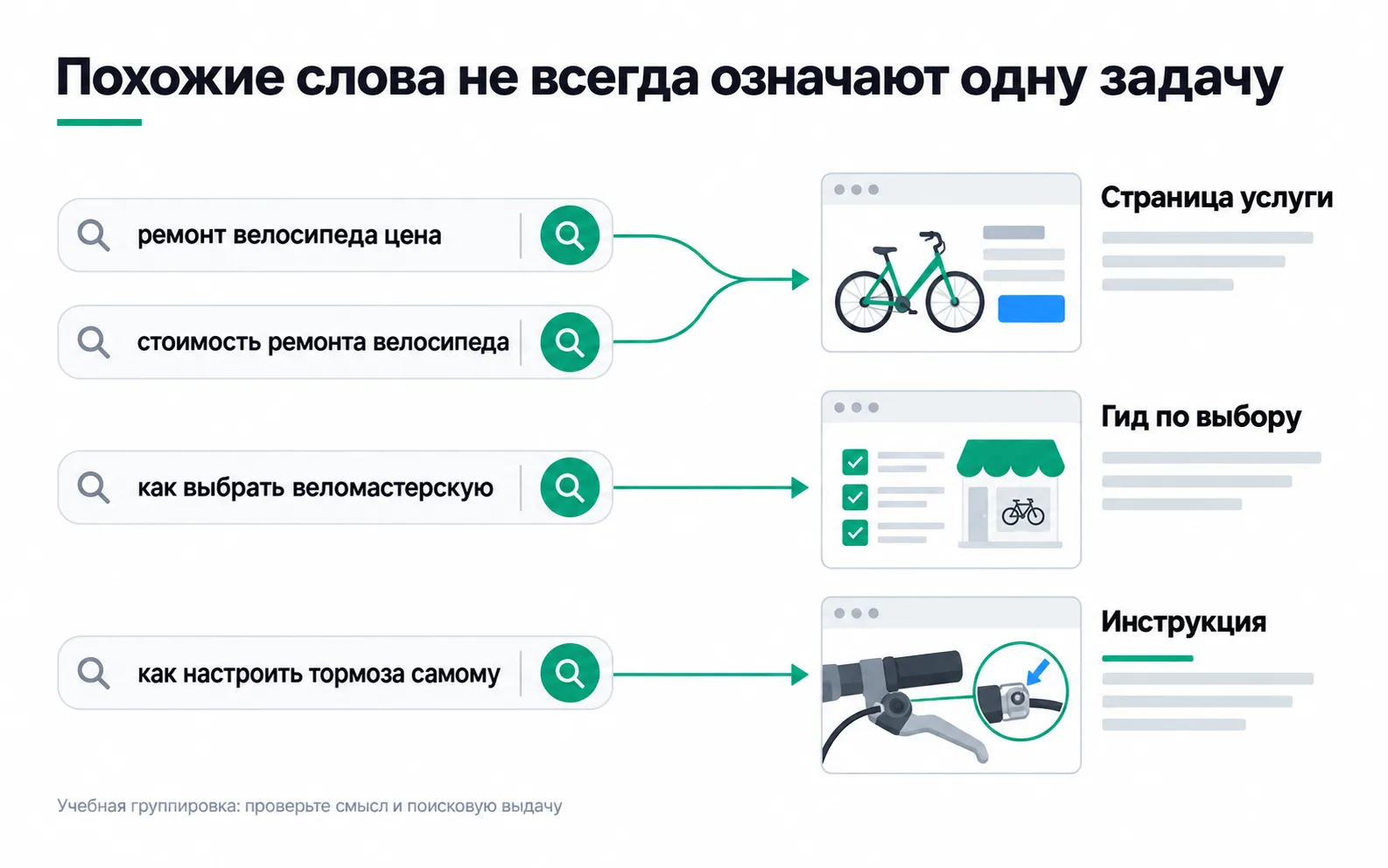
The picture shows the same principle in another niche: similar words lead to different pages when there are different tasks behind them.
Long-tail: rare, precise queries
Long-tail queries are searched less often and are more specific than general ones. Ahrefs says such queries can run to three to five words, but it also counts short phrases as the tail if they are searched less than other queries on the same topic, so a word-count filter will miss short rare queries.
At the school, "analytics course in the evening" is a typical tail query: 40 searches a month against 1,400 for the general one. In return, the person has said exactly what they need, and the school has an answer for it, the evening practicum page. In advertising you can see the difference in price: in the school's search campaign an average click on the evening query cost 110 ₸ against 260 ₸ for the general one. Organic results have no price, so you open them by hand and look at who's in the top ten: course pages, aggregators or articles.
You don't chase the tail for its own sake. "Timesheet template" is precise, and the school could write about it since it teaches Google Sheets. But the person searching for it is an accountant who needs a file by the end of the month, not an analytics course. The yardstick is the same as for any group: does the task connect to what the school sells?
One task, one page
When two pages answer the same task, the search engine picks which to show, and not necessarily the one you'd pick. That's what happened with the school's evening practicum. Its page was once made as a copy of the course page, with only the timetable block changed, and both have the same title, "Data analytics course". To a search engine these are two almost identical pages for one query. So in the core they get different groups: the course page answers people choosing a course and links to the evening group, while "evening, after work, at 18:00" goes into the evening practicum's title and first paragraph.
A separate page is justified by a separate task or a different offer. The evening practicum is a different offer: a different time, a different group. "Analytics course price" and "analytics course cost" are one task in different words, and a price section on the course page covers it.
From the table to a page brief
Every row with "rewrite" or "create" turns into a brief: the page, the main query, a draft title, the questions the page must answer, and a check date. For the course page the questions come from the same WhatsApp chats: what the course includes, how much it costs, when the groups meet, whether homework is checked. How to turn that into a title, description and text is what on-page SEO covers.
Two or three months after publishing, the marketer opens the Performance report in Search Console filtered by the page, on the Queries tab. If the course page shows up for queries from its group, the core got it right. If people find it through something else, say "data analyst salary", the first step is to reread the text: it may be answering the wrong question. A new page for that query comes only after that check.
Instead of twenty articles the owner got a plan for the month: rewrite the course page, adjust the evening practicum and the checklist, write one article on CAC. A hundred-article blog can be discussed later, once it's clear which of these pages bring in leads.
Exercise: a mini core for your project
The table gives mistakes away at once. Adding up Wordstat rows without quotes inflates demand, because the long phrases are already inside the short ones. A separate page for every synonym means the groups were built by words, not by tasks. And an empty "not taking" column means no decisions have been made yet. At the school it holds jobs and free courses; your project will have its own queries the business has no answer for.
The three groups you picked show what guided you. If you went by the biggest numbers, check them against the task: high volume from people just looking around can bring fewer leads than low volume from people ready to buy. A good one-sentence explanation names both: "The course page first, because this group is where people choose where to study, and we already have the page."
Video: collecting queries with a tool
A video about the keys.so service. The five minutes in the title go on collecting the list; grouping and deciding on pages take longer.